



Free Funnel Audit
Convert more customers today!
SEO
10 mins read

SEO
10 mins read
Have you ever been in a situation where you keep running ads, you notice that your traffic is growing and clicks are coming daily, but when it comes to checking the sales, the numbers feel quite disappointing?
We know it sounds a bit confusing because you may think people are already showing interest. But now the question is, why are they not converting into actual paying customers?
Most businesses face this exact situation at some point. Here, the problem is not traffic, but what happens after the click. This is exactly the point where many potential customers quietly drop off without converting. They lose interest, face friction, or simply do not feel convinced.
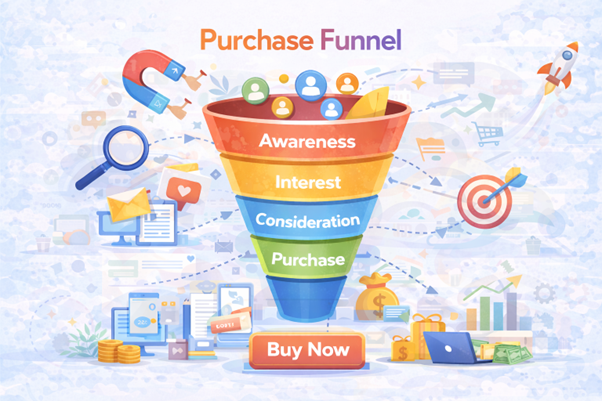
A purchase funnel helps you understand how users move from interest to action. It shows each step a buyer takes before making a final decision. In simple terms, a purchase funnel maps the journey from first touch to purchase, highlighting where users lose interest or face friction.
In this guide, you will learn how the funnel works. We will break down the purchase funnel stages with practical and clear examples. You will also discover simple strategies to improve conversions at each stage.
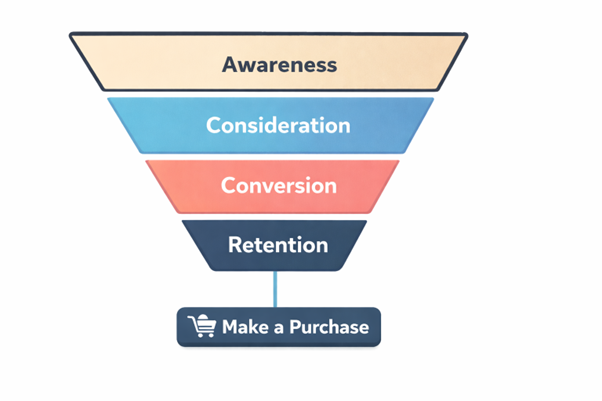
A purchase funnel is a model that explains how customers move toward buying. It shows how the customers are moving starting from their first interaction to final purchase decision clearly.
Think of it as a step-by-step journey a buyer follows before purchasing. At the top, many people enter, but only a few reach the final stage. This journey starts with awareness and ends with loyalty. Each stage represents a different level of intent and understanding.
Many marketers also connect it with the AIDA model, which stands for Awareness, Interest, Desire, and Action. However, modern funnels go beyond this simple structure today. They include retention and repeat purchases as key stages.
Understanding this model helps you guide users with the right message. It also helps you reduce confusion and improve overall conversions. Here, platforms like CausalFunnel help map user intent across funnel stages. They use AI to identify high-intent users and predict behavior patterns.
This allows businesses to focus on users who are more likely to convert, improving targeting and reducing wasted effort across the funnel.
Customer journeys are no longer simple or linear anymore. People switch devices, platforms, and sources before making decisions.
Despite this complexity, the purchase funnel remains very useful. It gives structure to an otherwise messy and unpredictable journey. Businesses use it to understand customer behavior at different stages, as it helps them deliver the right content at the right time.
Today’s buyers expect fast answers and smooth experiences across channels; this is when a funnel helps. A clear funnel helps you meet those expectations more effectively. Without a funnel, you risk losing users at critical decision points. You also miss chances to guide them toward the next step.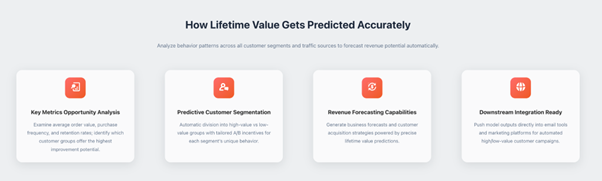
Here’s when CausalFunnel also helps, as they help adapt to non-linear journeys easily. They track user behavior without relying heavily on cookies or outdated methods. This helps businesses understand real intent, even across multiple touchpoints, bringing better clarity to how users actually move through the funnel.
Every purchase funnel has multiple stages that guide the customer journey. Each stage requires a different strategy and type of content to work with. When you understand these stages, it helps you align your efforts with user intent. It also improves your chances of moving users toward conversion smoothly.
This is the first stage where users realize they have a problem. They are not looking for products yet, but searching for information.
At this stage, users explore topics and try to understand their needs. They often search using questions or general problem-based queries. Your goal is to educate and attract users without selling aggressively. Therefore, you must focus on providing value and building initial trust.
Common awareness-stage content includes:
For example, someone searching for “why is my website slow.” This falls under the awareness stage where people are still looking for answers. These sections of people are still not ready to buy the product or service, but they want answers first.
At this stage, users start exploring possible solutions to their problem by comparing different options and trying to understand what works best.
This is where trust and credibility become very important factors, as users want proof that your solution can actually help them succeed. At this stage, you need to educate and guide without pushing too hard. You must help users feel confident about their choices.
Effective content types include:
For example, a user comparing SEO tools is in this stage. They are evaluating options before making a final decision.
In this stage, users show a strong interest in a specific solution. They might visit pricing pages or explore product features in detail. This clearly means that they are closer to buying, but still need reassurance before deciding. Your job is to reduce doubts and strengthen their confidence.
Therefore, in this stage, you must highlight value, benefits, and real user experiences clearly. Emotional triggers also play a strong role at this stage.
Helpful tactics include:
For example, a user adding a product to the cart shows desire. They are almost ready, but still need a final push.
This is the stage where users finally decide to take action. They are ready to buy, sign up, or complete a conversion.
At this point, even small issues can cause drop-offs quickly. You must remove all friction and make the process smooth. Your focus should be on clarity, trust, and ease of use. Make sure users feel confident about completing the purchase.
Important elements include:
For example, a complicated checkout process can reduce conversions fast. Even interested users may leave without completing the purchase.
The journey does not end after the purchase is complete. This stage focuses on keeping customers engaged and satisfied long-term.
Happy customers often return and become repeat buyers over time. They may also recommend your product to others naturally. Your goal is to build strong relationships after the first purchase. This increases lifetime value and reduces acquisition costs.
Effective retention strategies include:
For example, a customer receiving helpful follow-up emails feels valued. This increases the chance of future purchases and long-term trust.
Optimizing your purchase funnel requires a clear and structured approach. You must identify weak points and improve them step by step.
To optimize your purchase funnel, start by understanding where users drop off most frequently, and then focus on improving those areas with targeted strategies.
Here are key ways to optimize your funnel effectively:
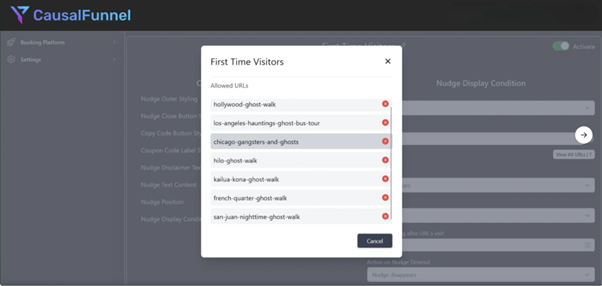
Platforms like CausalFunnel improve optimization using AI insights. They analyze user journeys and highlight exact points of drop-off. They also enable personalization based on real-time user behavior. This helps deliver better experiences and improve conversion rates.
Many businesses lose conversions due to simple but costly mistakes. These issues often go unnoticed but hurt performance across the funnel. Fixing them can quickly improve user experience and conversion results. Let’s break down the most common mistakes in a practical way.
Many businesses focus only on traffic or final conversions and forget that users need nurturing before making a decision.
The middle stage builds trust and answers deeper questions. When you skip, it creates gaps in the customer journey. This often leads to users dropping off without taking action.
What to do instead:
Unclear messaging confuses users and reduces engagement quickly. If users do not understand your value, they will leave fast.
Many websites focus too much on features instead of benefits. Users care more about how your solution helps them.
Common issues include:
What to do instead:
A strong call-to-action guides users toward the next step. Without it, users feel lost and may leave the page.
Many websites either hide CTAs or make them unclear, and some use generic phrases that do not drive action.
Common CTA mistakes include:
What to do instead:
Many businesses collect leads but fail to follow up properly. This leads to missed opportunities and lost potential revenue.
Users often need reminders before making a final decision. Without follow-ups, they may forget or choose competitors.
What to do instead:
Decisions without any concrete data often lead to poor results. For accurate information, you must understand how users behave across your funnel.
Without data, you cannot identify where users drop off. You also miss chances to improve key touchpoints.
What to do instead:
Not all users are at the same stage in the funnel. Treating everyone the same reduces relevance and engagement.
Users expect personalized experiences based on their needs. Generic messaging often fails to connect with them.
What to do instead:
Even small issues can stop users from completing a purchase. Friction creates frustration and increases drop-off rates. Common friction points include slow pages and complex forms. Users expect smooth and fast experiences at every step.
Common friction issues include:
What to do instead:
Measuring performance helps you understand what is working and what is not. You must track metrics at each stage of the funnel carefully. Different stages require different performance indicators to be analyzed properly. This gives you a clear view of the entire funnel.
Here are key metrics by stage:
Tracking these metrics helps you find gaps and improvement opportunities. It also supports better decision-making and long-term growth.
Funnel Type | Focus Area | Goal |
Purchase Funnel | Customer buying journey | Convert users into customers |
Marketing Funnel | Lead generation and awareness | Attract and engage users |
Sales Funnel | Closing deals and revenue | Convert leads into buyers |
A purchase funnel focuses on the complete customer journey. Marketing and sales funnels focus on specific parts of that journey. Understanding the difference helps align your strategies better. It also ensures a more connected and effective process.
Let’s understand this with a simple real-life example. Imagine a user looking to buy a new smartphone online. They first search for “best budget smartphones” and read blogs. This is the awareness stage, where they explore options.
Next, they compare different brands and models in detail. This is the interest stage where they evaluate choices. Then they visit a specific product page and check reviews. This shows desire as they consider buying seriously.
Finally, they add the product to the cart and complete the checkout. This is the action stage where conversion happens. After purchase, they receive follow-up emails and offers. This builds loyalty and encourages repeat purchases later.
A purchase funnel is not just a model, but a working system where each stage plays a critical role in driving conversions. If one stage fails, the entire journey can break quickly. That is why you must optimize every step carefully.
Platforms like CausalFunnel make this process smarter and more efficient. They help you identify high-intent users and improve funnel performance using AI, and if you want better conversions without wasting traffic, this is important. Start using smarter funnel insights to drive real business growth today.Purchase funnel stages include awareness, interest, desire, action, and loyalty. Each stage represents a step in the customer journey.
Yes, it helps structure complex customer journeys effectively. It also improves targeting and conversion strategies significantly.
All stages are important and work together as a system. Weakness in one stage can affect the entire funnel performance.
Focus on reducing friction and improving user experience. Also, test different strategies and optimize based on data.
Start using our A/B test platform now and unlock the hidden potential of your website traffic. Your success begins with giving users the personalized experiences they want.
Start Your Free Trial

Empowering businesses to optimize their conversion funnels with AI-driven insights and automation. Turn traffic into sales with our advanced attribution platform.
Trusted by Customers


©CausalFunnel Inc. All rights reserved.