



Free Funnel Audit
Convert more customers today!
SEO
10 mins read

SEO
10 mins read
Are you paying too much for clicks that don’t convert? A good CPC is not about low cost; it is about real results.
Running Google Ads can bring customers quickly. However, many advertisers ask one simple question:
What is a good CPC for Google Ads?
Understanding CPC helps control advertising costs. It also helps build profitable campaigns. Many beginners focus only on lowering costs. However, the cheapest click is not always the best click.
The real goal is simple: You want clicks that turn into customers. This guide explains everything in clear terms.
You will learn:
By the end, you will know how to evaluate CPC properly.
A good CPC for Google Ads usually ranges between $1 and $4 for search ads. However, the ideal CPC depends on several factors.
Important factors include:
Many marketers compare results with the Average CPC for Google Ads.
Typical ranges include:
Search ads:
$2 to $4 per click
Display ads:
$0.50 to $1 per click
Some industries pay much more.
Examples include:
These industries compete for valuable customers. One new client may generate thousands of dollars. Because of this, advertisers accept a higher CPC. A good CPC always depends on profitability, not only price.
CPC means cost per click. It shows how much you pay when someone clicks your ad. Every click uses part of your advertising budget. Because of this, CPC affects how far your budget goes.
Google Ads, especially Search Ads, work through an auction system. Advertisers bid on keywords that users search on Google. However, the highest bid does not always win.
Google also evaluates ad quality and relevance. These signals influence the final Google Ads cost per click. High-quality ads often pay less for the same keyword.
This system encourages advertisers to create helpful ads.
Also Read: The Ultimate Toolkit to Uncover Hidden Competitors’ PPC Keywords
CPC affects campaign efficiency. A lower CPC often allows more clicks. However, cheap clicks do not always produce customers.
Some users click ads without buying anything. These clicks increase costs without generating results. Because of this, advertisers must track other metrics.
Important campaign metrics include:
These numbers reveal the real success of campaigns. Successful advertisers focus on profitable conversions, not cheap clicks.
Many advertisers compare campaigns with benchmarks. The Average CPC for Google Ads provides a useful reference. However, CPC varies greatly across industries.
Most reports show these average ranges:
Search ads:
Display ads:
These values represent general benchmarks. Actual campaign costs may still differ. Several factors influence CPC values.
Important factors include:
Because of these factors, CPC can vary widely.
CPC changes significantly across industries. Some industries compete aggressively for valuable search keywords, while other industries face lower competition and cheaper clicks.
Understanding Google Ads CPC by industry helps advertisers evaluate performance.
Below is a simplified benchmark table:
Industry | Average CPC Range |
Legal | $10 – $15 |
$5 – $12 | |
Insurance | $6 – $14 |
SaaS | $4 – $8 |
$3 – $6 | |
$1 – $3 | |
$1 – $2 |
Source: WordStream Google Ads Benchmarks and aggregated PPC industry reports.
These values represent common PPC CPC benchmark ranges. However, campaign results may vary depending on strategy. Several factors influence industry CPC levels.
Important factors include:
For example, insurance companies compete aggressively for leads. Each new customer may produce long-term revenue. This situation increases the Google Ads cost per click.
E-commerce companies usually operate with smaller profit margins. They must maintain a lower CPC to remain profitable. Advertisers should not panic when CPC increases slightly, as a higher CPC sometimes reflects strong market demand.
Instead, focus on improving campaign efficiency. The Average CPC for Google Ads offers a useful benchmark. However, industry context always matters more. Successful advertisers track CPC trends regularly, which helps them adjust bidding strategies at the right time.
Understanding these benchmarks helps businesses build smarter campaigns.
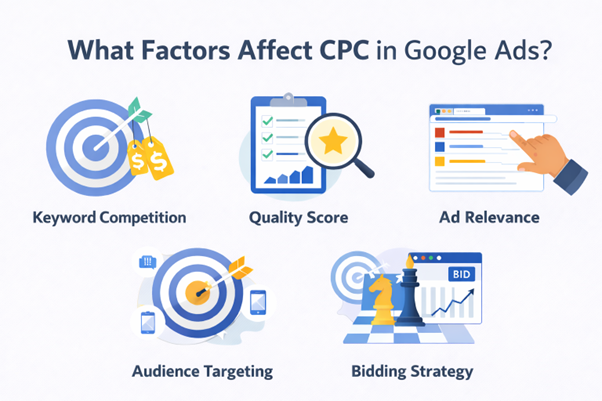
Several factors influence the Google Ads cost per click. These factors decide how much advertisers pay for each click.
Some factors increase CPC quickly. Other factors help reduce campaign costs.
Understanding these factors helps you manage ad spending better. It also helps improve your campaign performance. Let’s look at the most important factors that affect CPC:
Keyword competition strongly affects CPC. Some keywords attract many advertisers. These are usually broad or generic keywords with high search demand.
Examples include terms like “marketing tools,” “CRM software,” or “online accounting.” These keywords are short, popular, and highly competitive. Many businesses want to appear for them, which increases the Google Ads cost per click.
Industries like finance and legal services often have heavy competition. Because of this, they usually have a higher Average CPC for Google Ads. But not every keyword is expensive. Many advertisers focus on long-tail keywords because they usually contain three or more words.
Examples include:
These searches show clear user intent that leads to better conversions. And, better conversions improve campaign performance. This is why many advertisers prefer long-tail keywords.
Quality Score is another important factor. Google assigns a Quality Score to every keyword. This score measures how useful and relevant your ads are.
Higher scores usually reduce advertising costs. Google rewards helpful ads with lower CPC.
Three main factors affect Quality Score:
Relevant ads receive more clicks to improve engagement signals. Landing pages also affect campaign performance. A clear landing page helps users find answers quickly. Better user experience improves campaign results. Over time, strong campaigns often see lower CPC.
Improving Quality Score requires regular testing. Many businesses find this process difficult. Experts can often improve campaigns faster.
Ad relevance shows how well your ad matches a search query. Google wants users to see helpful ads that match searches, which usually receive more clicks.
Higher click rates improve campaign performance. And better performance increases Quality Score, which eventually reduces the Google Ads cost per click.
Advertisers should organize keywords carefully. Each ad group should focus on one clear topic.
For example:
This structure improves ad relevance. Better relevance improves ad performance. It also helps control the Average CPC for Google Ads.
Also Read: Understanding PPC Examples: A Guide to Real Ads and Why They Succeed
Audience targeting also affects CPC. Google Ads allows advertisers to reach specific audiences.
Advertisers can target users based on:
Better targeting improves traffic quality. High-quality visitors interact more with Ads, and better engagement improves campaign signals. Strong signals help reduce the Google Ads cost per click.
Many advertisers overlook advanced targeting options. However, proper targeting often lowers campaign costs. Advertisers should review targeting settings regularly. Small changes can improve campaign performance quickly.
Bidding strategy also influences CPC. Google Ads offers several automated bidding options. These tools adjust bids using machine learning.
Common bidding strategies include:
Each strategy focuses on a different goal. Maximize clicks focuses on traffic, target CPA focuses on lowering conversion costs, and target ROAS focuses on improving revenue performance.
Choosing the right strategy improves campaign efficiency. A poor strategy may increase CPC without improving results. Advertisers should test strategies carefully. Testing helps find the best option for each campaign.
However, testing requires proper monitoring. Many businesses work with experts for better results. You can explore advanced campaign strategies at CausalFunnel. Our team of experts helps improve campaign performance faster.
Many advertisers want a simple answer. However, there is no single CPC that works for every campaign. A good CPC depends on the industry and campaign goals. Some industries accept higher CPC values, while others require lower CPC to stay profitable.
Advertisers should compare CPC with conversion value. Let’s look at a simple example:
A campaign pays five dollars per click.
One conversion produces five hundred dollars in revenue.
In this case, the CPC works well. Now imagine a lower conversion value.
A product generates only twenty dollars in revenue.
A five-dollar CPC becomes expensive.
This example shows why context always matters. Many advertisers compare CPC with the Average CPC for Google Ads. Benchmarks help set expectations; however, real campaign data matters more.
Advertisers should track important metrics such as:
These numbers show the real campaign performance. Higher CPC campaigns can still generate strong profit. Lower CPC campaigns may still lose money.
Successful advertisers focus on profitable conversions. They focus on results instead of cheap clicks.
Continuous optimization improves campaign results. Experts often find areas where advertising money gets wasted. Professional insights help campaigns improve faster.
Reducing CPC requires smart campaign improvements. Advertisers should focus on relevance and performance. Below are several effective ways to reduce CPC:
Quality Score strongly affects CPC. Improving this score often lowers advertising costs.
Advertisers should focus on:
Better relevance increases engagement and improves campaign performance. Improved performance lowers the Google Ads cost per click.
Long-tail keywords usually have lower competition. Lower competition often means lower CPC. These keywords target specific searches.
Specific searches often convert better. Advertisers should research long-tail keywords regularly to improve campaign efficiency.
Landing pages strongly affect ad performance. Slow pages reduce engagement quickly, confusing pages frustrate visitors, and poor user experience hurts campaign results.
Advertisers should create clear landing pages that match the ad message. Better pages improve conversions and reduce CPC.
Better targeting improves traffic quality.
High-quality visitors interact more with ads. Better engagement improves campaign signals, and strong signals help control CPC growth.
Advertisers should review targeting settings often. Small improvements can reduce wasted ad spending.
Regular testing improves campaign performance.
Advertisers should test different headlines. They should also test multiple descriptions. Small changes can increase click-through rates.
Higher click rates improve Quality Score and reduce the Google Ads cost per click. Testing also helps campaigns stay competitive.
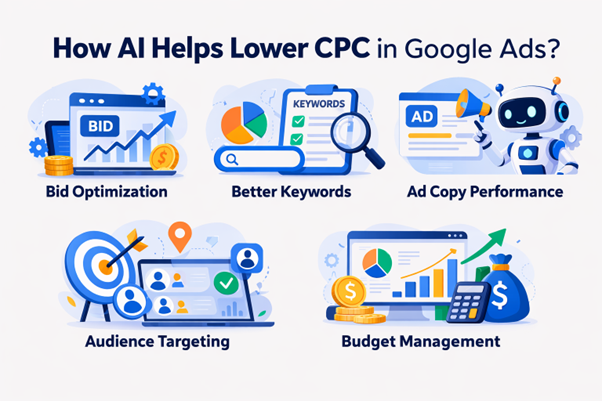
AI is changing how advertisers run Google Ads campaigns. Many marketers now use AI tools to improve campaign performance.
These tools analyze large amounts of advertising data. They identify patterns and trends very quickly and help advertisers make better decisions.
AI can help lower the Google Ads cost per click. It can also improve conversions and campaign results. Many businesses now rely on AI to manage PPC campaigns. AI tools can spot problems that humans often miss. This helps advertisers optimize campaigns faster.
Bidding has a direct impact on CPC. AI tools help optimize bidding automatically. These tools analyze campaign data in real time and adjust bids based on performance signals to help advertisers avoid paying too much for clicks.
AI analyzes several important signals, such as:
These signals help AI predict which clicks may convert. If a click looks less valuable, the bid may decrease. If a click looks valuable, the bid may increase.
This smart system helps control the Google Ads cost per click. Over time, campaigns become more efficient.
Keyword selection strongly affects campaign success. AI tools help advertisers discover better keyword opportunities.
These tools study search trends and campaign data. They often identify keywords that advertisers overlook. Many tools also recommend long-tail keywords.
Long-tail keywords usually have lower competition. And, lower competition often means lower CPC. This helps reduce the Average CPC for Google Ads.
Long-tail searches also show clear user intent. Clear intent often leads to better conversions. And better conversions improve overall campaign performance.
Writing strong ad copy takes time and testing. AI tools can help generate ad ideas quickly.
These tools study ads that already perform well. Then they suggest headlines and descriptions. Advertisers can test many ad variations quickly. More testing helps identify high-performing ads.
Strong ads usually attract more clicks. Higher click rates improve engagement signals. Better engagement improves Quality Score. Eventually, higher Quality Scores reduce the Google Ads cost per click.
Audience targeting is another area where AI helps.
AI tools analyze user behavior and engagement patterns. These patterns reveal which audiences respond to ads. Advertisers can focus on these high-quality audiences.
Better audiences improve engagement, leading to the improvement of campaign signals.
Strong signals often reduce CPC over time. AI also helps identify low-quality audiences. Advertisers can exclude these users from campaigns. This helps reduce wasted ad spending.
Managing budgets across campaigns can be difficult. Some campaigns perform much better than others. AI tools analyze performance data across campaigns. They identify campaigns with strong conversion results and recommend better budget distribution.
Budgets move toward high-performing campaigns. This improves overall campaign efficiency. It also helps control the Google Ads cost per click. Better budget allocation often improves return on ad spend.
AI tools are powerful, but they still require strategy. Campaign setup and monitoring remain very important.
Experienced PPC experts understand Google Ads systems deeply. They analyze campaign data, identify improvement areas, and test keywords, ads, and targeting regularly. These improvements help reduce wasted advertising spending.
Many businesses work with specialists to improve campaigns faster. Expert teams often help reduce the Average CPC for Google Ads while improving conversions.
If you want expert support for campaign optimization, visit CausalFunnel to get in touch with professional PPC specialists who can improve campaign efficiency quickly.
Also Read: 10 Data-Driven PPC Competitor Analysis Examples That Actually Work
High CPC can reduce campaign profitability. Advertisers should monitor campaign performance carefully. Some warning signs may indicate high CPC.
Watch for these signals:
These issues often increase the Google Ads cost per click. Fixing these problems can improve campaign efficiency. Regular optimization helps control advertising costs.
Lower CPC is helpful, but balance is important. Advertisers should focus on results, not only on low costs.
Here are simple tips to maintain a healthy CPC.
Understanding CPC is important for successful advertising. The Google Ads cost per click depends on many factors. These include keyword competition, Quality Score, and targeting.
A good CPC always depends on your business goals. The Average CPC for Google Ads can provide a helpful benchmark. However, real campaign data is more valuable.
Successful advertisers focus on conversions and profitability. They test campaigns and optimize regularly. With the right strategy, businesses can control costs and improve results.
If your campaigns struggle with high CPC or poor performance, reach out to our CausalFunnel team for Google Ads optimization support today!
A good CPC depends on your industry and campaign goals. Many advertisers compare results with the Average CPC for Google Ads as a benchmark.
The Average CPC for Google Ads usually ranges between $1 and $2 for search ads. However, highly competitive industries may see much higher CPC.
High CPC often happens because of strong keyword competition. Poor Quality Score or weak ad relevance can also increase costs.
Yes, Quality Score strongly affects CPC in Google Ads. Higher Quality Scores usually reduce the Google Ads cost per click.
Start using our A/B test platform now and unlock the hidden potential of your website traffic. Your success begins with giving users the personalized experiences they want.
Start Your Free Trial

Empowering businesses to optimize their conversion funnels with AI-driven insights and automation. Turn traffic into sales with our advanced attribution platform.
Trusted by Customers


©CausalFunnel Inc. All rights reserved.