



Free Funnel Audit
Convert more customers today!
SEO
10 mins read

SEO
10 mins read
Businesses must understand their customers faster than ever before. Markets change quickly across every industry today. Old reports alone do not support smart decisions anymore. Teams need clear and timely customer insights to act effectively. These insights guide marketing, product, and support teams efficiently. They also improve customer experience and drive long-term growth.
This guide shares a simple six-step framework for insights with each step building.on the previous one to ensure clarity. You will learn how to collect, analyze, and apply insights. You will also learn how to measure real business impact. The goal is clear, actionable knowledge not complex theory. Let’s start with a modern definition of customer insights.
Customer insights explain why customers act in certain ways. They uncover patterns hidden inside raw customer data. Data alone does not create value for your business. Insights turn data into actionable steps for teams.
In 2026, insights must be fast and predictive. Monthly reports alone cannot keep teams competitive anymore. Modern systems can analyze data in real time. They connect behavior across multiple digital and offline channels. This means businesses can track what users click, how long they stay, which pages they visit before converting, and where they drop off. They can identify which traffic sources drive the highest conversion rates, which keywords generate qualified leads, and which campaigns produce real revenue instead of just clicks.
Advanced systems also connect CRM data, sales outcomes, repeat purchases, and customer lifetime value to marketing activity. Instead of relying on isolated metrics, decision-makers gain a unified view of user intent, engagement patterns, and revenue impact allowing them to optimize messaging, targeting, and page performance with precision.
Customer insights now combine behavioral and emotional signals. They track customer preferences, needs, and intent accurately. They also predict what customers are likely to do next. This change improves decision quality across every department.
Here is the difference between past and modern approaches:
Traditional Approach | Modern Approach |
Static reports | Real-time dashboards |
Siloed systems | Unified customer data |
Reactive decisions | Predictive actions |
Manual analysis | AI-powered models |
Modern insights drive faster business responses. They reduce risks and increase customer loyalty. This modern definition guides every step in this framework.
Customer expectations continue rising every year. People expect fast and personalized experiences everywhere. They switch brands immediately when experiences feel poor.
Strong customer insights help businesses prevent churn. They identify problems before customers leave. They also reveal new opportunities for growth.
Companies using advanced insights often grow faster. They improve customer retention and average order value. They also reduce wasted marketing and operational costs.
Customer insights improve performance in many areas:
Without clear insights, teams rely on assumptions. Assumptions often lead to wasted time and budget. Data-driven clarity reduces mistakes and improves results.
Insights also support cross-team collaboration effectively. Marketing, sales, and product teams share one unified view. This shared understanding increases alignment and team speed.
Strong customer insights start with clean, connected data. Many companies store data across disconnected systems. These silos create incomplete views of customer behavior.
Silos block a full understanding of the customer journey. Teams see fragments instead of the full story. Decisions become inconsistent and reactive without proper data.
Start by mapping all customer data sources.
Common data challenges include:
Identity resolution solves duplicate profile issues.
It links multiple records to one real customer. This creates a single, accurate customer profile.
Unified profiles strengthen analysis across all teams. They improve accuracy and reduce reporting confusion. They also ensure insights are consistent and reliable.
Data governance is equally important. Clear rules protect privacy and ensure compliance. Strong governance builds long-term trust with customers.
A unified data foundation supports scalable insights. It prepares systems for advanced analytics and AI models. Without this base, customer insights remain incomplete and limited.
Collecting data is only the first step. The real value comes from interpretation. You must connect patterns to business decisions.
Start by analyzing customer behavior trends. Look at purchase frequency and browsing duration. Study drop off points in funnels. Review engagement across email and social channels.
Use structured methods to uncover meaning:
Segmentation improves personalized communication efforts. Journey mapping highlights friction and confusion points. These actions generate practical customer insights.
Always link insights to measurable goals. For example, connect findings to retention targets. Or align insights with revenue growth objectives.
Avoid analyzing data without clear purpose. Random analysis wastes time and resources. Focused analysis drives meaningful outcomes.
Customer insights should guide specific actions. They should answer clear business questions. When insights lack direction, they lose impact.
Structured interpretation creates stronger results. It also prepares your organization for predictive modeling.

Tools make customer insights easier to generate. They automate data collection and pattern detection. They also reduce manual reporting time.
Different tools serve different business needs. You must choose tools based on clear goals. Avoid buying tools without defined use cases.
Here are major tool categories to consider:
These tools track digital behavior across websites and apps. They monitor clicks, page views, and session duration. They record navigation paths and feature interactions clearly. Teams see where users engage and where they struggle.
They show where users drop off quickly. They highlight friction points during sign-up or checkout. They reveal which pages drive strong engagement. They also show which features remain underused.
Examples include:
These platforms reveal behavioral patterns across channels. They connect traffic sources with on-site actions. Teams can compare performance across campaigns and devices. They support segmentation based on real usage behavior. They also enable deeper customer journey analysis.
When combined with other systems, patterns become clearer. Behavior data strengthens overall customer insights across teams.
Feedback tools collect direct opinions from real customers. They capture thoughts, feelings, and satisfaction levels clearly. They reveal how customers perceive products and services. This helps teams understand emotional reactions behind behavior.
These tools highlight hidden experience gaps quickly. They uncover issues that data reports may miss. Customers often share pain points in open responses. That feedback exposes friction across touchpoints and journeys.
Examples include:
Surveys provide structured and measurable response data. They allow teams to track satisfaction trends over time. Net Promoter Score surveys measure loyalty and advocacy. Post-purchase surveys reveal onboarding or checkout problems.
Feedback tools add emotional depth to analytics reports. Behavior data shows what customers did. Survey data explains how customers felt. This combination improves customer insights quality significantly. It supports better decisions across product and service teams.
CRM tools centralize customer relationship data in one place. They track sales activity across every interaction. They store emails, calls, and meeting history clearly. They support lifecycle tracking across departments and teams. Marketing and sales teams stay aligned through shared records. Leaders gain visibility into pipeline performance easily.
Examples include:
These platforms organize relationship data effectively. However, CRM tools alone may not unify all systems. Integration platforms connect disconnected data sources together. They eliminate silos across marketing, finance, and support. They improve visibility across the entire customer journey.
For example, CausalFunnel helps businesses unify fragmented data. It connects CRM, website, and advertising platforms seamlessly. It applies machine learning to identify real performance drivers. Instead of surface metrics, teams see causal relationships clearly. This improves budget allocation and campaign effectiveness.
When CRM systems integrate with intelligence platforms like CausalFunnel, companies move beyond tracking toward deeper insight. They shift from reporting activity to understanding true impact.
These tools monitor brand mentions online. They analyze trends across social platforms. They detect reputation risks early.
Examples include:
Social data reveals emerging customer needs. It also highlights competitive market shifts.
When tools work together, insights improve greatly. Disconnected tools reduce analysis accuracy. Choose systems that support unified data flows.
Tool selection should support your long term strategy. It should not focus only on short term reports. Strong systems make customer insights scalable.
AI strengthens customer insights through pattern recognition. It processes massive datasets very quickly. It detects signals humans often miss.
Predictive models forecast likely future behavior. They estimate churn risk before customers leave. They also suggest the next best product offers.
Common predictive applications include:
Retail brands use AI for purchase timing predictions. Banks use models to reduce fraud exposure. SaaS companies forecast subscription renewals.
AI also improves personalization across channels. It adapts website content in real time. It adjusts offers based on user intent signals.
Machine learning models improve over time. They learn from new behavioral data continuously. This increases prediction accuracy gradually.
However, AI requires clean structured data. Poor data quality weakens model performance. This links back to your foundation step.
Customer insights powered by AI become proactive. They replace reactive and delayed decisions. This shift drives higher retention and revenue growth.
Insights create value only through action. Reports alone do not improve performance. Execution determines real business impact.
Customer insights should guide daily workflows. They must influence marketing and product strategies. They should also support leadership planning sessions.
Here is how departments can apply insights:
Marketing becomes more precise with clear insights.
Campaign waste decreases significantly.
Product decisions become data informed instead of opinion driven.
Sales cycles shorten when signals guide actions.
Support becomes more responsive and efficient.
To enable activation, build real time dashboards. Create automated alerts for behavior changes. Share unified metrics across departments regularly.
Customer insights should not stay isolated. They must flow into everyday decision making. Activation turns information into measurable outcomes.
Consider an ecommerce retail company. They faced high cart abandonment rates. Basic reports showed frequent drop offs.
Deeper customer insights revealed shipping concerns. Customers abandoned carts after viewing shipping fees. The team introduced transparent pricing earlier.
They also tested free shipping thresholds. Conversion rates improved within two months. Revenue per visitor increased steadily afterward.
This example shows structured insight applications. Clear analysis leads to focused action. Focused action drives measurable growth.
Measuring impact proves the value of your work. Without metrics, decisions remain assumptions and guesses. Clear KPIs show whether insights drive real results.
Start by defining what success looks like. Link outcomes to retention, revenue, or engagement goals. Metrics must reflect both short-term and long-term impact.
Key KPIs for customer insights include:
Track before and after implementing insights. Compare results across segments and channels. This highlights which actions worked best.
Always communicate results to leadership clearly. Visual dashboards improve comprehension and engagement. Regular updates reinforce the importance of insights.
Measuring ROI also supports budget justification. It ensures continued investment in tools and staff. Teams see the direct value of actionable customer insights.
Scalable systems ensure insights grow with business needs. Cloud platforms handle increasing data without slowing performance. Automation reduces repetitive work and speeds decision-making.
Real-time analytics become more critical as volume grows. They support instant responses to customer behavior changes. Governance frameworks must expand alongside data growth.
Checklist to scale insights effectively:
Scalable insights allow rapid adaptation to new channels. They also future-proof businesses against changing customer expectations. Proper scaling ensures long-term competitive advantage.
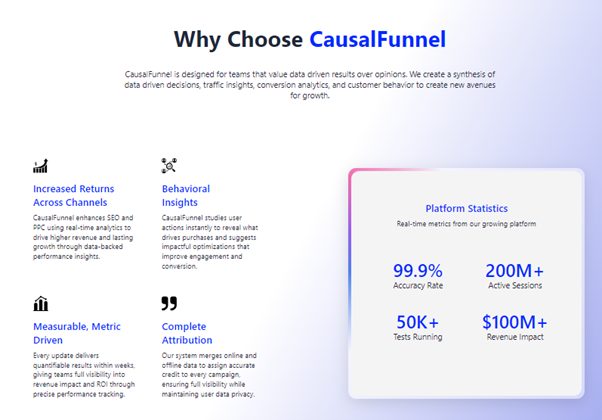
AI-driven platforms accelerate modern customer insights creation. They analyze behavior patterns and predict intent early. They also segment audiences in real time.
Platforms like CausalFunnel go beyond basic analytics tools. They uncover why visitors leave without converting. They identify what drives purchases and repeat engagement. They also forecast customer lifetime value using behavior signals.
CausalFunnel uses DeepID for cookieless tracking. This enables anonymous visitor recognition with privacy compliance. It predicts buying intent with strong accuracy levels. It also builds persona-based segmentation automatically.
Real-time heatmaps and session replays expose friction points. AI triggers timely nudges when hesitation appears. These platforms turn customer insights into measurable revenue growth.
Even experienced teams can make avoidable errors. Recognizing mistakes early improves insight accuracy and adoption.
Common pitfalls include:
How to overcome them:
Avoiding these mistakes strengthens insight reliability. It also improves organizational trust and adoption.
Providing resources makes insights actionable for teams. Templates save time and guide structured thinking.
Resources increase engagement and make the guide practical. They also help readers implement customer insights immediately.
Short stories illustrate practical application. Readers see exactly how insights create value.
Example 1: Retail Brand
Example 2: SaaS Company
Example 3: Banking Service
Case studies make concepts tangible. They show how every step of insights creates measurable outcomes.
Customer insights transform raw data into actionable knowledge. They guide decisions, improve experiences, and increase revenue. Following a structured 6-step framework ensures clarity. Tools, AI, and measurable outcomes make insights operational. Scaling properly secures long-term business advantage. Templates, case studies, and checklists make insights practical. This 2026 guide ensures your team acts with confidence.
Customer insights are deep understandings of behavior and intent. They explain why actions happen and predict future trends.
Analytics platforms, CRM systems, surveys, and social listening tools. AI-powered predictive systems also enhance understanding.
They allow fast decisions before issues escalate. They improve customer experience and retention rates.
Yes, even small businesses benefit from structured insights. Free and low-cost tools allow practical adoption.
Start using our A/B test platform now and unlock the hidden potential of your website traffic. Your success begins with giving users the personalized experiences they want.
Start Your Free Trial

Empowering businesses to optimize their conversion funnels with AI-driven insights and automation. Turn traffic into sales with our advanced attribution platform.
Trusted by Customers


©CausalFunnel Inc. All rights reserved.