



Free Funnel Audit
Convert more customers today!

SEO
10 mins read

SEO
10 mins read
An SEO roadmap strategy is your long-term plan for search growth. It connects strategy, execution, and measurement, and turns ideas into organized action steps.
Many people confuse strategy with tactics. Tactics are single actions, like writing content. Strategy defines the direction behind those actions.
A roadmap combines both in one system. It defines goals, timelines, and ownership. It also defines tracking and performance checks.
An SEO roadmap includes:
Without these elements, progress becomes reactive. With them, growth becomes predictable and measurable.
A roadmap is also flexible. It allows adjustment based on performance data. It is structured, yet adaptable to change.

You may already be doing SEO work. You might publish blogs and fix technical errors. You might even track traffic monthly. However, activity does not guarantee growth. Growth requires clarity and alignment.
A roadmap prevents scattered execution. It helps your team focus on high-impact actions and removes guesswork from decision-making.
Here is what happens without a roadmap:
A clear SEO roadmap strategy solves these issues. It creates structure across your organization, and supports planning, budgeting, and forecasting.
It also supports smarter decision-making. You can compare effort against expected return and prioritize tasks with higher impact.
If you want data-backed SEO growth, structure matters.
Many teams face similar challenges. These issues slow down long-term growth.
Common failures include:
These failures create wasted effort, reduce the return on your SEO investment, and make scaling almost impossible.
A structured roadmap reduces these risks. It builds consistency across months and quarters.
Not every team needs the same roadmap. A SEO roadmap for beginners looks different. An enterprise SEO roadmap is more complex. Beginners usually focus on foundations, while enterprise teams focus on scale and governance.
Below is a simplified comparison table:
Factor | SEO Roadmap for Beginners | Enterprise SEO Roadmap |
Goals | Traffic growth and visibility | Revenue and multi-channel growth |
Team Size | One or two people | Cross-functional teams |
Focus | Basic technical fixes | Advanced audits and automation |
KPIs | Organic sessions | Revenue, conversions, forecasts |
Workflow | Simple checklist | Defined SEO workflow system |
A SEO roadmap for beginners focuses on essentials like core foundations that make a site visible, crawlable, and useful without adding complex forecasting or automation layers. It prioritizes keyword research and content basics by fixing major technical issues first. An enterprise roadmap focuses on scale. It includes forecasting and detailed reporting by using automation tools for monitoring.
Both approaches require clarity and planning. The difference lies in complexity and depth.
Every roadmap needs clear building blocks. Without these, execution becomes fragmented.
A strong SEO roadmap strategy contains:
Let us break this down clearly.
Your SEO plan must align with business goals. Traffic alone is not enough. Revenue impact should be considered.
Clear objectives improve decision quality. They help you prioritize correctly.
Keyword mapping prevents content overlap. It ensures pages target clear themes.
It supports a strong content optimization strategy.
A technical SEO audit reveals hidden barriers. These issues block indexing and ranking. Fixing them improves crawl efficiency.
Your roadmap must include publishing frequency. It should define update cycles and map content to search intent.
Authority influences rankings significantly. Roadmaps should include outreach planning. Link building must align with goals.
Tracking ensures progress remains visible. Define monthly and quarterly review cycles. Measure performance against clear SEO KPIs.
Manual tracking becomes difficult over time. Large teams require centralized dashboards.
Technology improves clarity and speed. It connects data with execution insights. Platforms like CausalFunnel help streamline performance tracking. They connect analytics with growth insights. They support smarter roadmap decisions.
Instead of guessing, you analyze behavior patterns. Instead of reacting, you plan strategically. Modern SEO requires better data visibility. Automation reduces repetitive manual work. Insights improve prioritization decisions.
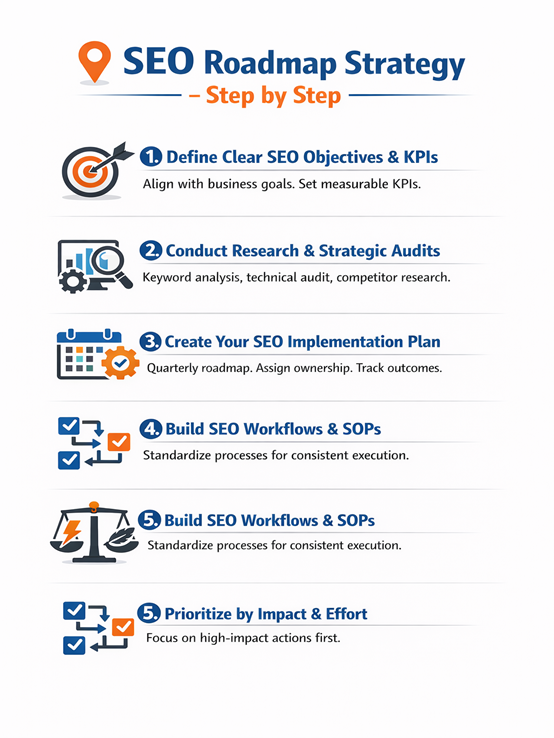
A strong SEO roadmap strategy must be practical. It must guide action month by month and connect research with execution.
Let us build it step by step.
Every roadmap begins with defined outcomes. Without goals, priorities become unclear.
Start with business alignment first. Ask what SEO must achieve this year. Is the goal traffic, leads, or revenue? Now connect those goals to measurable indicators. These are your SEO KPIs.
Common KPIs include:
Keep your KPI list focused and realistic. Too many metrics create confusion. Select five or six strong indicators.
Next, set a timeline for tracking. Monthly reviews work for most teams. Quarterly reviews support strategic decisions.
Clarity in this stage prevents misalignment later. It sets the tone for your entire roadmap.
Now we move to research. This step builds your planning base.
Begin with keyword analysis. Cluster keywords by search intent. Group them by topic relevance. This supports a clear SEO strategy framework. It avoids content duplication later. It strengthens topical authority over time.
Next, conduct a technical SEO audit. Identify crawl errors and indexing issues. Check page speed and mobile usability. Review internal linking structure.
You should also analyze competitors. Find keyword gaps and content opportunities. Study their ranking patterns carefully.
A strong audit phase answers these questions:
This stage shapes your SEO implementation plan. It ensures decisions rely on data.
Now we translate research into action. This is where structure becomes powerful.
Your roadmap must follow time blocks. Monthly or quarterly planning works best.
Below is a simple quarterly structure:
Quarter | Focus Area | Core Actions | KPI Focus |
Q1 | Foundation | Technical fixes and audits | Index health |
Q2 | Content Expansion | Publish and optimize pages | Traffic growth |
Q3 | Authority Growth | Link-building campaigns | Domain strength |
Q4 | Optimization | Update high-potential pages | Conversions |
This framework keeps your work organized. It prevents scattered efforts across teams.
Within each quarter, define:
This becomes your SEO execution plan. It connects strategy with consistent progress.
If your team manages multiple campaigns, structure matters even more.
Platforms like CausalFunnel help track roadmap execution clearly. They centralize data across initiatives and timelines.
When decisions rely on data dashboards, prioritization becomes easier. That improves resource allocation across quarters.
Planning alone is not enough. Execution consistency drives long-term results.
This is where SEO workflow systems matter. Workflows define how tasks move across teams. They reduce confusion and delays.
Let us take content publishing as an example.
A simple workflow may include:
Each stage needs a defined responsibility and clear deadlines. You should also build SOPs for repeat tasks. For example, updating old blog posts.
An SOP might include:
Consistency improves scalability. It protects quality across growth stages.
Not every task deserves equal attention. Prioritization protects your team’s energy.
Use an impact versus effort model. High-impact, low-effort tasks come first. Low-impact tasks move to later phases.
For example:
High Impact:
Medium Impact:
Lower Impact:
Prioritization prevents burnout and confusion. It strengthens your SEO planning process.

Your roadmap should not focus on one area only. Balance is critical for stable growth.
A complete SEO roadmap strategy includes:
If one area dominates, growth becomes unstable. Balanced execution protects long-term scalability. Your roadmap should also remain flexible. Search behavior changes over time. Algorithm updates shift ranking patterns.
Quarterly reviews allow smart adjustments. Monthly monitoring protects momentum.
Tracking progress protects your investment. Without tracking, results become assumptions.
Start with a fixed review schedule. Monthly reviews work for tactical updates. Quarterly reviews support strategic changes.
During monthly reviews, check:
This keeps small problems from growing larger. It also highlights early wins clearly. Quarterly reviews require deeper analysis. Compare goals with actual performance results. Review forecasting accuracy carefully.
If growth slows, investigate root causes. Do not react emotionally to short-term dips. Look for consistent performance patterns.
Tools that centralize analytics simplify monitoring. We at CausalFunnel help connect insights with execution. They allow faster performance analysis across campaigns.
When data becomes visible in one place, decisions improve. That strengthens your roadmap refinement process.
Data must drive your improvements. Assumptions slow down meaningful growth. Start by identifying underperforming pages. Check if intent alignment remains accurate. Review keyword targeting clarity carefully.
Common optimization opportunities include:
Content refresh cycles protect rankings. Search engines reward updated, useful pages.
Next, evaluate technical improvements. Review crawl errors and indexing coverage. Optimize page speed where possible. Improvement should follow impact analysis. Fix high-impact issues before minor ones. This approach protects your resources.
Optimization is never a one-time event. It is a continuous performance cycle.
Once your system works, scaling becomes possible. Scaling requires discipline and structure. Begin by expanding keyword clusters. Target related search intent variations. Strengthen topical authority across categories.
Next, increase publishing frequency carefully. Maintain quality while improving consistency. Do not sacrifice clarity for volume. You should also expand link acquisition efforts. Authority growth accelerates ranking stability. Quality links outperform quantity-based campaigns. At this stage, automation becomes critical. Manual tracking slows scaling efforts.
We at CausalFunnel support data-driven scaling decisions. We centralize analytics and conversion insights clearly.
Scaling should remain controlled and strategic. Rapid expansion without monitoring creates risk.
Basic tracking focuses on traffic only. Advanced tracking connects traffic with revenue. Move beyond simple ranking reports, track revenue per organic visitor, and measure conversion paths clearly.
Important advanced indicators include:
This level of tracking strengthens forecasting. It transforms SEO into a business growth engine. A mature SEO roadmap strategy connects marketing and finance. It aligns search performance with company goals.
When KPIs reflect revenue impact, leadership support increases. Budget approvals become easier and faster.

Search trends shift constantly. Your roadmap must adapt accordingly.
If a strategy underperforms consistently, adjust it. Do not remain attached to failing initiatives. Refinement requires honest evaluation. Look at performance objectively and calmly.
Ask these critical questions:
These reflections protect long-term performance.
At this stage, SEO becomes systematic. It stops feeling chaotic or reactive.
Your roadmap should now function like this:
This loop repeats each quarter. It improves accuracy with every cycle. A well-managed system reduces stress significantly. It replaces guesswork with structured improvement.
If you want to simplify this entire process, explore CausalFunnel. Our platform supports performance tracking and roadmap alignment clearly. We help connect user behavior with SEO decision-making.
When technology supports your roadmap, scaling becomes sustainable.
A powerful SEO roadmap strategy evolves continuously. Planning alone does not guarantee results. Execution alone does not guarantee growth. True success requires alignment and measurement. It requires structure and disciplined review.
Remember these final principles:
SEO growth becomes predictable with structure. Your roadmap becomes your long-term advantage.
Now that you have the full system, apply it consistently and measure honestly. That is how sustainable SEO growth happens.
An SEO roadmap strategy is a structured plan for SEO growth. It outlines goals, tasks, timelines, and performance metrics. It also connects execution with measurable business outcomes.
An SEO strategy defines overall direction and vision. A roadmap explains how to execute that strategy step by step. It includes timelines, priorities, and assigned responsibilities.
Yes, beginners can build a simple roadmap. An SEO roadmap for beginners focuses on fundamentals. It includes keyword research, technical basics, and content planning. Consistency matters more than complexity.
Most roadmaps cover twelve months. Quarterly milestones improve tracking and focus. However, monthly reviews help adjust strategy quickly.
Start using our A/B test platform now and unlock the hidden potential of your website traffic. Your success begins with giving users the personalized experiences they want.
Start Your Free Trial

Empowering businesses to optimize their conversion funnels with AI-driven insights and automation. Turn traffic into sales with our advanced attribution platform.
Trusted by Customers


©CausalFunnel Inc. All rights reserved.