



Free Funnel Audit
Convert more customers today!
SEO
10 mins read

SEO
10 mins read
Search engine optimization often feels confusing for many business owners and marketers today. Many people try random tactics without following a clear and stable process. This approach often leads to weak results and wasted effort in the long term.
SEO methodologies solve this problem by adding structure to SEO work. They guide what to do, when to do it, and how to measure success. They also help teams stay focused on actions that create long-term growth.
This guide explains how SEO methodologies work in simple language. It shows how they support rankings, traffic growth, and business goals. You will also learn how strong frameworks protect websites from sudden algorithm changes.
By the end, you will understand how to build SEO systems that scale safely. You will also see why many top agencies rely on clear methodologies today.
SEO methodologies are structured systems used to plan and execute SEO work. They define clear steps instead of random experiments or short-term tactics. A methodology is not the same as a single SEO strategy. A strategy sets goals, while a methodology defines the working process.
SEO methodologies usually combine several core areas into one workflow:
Good methodologies reduce mistakes caused by guesswork and rushed decisions. They help teams repeat successful actions across different projects. A strong methodology also adapts when search engines update their systems. This flexibility protects rankings during large algorithm changes.
When people search for seo methodologies, they often want reliable systems. They want processes that work across industries and website sizes. Clear frameworks also help new team members learn faster. They remove confusion and reduce errors during execution stages.
SEO growth rarely happens from one lucky action or a single page update. It comes from steady work that compounds over time.
Methodologies help create this steady progress through organized planning. They also prevent teams from chasing every new SEO trend blindly.
Well-designed systems support long-term business goals in several ways:
Search engines reward websites that improve slowly but consistently. Methodologies support this pattern through stable improvement cycles. Without structure, SEO often becomes reactive and stressful. Teams fix problems only after traffic drops appear in reports.
With proper systems, teams predict issues before serious damage occurs. They solve problems early while rankings remain stable. This approach also builds trust with business leaders and clients. Clear processes create confidence in long-term SEO investments.
SEO methodologies also make growth measurable and easier to explain. They connect daily work with real business results.
Strong methodologies always include several common building blocks. These blocks work together to support rankings and user experience growth.
Technical SEO forms the base of every successful SEO methodology today. Search engines must crawl and understand websites without friction.
This part focuses on website health and performance quality:
Technical problems often block content from ranking correctly. Methodologies fix these issues early to prevent hidden traffic losses. Healthy technical systems also improve conversion rates indirectly. Users trust fast and stable websites more than slow platforms.
Keyword research guides what content should be created or improved. Search intent explains why users search for specific phrases.
Strong methodologies combine both elements carefully:
This step prevents writing content that your audience doesn’t actually need. It also avoids targeting keywords with impossible competition levels. SEO methodologies list keyword research as a repeating process. Search behavior changes often, requiring regular updates.
Intent-based research also improves page satisfaction metrics. Happy users stay longer and engage more with helpful content.
Content transforms research into real value for website visitors. Methodologies treat content as a long-term business asset.
This section usually includes:
Good content frameworks prevent thin or duplicate pages. They also reduce the risk of content penalties from search engines.
Modern SEO favors helpful and human-focused content. Methodologies guide writers to balance clarity with technical structure. Strong content systems also improve brand trust. Readers return when information remains useful and accurate.
Search engines still use links as trust signals between websites. Methodologies include safe and ethical link-building practices.
Common focus areas include:
Poor link practices cause long-term damage to domain trust. Methodologies reduce this risk through strict quality control rules. Authority building also strengthens rankings for competitive keywords. It helps content outperform weaker pages with similar topics.
SEO without tracking becomes guesswork very quickly. Methodologies rely on clear measurement systems for progress evaluation.
Important tracking areas include:
Data helps teams identify what works and what fails. They adjust strategies before problems become expensive.
This cycle repeats regularly in mature SEO systems. It turns SEO into a predictable growth channel. Measurement also helps justify budgets and future investments. Leaders trust data more than opinions during planning.
If you want to connect SEO traffic with real business actions, use CausalFunnel. It shows which pages create leads, calls, and actual customers clearly.

Many businesses use different SEO systems based on their goals and resources. Each methodology follows the same base rules but applies them differently. Choosing the right one depends on website size, budget, and competition level.
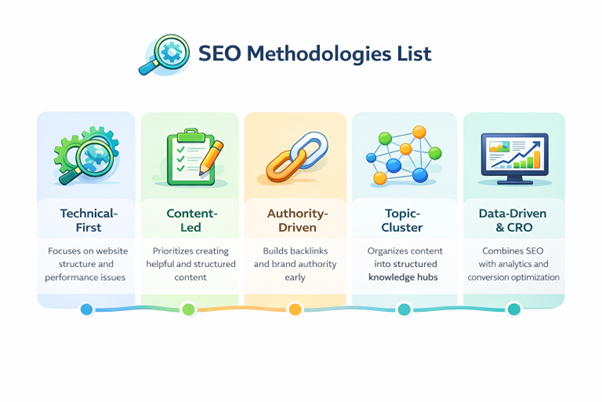
Below is a practical seo methodologies list used by agencies and in-house teams today.
This approach starts by fixing website structure and performance issues first. It treats technicalities as the base for all other SEO activities.
This methodology focuses strongly on areas like:
This approach works best for websites with many hidden technical problems. Large e-Commerce platforms often benefit from this structure. It also suits businesses that recently migrated their websites. Poor migrations often damage rankings without technical recovery steps.
The limitation of this method is slower content expansion. Traffic growth depends heavily on fixing infrastructure first. Many agencies combine this approach with content systems later. It creates strong foundations for long-term scaling.
This framework focuses on creating helpful and structured content first. It assumes technical basics already exist at acceptable levels.
Key elements include:
This approach works well for blogs and knowledge-driven businesses. SaaS platforms and media websites often follow this model. It builds steady traffic by answering user questions clearly. It also improves trust through consistent educational content delivery.
The main risk involves ignoring technical problems for too long. Search engines cannot rank content properly on broken websites. Balanced teams often blend this method with technical audits quarterly. This keeps both quality and performance stable.
This approach prioritizes backlinks and brand mentions early. It aims to build trust signals before aggressive content expansion.
Common actions include:
This system helps new websites compete faster in difficult markets. It also works for businesses entering crowded industries. Strong authority helps pages rank with less content depth sometimes. Search engines trust domains with strong backlink profiles more often.
However, poor link quality causes severe penalties over time. Strict quality control becomes critical in this methodology. Many agencies mix authority building with content publishing schedules. This prevents dependency on links alone.
This framework organizes content around main topics and subtopics. It creates structured knowledge hubs instead of random blog posts.
The process includes:
This method helps search engines understand topical expertise clearly. It also improves user navigation between related subjects. It works very well for educational and service-focused websites. Readers spend more time exploring structured content paths.
This method requires careful planning before publishing content. Poor structure weakens its effectiveness quickly. Strong internal linking becomes essential for success. Broken clusters confuse both users and search engines.
This system combines SEO with conversion optimization and analytics. It focuses on traffic quality instead of only traffic quantity.
Main practices include:
This method often produces slower traffic growth initially. However, revenue growth improves more consistently over time. Advanced teams usually adopt this system after basic SEO stability. It adds strong business value to organic traffic strategies.
For businesses aiming to maintain and optimize their SEO strategies, explore SEO maintenance and optimization tools by Causal Funnel. These tools help track performance, refine strategies, and maximize results consistently.
No single system fits every business situation equally well. Choosing incorrectly often wastes time and marketing budgets. Start by reviewing your current website’s condition carefully. Each business type requires different priorities.
Use the following factors to guide your decision:
Small websites benefit from content or technical-focused systems. Large platforms require strong technical and authority systems first.
Complex websites often hide thousands of crawl errors. These problems must be fixed before content scaling begins.
Low competition markets grow faster with content strategies. High competition markets require authority building alongside content.
New websites often struggle without strong backlinks early. Authority signals help compete against older domains.
Lead generation websites benefit from conversion-focused methodologies. E-commerce businesses require technical stability and analytics integration.
Blogs benefit more from content cluster frameworks. Service companies often need balanced approaches.
Limited budgets require simple and focused systems. Large budgets allow hybrid methodologies with multiple teams.
Complex systems fail when teams lack execution capacity. Simple systems often outperform poorly managed advanced frameworks.
Websites with many technical errors need technical-first approaches. Healthy websites can focus on content and authority growth.
Running a full audit helps determine this starting point. Skipping audits causes the wrong methodology selection frequently.
You can use this basic guide to choose faster:
Many businesses combine two systems after initial stabilization. Hybrid approaches often deliver the best long-term results.
The key is consistency, not perfection. Changing systems too often slows down growth significantly.
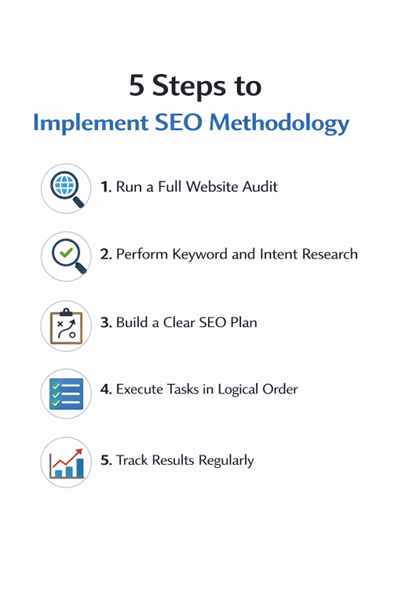
A clear process helps teams avoid confusion and repeated mistakes. This example shows how most businesses apply SEO methodologies safely.
Start by reviewing technical health, content quality, and backlink profiles. Audits reveal hidden problems blocking search engine visibility.
Common checks include:
This step builds a reliable starting baseline for future improvements.
Next, research what users actually search for online. Focus on problems, services, and questions users want answered.
Group keywords by:
This step prevents wasted effort on low-value content topics.
Turn research into a realistic execution roadmap. Define tasks, timelines, and success measurement goals.
Plans usually include:
Clear planning keeps teams aligned and accountable.
Start with technical fixes before publishing new content. Search engines must crawl pages properly first.
Then continue with:
Execution quality determines long-term results.
Review data weekly and monthly for patterns. Small changes often produce great improvements.
Track metrics like:
Adjust priorities based on real data, not assumptions.
Many teams fail despite using structured frameworks. These mistakes often cause slow or negative results.
Avoid these frequent problems:
SEO rewards patience and consistency over shortcuts. Stable systems always outperform rushed experiments long-term.
Tools help teams execute tasks more efficiently and with greater accuracy. They also improve decision-making using real data.
These tools help discover keywords and analyze competitors:
They guide content planning and opportunity discovery.
These tools scan websites for hidden technical problems:
They protect websites from crawling and indexing failures.
These tools support writing and updating content:
They improve user experience and clarity.
These tools measure progress and conversions:
Data guides future SEO decisions.
These tools support outreach and backlink monitoring:
They help maintain authority safely.
SEO systems continue evolving as search engines improve. Future methodologies will focus more on quality and user satisfaction.
Key trends shaping future frameworks include:
Flexible methodologies will adapt faster than rigid systems. Continuous learning will remain essential for success.
SEO methodologies provide structure to complex optimization processes. They help teams avoid guesswork and wasted resources.
Strong frameworks combine:
Businesses that follow structured systems grow more predictably over time. Random SEO actions rarely deliver strong or lasting results. The right methodology depends on your goals, market, and available resources. Consistency matters more than perfection for long-term success.
If you want to improve SEO decisions using real customer behavior, check out CausalFunnel. It helps teams understand what users do after clicking on search results. You can see which pages support sales, along with traffic growth, and find weak points that stop visitors from converting. Such insights help teams refine SEO methodologies with confidence and clarity.
Yes, methodologies define processes, while strategies define business goals. Both work together to guide SEO planning and execution.
Review frameworks every six to twelve months for improvement. Search behavior and technology change often.
Small businesses should start with simple systems first. Complex systems require more resources and experience.
Automation helps with tasks, not decision-making. Human review remains essential for quality control.
Most websites see changes within three to six months. Strong results usually appear after consistent yearly effort.
Start using our A/B test platform now and unlock the hidden potential of your website traffic. Your success begins with giving users the personalized experiences they want.
Start Your Free Trial

Empowering businesses to optimize their conversion funnels with AI-driven insights and automation. Turn traffic into sales with our advanced attribution platform.
Trusted by Customers


©CausalFunnel Inc. All rights reserved.