



Free Funnel Audit
Convert more customers today!
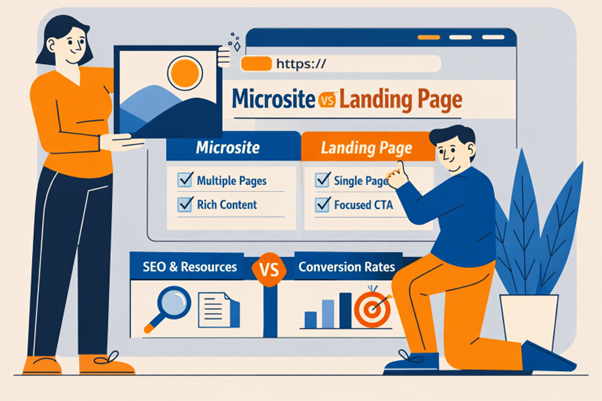
SEO
10 mins read

SEO
10 mins read
Businesses often compare microsite vs landing page before launching new marketing campaigns online. Both tools help brands attract visitors and increase customer actions online.
But the final choice depends on your goal, budget, traffic source, and timeline. Some people even compare microsite vs website vs landing page. Each option serves a different marketing purpose and supports a different stage of the funnel.
In this guide, you will learn:
By the end, you will feel clear and confident about which format fits your needs best.
If you want expert help planning campaigns, visit CausalFunnel. Our team helps brands design smarter digital funnels.
A landing page is a single web page that focuses on one clear goal, which is lead generation or sales. Visitors arrive after clicking an ad or email link. Unlike a full website, navigation is limited, which keeps visitors focused on one action.
That action is called a call to action. You may also hear the term conversion-focused design.
Here are the main features of a landing page:
Landing pages work best for paid traffic campaigns. They are common in lead generation landing page strategies.
For example, a webinar signup page is a landing page. An ebook download page is also a landing page.
Businesses use landing page best practices to increase conversions. They test headlines using A/B testing landing page tools.
Landing pages are simple and focused. They are built to convert visitors quickly. Many high-converting landing page examples follow the same structure. They remove distractions and guide users clearly.
If your goal is quick action, landing pages work well. They are fast to build and easy to optimize.

A microsite is different from a landing page containing multiple pages. A microsite supports a specific campaign or theme, which often feels like a small standalone website.
Some microsites live on subdomains, others live inside subfolders of a main site.
This detail affects microsite SEO performance. Search engines treat subdomains differently from subfolders.
Microsites focus more on storytelling and branding. They allow deeper content and exploration.
Here are key characteristics of a microsite:
Many branded campaign microsites support product launches, while others promote events or seasonal promotions.
When people compare microsite vs website vs landing page, confusion appears.
A website is long-term and broad.
A microsite is short-term and focused.
A landing page is single-goal and direct.
Microsite examples often include interactive experiences. They may feature quizzes, calculators, or videos. A microsite structure allows more creativity. It gives space for deeper content.
However, microsites cost more to build. They also require more planning and design work.
If you need a content-rich campaign page, consider a microsite. If you need quick conversions, choose a landing page instead.
Now, let us compare them clearly. This is where the microsite vs landing page debate becomes simple.
Below is a quick comparison table:
Factor | Landing Page | Microsite |
Purpose | Single conversion goal | Campaign storytelling and branding |
Content Depth | Short and focused | Multiple pages and detailed |
Navigation | Minimal or none | Full navigation menu |
SEO Impact | Targets one keyword | Targets broader keyword sets |
Cost to Build | Low to medium | Medium to high |
Time to Launch | Fast deployment | Longer planning cycle |
Conversion Focus | Very high | Moderate and indirect |
Best For | Paid ads and lead capture | Brand campaigns and launches |
This table highlights landing page vs microsite differences clearly. It shows how each option serves different marketing needs.
Landing page SEO targets one main keyword. Microsite SEO can target multiple related keywords.
A landing page supports strong conversion rate optimization. A microsite supports brand awareness and engagement.
When choosing between a microsite vs landing page for SEO, think about intent. Are you targeting one keyword or many?
If your goal is direct response marketing, choose landing pages. If your goal is engagement, consider microsites.
Planning matters more than format alone. Your strategy should guide your decision.
Landing page SEO focuses on one main keyword. That keyword matches one specific user intent. Because the content is short, ranking can be harder. However, focused optimization can improve results.
Microsites allow broader keyword targeting. They can rank for multiple related search terms.
Here are important SEO factors to consider:
The SEO impact of microsites depends on structure, and that of landing pages depends on optimization quality.
If you compare a microsite vs landing page for SEO, think long term. Microsites support organic traffic strategy expansion, whereas landing pages support paid traffic conversions better. They also support strong landing page conversion rate tracking.
Choosing the right format improves organic traffic growth and overall campaign performance.
Conversion strategy is where the real difference appears. Both formats guide users, but in different ways.
A landing page focuses on one action. That action could be signup, download, or purchase. There is usually one strong call to action. Everything on the page supports that goal. Landing pages also support strong conversion rate optimization. They are built for measurable campaign performance.
Here is how landing pages improve conversions:
This format works best for paid traffic campaigns. It also works well for a landing page for lead generation.
Microsites follow a different conversion path. They educate visitors before asking them to take action. They also present helpful information that prepares users for the next step. This approach builds comfort and reduces decision pressure. Microsites may include several calls to action. Users move through content before deciding. Microsites support campaign-specific content journeys. They often target users in earlier funnel stages.
Here is how microsites support conversions:
When comparing a microsite vs a landing page, intent matters most.
Short-term goals favor landing pages. Brand building favors microsites.
If you want help mapping funnel stages clearly, visit CausalFunnel. We design strategies that connect traffic to revenue.
Many marketers confuse these three formats. Understanding each role removes uncertainty.
A website is your main digital home. It supports long-term brand authority.
A microsite supports one focused campaign. It usually runs for a limited time.
A landing page supports one clear conversion goal. It removes distractions and speeds decisions.
Below is a clear comparison table.
Feature | Website | Microsite | Landing Page |
Purpose | Ongoing brand presence | Campaign focus | Single conversion goal |
Size | Large and multi-section | Medium and focused | Single page |
Navigation | Full site navigation | Limited campaign menu | Minimal or none |
SEO Scope | Broad keyword coverage | Thematic keyword focus | One main keyword |
Funnel Stage | All stages | Middle to top | Bottom of funnel |
Maintenance | Continuous updates | Temporary updates | Campaign-based updates |
This table simplifies microsite vs website vs landing page decisions. Each serves a specific marketing funnel structure.
Websites build trust and long-term visibility.
Microsites drive engagement around themes.
Landing pages drive fast, measurable actions.
If you run content marketing campaigns, choose wisely. Your funnel stage determines your format.
When evaluating microsite vs website vs landing page, ask this:
Are you educating, engaging, or converting?
Clear intent improves marketing campaign performance. It also prevents wasted development budgets.
Landing pages work best for focused campaigns. They shine in performance marketing environments.
Use a landing page when you need:
Landing pages are ideal for paid traffic campaigns. They align well with Facebook Ads and Google Ads. Because landing pages are focused, they convert better. They often support higher landing page conversion rate benchmarks.
If your campaign has one offer, choose this format. If your goal is fast testing, landing pages work well.
They also support quick edits and updates. This makes A/B testing landing pages easier.
Businesses often choose landing page builder tools. These tools reduce development time and cost.
Landing pages support direct response marketing strategies. They provide measurable and trackable results.
If your team needs structured funnel support, consider expert help, explore solutions at CausalFunnel. Our team helps brands build high-converting landing page systems.
Microsites work best for immersive campaigns. They allow more creative flexibility.
Use a microsite when you need:
Microsites support the microsite marketing strategy expansion. They allow detailed campaign messaging.
Microsites help brands stand out visually. They often include animation and video content. A content-rich campaign page builds deeper interest. It encourages users to explore longer.
Microsites also support broader keyword targeting. This helps expand organic traffic strategy efforts.
If resources are limited, landing pages may work better. If branding matters more, choose microsites.
Understanding microsite vs landing page tradeoffs saves money and improves long-term marketing clarity.
Budget plays a major role in decisions. Both formats require different resource levels.
Below is a simplified cost comparison table:
Resource Factor | Landing Page | Microsite |
Development Time | Short | Longer |
Design Complexity | Low to medium | Medium to high |
Maintenance Cost | Low | Moderate |
Content Creation | Limited | Extensive |
SEO Investment | Focused keyword | Multiple keywords |
Landing pages cost less to build, as they require fewer design elements. Microsites require more content production. They may involve developers and designers.
The cost of building a microsite is higher. It also demands greater marketing budget allocation.
Landing pages offer faster launch cycles. They allow rapid campaign testing.
Microsites provide a stronger brand presence. They require larger upfront planning.
If you compare a microsite vs landing page, consider ROI. Small campaigns benefit from landing pages, while large campaigns benefit from microsites.
Choosing correctly protects your resources and ensures marketing investments drive returns.
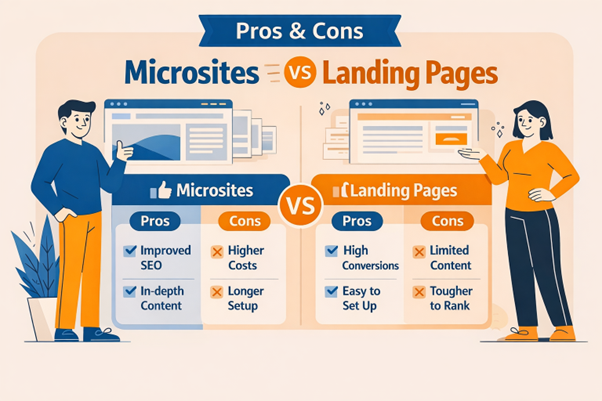
Every marketing format has strengths and limits. Understanding both helps you avoid costly mistakes.
Let us break down the advantages clearly.
Landing pages focus on one single outcome. They remove distractions and guide users quickly.
Here are key landing page benefits:
Landing page SEO works best for high-intent keywords. They perform well for transactional searches.
A high-converting landing page supports measurable ROI. It also improves campaign performance tracking.
However, landing pages have some limits.
Landing pages are built for action. They are not built for exploration.
Now, let us examine microsites.
Microsites allow deeper storytelling experiences. They create immersive brand environments.
Here are major microsite advantages:
Microsite SEO supports thematic keyword clusters. It helps brands build topical authority.
A strong microsite marketing strategy improves awareness. It also increases time on site.
When comparing a microsite vs landing page, weigh tradeoffs carefully. Choose based on business goals, not trends.
If you want strategic clarity, visit CausalFunnel. We help brands align format with the funnel stage.
The right choice depends on your goal. There is no universal winner.
Choose a landing page if you need:
Choose a microsite if you need:
Choose a website for long-term growth. It supports content marketing and authority building.
When thinking about a microsite vs landing page, ask one question: What action should the user take next? If the answer is simple and direct, choose landing pages. If the answer requires exploration, choose microsites.
Many businesses struggle with format decisions. They mix structures and lose clarity. Strategic planning solves this problem quickly. A structured funnel makes execution easier.
If you want expert help designing your funnel, visit CausalFunnel. We help brands connect traffic, messaging, and revenue.
Now that you understand microsite vs landing page deeply, use this knowledge to plan smarter campaigns. Choose based on strategy, not assumptions.
Purchases do not always appear instantly. Depending on your attribution window, they may show within a few hours or even a few days. If you are using a 7-day click setting, a customer can click today and buy later, and the sale will still be counted.
This usually happens because the pixel is not installed correctly, the event is placed on the wrong page, or the domain is not verified. Start by checking Test Events and make sure the Purchase event fires only on the order confirmation page.
In most cases, yes. The Pixel tracks browser activity, but browsers now block or limit some data. Conversions API sends data directly from your server, which improves accuracy and reduces data loss.
You should test your tracking every time you change your website, checkout process, or ad structure. Even small updates can break event tracking without you noticing.
Daily fluctuations are normal. Look at 7-day trends instead of single-day performance. Reacting too quickly can lead to turning off campaigns that are actually working.
If you sell directly through Facebook or Instagram Shops, Meta handles much of the tracking. But if you send traffic to an external site, you need Pixel and preferably Conversions API for accurate reporting.
Start using our A/B test platform now and unlock the hidden potential of your website traffic. Your success begins with giving users the personalized experiences they want.
Start Your Free Trial

Empowering businesses to optimize their conversion funnels with AI-driven insights and automation. Turn traffic into sales with our advanced attribution platform.


