



Free Funnel Audit
Convert more customers today!
SEO
10 mins read

SEO
10 mins read
A single structural mistake in a PPC campaign can quietly drain thousands of dollars in ad spend. And surprisingly, one of the most common causes is poor keyword grouping.
Most PPC campaigns do not fail due to budget constraints. They fail because of structure. You might have the right keywords and the right product. Yet the campaign can struggle. The click-through rate could stay low, and the quality score could refuse to rise.
What many advertisers do is, they put too many keywords into a single ad group. These keywords may look related on the surface, but they target different user intentions. When that happens, ads become generic, landing pages stop matching the search query, and Google notices the mismatch.
In this guide, we will walk through how to group keywords effectively, step by step. You will learn why keyword grouping matters, how to build logical ad groups, what mistakes to avoid, and how better structure directly improves campaign performance.
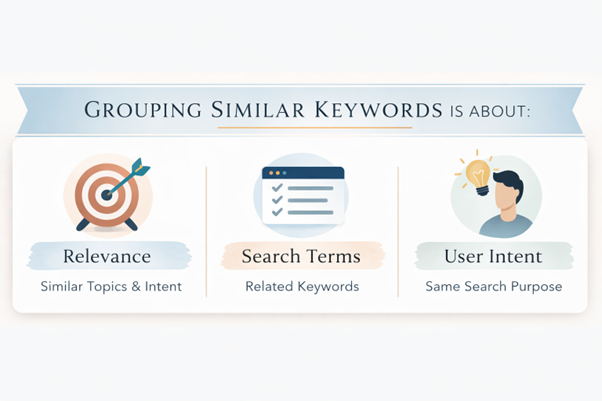
Many beginners misunderstand keyword grouping. They assume that similar keywords simply share a few words. But similarity in PPC is not about spelling; it is about search intent.
Two keywords may look alike yet represent completely different user goals. For example:
“running shoes”
“running shoes repair”
The first keyword targets buyers, while the second targets people looking for repair services. Placing both in one ad group would confuse the ad message.
Proper keyword grouping focuses on four key factors:
Let’s look at a simple example.
Campaign: Running Shoes
Ad group: Trail Running Shoes
Keywords might include:
Each keyword points to the same general goal, and that is purchasing trail running shoes.
Strong keyword groups usually share these characteristics:
When advertisers follow this structure, writing ads becomes easier. Instead of vague messaging, you can write highly specific ads that match what the user searched. This clarity is what makes grouping similar keywords together in an ad group so powerful.
At its core, PPC advertising runs on relevance. Google tries to match a user’s search with the most helpful ad. When keywords in an ad group share the same intent, everything becomes clearer for the system.
How does that happen?
That alignment drives the key performance factors that matter in PPC campaigns.
First, ad relevance improves. If someone searches for “emergency plumber near me” and your ad mentions emergency plumbing services, the message feels precise.
Second, click-through rate increases. Users are more likely to click when the ad matches what they typed.
Third, Quality Score improves. Google rewards ads that match the keyword and landing page experience.
Fourth, the cost per click often drops. A higher Quality Score can reduce how much you pay for each click. A higher Quality Score can lower your cost per click. Ultimately, Google rewards ads that offer a better user experience.
Quality Score depends on three main factors:
Improving these factors requires strong keyword strategy and optimization. CausalFunnel’s SEO services help businesses analyze search intent, improve keyword targeting, and optimize landing pages to strengthen Quality Score and campaign performance.
These improvements combine into better campaign performance, and offer benefits like:
Platforms like CausalFunnel often emphasize this principle when optimizing paid campaigns. Their PPC optimization services frequently focus on restructuring ad groups first because structure affects nearly every metric in Google Ads.
Understanding this makes the rest of the process easier. Once you see how structure affects performance, keyword grouping becomes a strategic decision rather than a technical step.
If you have ever stared at a long keyword list and wondered where to start, you are not alone. A large list can feel overwhelming. But keyword grouping becomes manageable when you break it into simple steps.
Instead of thinking about hundreds of keywords at once, focus on themes. Each theme becomes an ad group. Within that group, you add closely related keyword variations.
This process works whether you manage a small local campaign or a large national account. Below are the four practical steps experienced PPC managers follow when building keyword groups.
Every ad group needs a clear starting point. That starting point is the core keyword theme. Think of this as the main topic that defines the ad group.
For example:
Each of these phrases represents a distinct service. They should not live in the same ad group.
When creating your campaign structure, begin by identifying the main offerings in your business. Each offering becomes a campaign or ad group theme.
For example, a bakery might structure campaigns like this:
Each ad group focuses on a specific product category.
This simple step prevents one of the biggest PPC mistakes, like mixed keyword intent.
Even advanced marketing teams revisit this step when optimizing accounts. In fact, campaign audits performed by CausalFunnel often begin by identifying weak keyword themes and restructuring them into tighter groups.
Once you establish the core theme, the next step becomes easier.
After choosing the main keyword theme, you expand the group with closely related variations. These variations help capture different ways users search for the same thing.
For example, if your core keyword is:
“birthday cake”
You might add variations like:
These keywords still represent the same user goal.
Common modifiers that expand keyword groups include:
Modifiers reveal small shifts in user intent, but they remain within the same general theme. This expansion method helps marketers cover multiple search patterns while keeping ads relevant.
Tools like Google Keyword Planner can help identify these variations using search behavior insights. The key rule is simple: if the same ad and landing page work for every keyword, the group is probably correct.
Keyword grouping only works if ads and landing pages match the keyword theme.
Imagine a user searches for “emergency plumber near me.” They click your ad and land on a generic plumbing services page. The user expected urgent help. Instead, they see a broad list of services.
That disconnect lowers conversions. To maintain relevance, every keyword group should have:
For example:
Keyword group: Emergency Plumber
Ad headline:
Emergency Plumber Available 24/7
Landing page:
Emergency plumbing services with a fast response time.
This alignment signals strong relevance to Google Ads. When relevance increases, Quality Score rises. Higher Quality Score often means lower CPC and higher ad position.
Many PPC specialists believe landing page alignment is just as important as keyword selection. That is why CausalFunnel analyzes user behavior across ads and landing pages to ensure the experience matches the search query.
Keyword grouping sets the foundation, while ad and landing page alignment completes the system.
Even experienced advertisers sometimes group too many keywords together. When keyword intent shifts, the ad group should split.
For example, imagine an ad group containing:
At first glance, these keywords look related, but the intent is different.
One targets buyers. Another targets repair services. A better structure would split these into separate groups.
You should split ad groups when:
Clear structure makes ads easier to write and campaigns easier to manage. If an ad group starts feeling confusing, that is often a signal that it should be divided into smaller groups.
Sometimes the easiest way to understand keyword grouping is to see real examples.
Below are three simple examples that mirror how many successful PPC campaigns are structured.
Campaign: Cakes
Ad group: Birthday Cakes
Keywords:
Ad copy can clearly mention birthday cakes. The landing page can show birthday cake options. This way, everything stays aligned.
Campaign: Plumbing Services
Ad group: Emergency Plumber
Keywords:
All keywords indicate urgency. The ad can highlight fast service and availability.
Campaign: PPC Services
Ad group: Google Ads Management
Keywords:
This structure allows advertisers to target users actively searching for PPC services. Real examples like these show that keyword grouping does not need to be complicated. It simply requires clear themes and consistent intent.
Even experienced advertisers make mistakes when structuring keyword groups. These mistakes often seem minor but can significantly reduce campaign performance.
Here are the most common issues:
One common example is combining informational and transactional keywords.
For instance:
“how to fix plumbing leak”
“emergency plumber near me”
The first searcher wants instructions. The second wants immediate help. Ads targeting both users will struggle to perform well.
Another mistake is building extremely large ad groups with dozens of keywords. Large groups force ads to become generic, which lowers relevance.
Good PPC campaigns often contain many small, focused ad groups rather than a few oversized ones.
Avoiding these mistakes protects your campaign structure and helps maintain strong relevance between keyword, ad, and landing page.
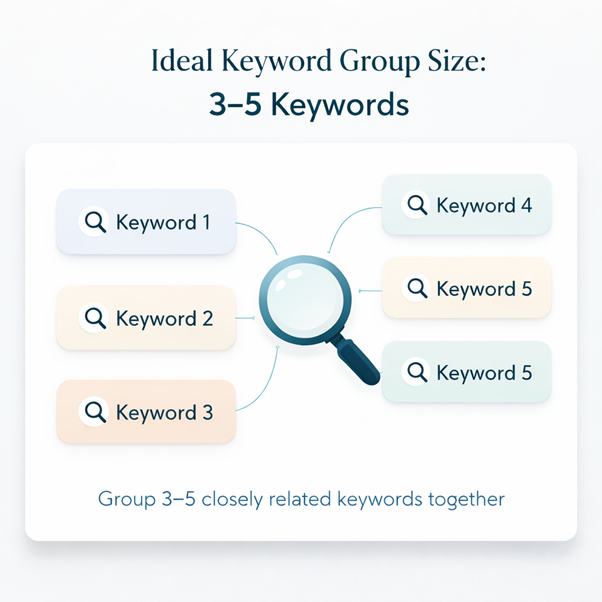
Many marketers ask the same question when building campaigns: how many keywords should an ad group contain?
There is no strict rule. But relevance matters more than quantity. Most experienced PPC managers aim for 5 to 20 keywords per ad group.
This range works well because it keeps the theme focused while still capturing keyword variations.
Smaller groups can sometimes perform even better. For example, a high-value service keyword may deserve its own dedicated ad group.
A good rule of thumb is simple. If one ad message fits all the keywords naturally, the group is probably structured well. If the ad feels too generic, the group may contain too many different intentions.
Keyword grouping is ultimately about clarity, not numbers.
Strong PPC campaigns rarely succeed by accident. They succeed because the structure supports relevance at every level.
That is why grouping similar keywords together in an ad group remains one of the most important practices in paid advertising. When keywords share intent, ads become clearer, landing pages feel more relevant, and campaigns perform better.
Marketers who take time to review their keyword structure often discover easy wins hiding inside their accounts.
A simple restructuring can raise Quality Score, reduce wasted spend, and improve conversion rates.
Keyword grouping in PPC is adding closely related words to the same group. This is done so that they share similar search intent, landing pages, and ads. When you group similar keywords together, you create more relevant ads, improving your campaign performance.
Keyword grouping improves ad relevance and Quality Score. When keywords share the same intent, ads match searches better, which often increases CTR and reduces cost per click.
Most PPC experts recommend 5–20 keywords per ad group. The key is relevance. If one ad and landing page work for all keywords, the group size is usually correct.
Yes, different match types can be in the same ad group if they represent the same keyword theme and intent.
Too many keywords make ads generic. This often lowers ad relevance, reduces CTR, and increases cost per click.
It can, but it is not recommended. Duplicate keywords may cause ad groups to compete against each other.
Review keyword groups regularly, especially when performance drops or new search trends appear.
Start using our A/B test platform now and unlock the hidden potential of your website traffic. Your success begins with giving users the personalized experiences they want.
Start Your Free Trial

Empowering businesses to optimize their conversion funnels with AI-driven insights and automation. Turn traffic into sales with our advanced attribution platform.
Trusted by Customers


©CausalFunnel Inc. All rights reserved.