



Free Funnel Audit
Convert more customers today!

SEO
10 mins read

SEO
10 mins read
The real SEO advantage is not better writing, but better intelligence. When you understand why competitors rank and what search engines reward, you stop chasing rankings. You start engineering them.
To do that consistently, you need a structured way to analyze the SERP, uncover strategic gaps, and turn insights into action.
That structured approach is called competitive intelligence SEO.
This approach helps you study what already works in search. You learn why certain pages rank and others fail. You stop guessing and start making informed decisions.
If you want expert support while building this process, visit CausalFunnel. Our team of experts helps businesses turn SEO data into measurable growth.
In this guide, you will learn three important things:
Let us start with the basics.
Competitive intelligence SEO is the practice of studying your search competitors. It helps you understand how they gain traffic and visibility. You analyze their keywords, backlinks, content, and technical setup.
This is not spying or copying. It is a structured SEO competitive analysis based on public data. You collect information, compare it, and improve your strategy.
Many businesses confuse business competitors with search competitors. They are not always the same. A company selling similar products may not rank above you. Instead, another blog or niche site may dominate results.
This is why SERP analysis is critical. You must study who appears in search results. That is where your true competition lives.
Competitive intelligence SEO helps you answer key questions:
When you answer these questions clearly, growth becomes predictable. You no longer rely on random content publishing. You build decisions based on competitive benchmarking data.
Search results are crowded and competitive today. Google rewards depth, clarity, and relevance. Surface-level content rarely wins long term.
Without competitor SEO analysis, you operate blindly:
Competitive intelligence SEO helps you:
It also saves time. Instead of testing randomly, you learn from proven winners. You observe patterns across top-ranking pages. Then you design stronger pages with intent alignment.
This method increases confidence in your SEO roadmap. It reduces risk and improves return on effort.
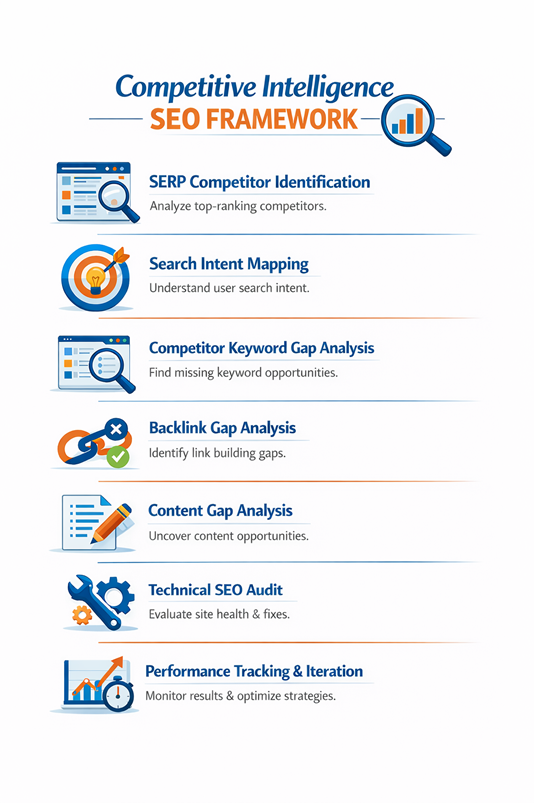
A competitive intelligence SEO framework keeps your process consistent. Without a framework, insights remain scattered and unused. Below is a practical framework you can follow:
Do not assume your business rivals dominate search. Search your core keywords manually. List the top ten ranking pages consistently.
Check for patterns in:
Your real competitors are those ranking above you.
Every keyword serves a user intent. Some users want information. Some users want comparisons while others want to purchase. Group competitor pages into intent categories.
Examples include:
Intent mapping prevents content mismatch. If the intent is wrong, rankings rarely improve.
This step reveals missed opportunities. Use SEO tools to extract competitor keyword lists. Look for keywords where they rank well.
Focus on three data points:
Identify keyword gap areas carefully. These gaps often signal fast-win opportunities. Avoid chasing every high-volume keyword. Relevance always matters more than volume.
Backlinks remain a strong ranking factor. Study competitor backlink profiles deeply. Look at referring domains and link quality.
Check for:
Backlink gap analysis shows where authority grows. It also reveals partnership opportunities.
Never copy links blindly. Always assess link quality and relevance.
Content depth often separates page one from page two. Study competitor content structure carefully. Notice headings, visuals, examples, and FAQs.
Ask yourself key questions:
Content gap analysis is not copying. It is about improving clarity and completeness. You should aim to create something better organized. Add clearer steps, examples, and supporting visuals.
Technical strength supports content performance. Even great content fails on slow websites. Conduct a simple technical SEO audit covering:
Technical issues create invisible ranking barriers. Fixing them often improves results quickly.
SEO is never a one-time task. Use rank tracking tools consistently. Monitor keyword movements weekly.
Track improvements in:
Adjust your strategy monthly based on data. Refinement is part of the framework.
This competitive intelligence SEO framework works because it is systematic. It connects research directly to action. It reduces guesswork in SEO planning.
It focuses on five pillars:
Most businesses skip structured analysis. They publish content without strategic comparison. That slows growth and wastes effort.
With competitive intelligence SEO, you build clarity first. Then you create smarter execution plans.
Now that you have learned the foundation, let us move into deeper execution steps. This is where competitive intelligence SEO becomes powerful.
Let’s focus on tactical workflows that help you make smarter SEO decisions. They reduce trial and error significantly.
Let us break this into practical actions:
Basic keyword research is not enough today. You must understand how competitors structure visibility. This is where true competitor keyword analysis begins.
Start by extracting their top-ranking pages. Then analyze the keywords supporting those pages. Focus on patterns instead of isolated keywords. Patterns reveal strategic intent alignment.
Competitors rarely rank with one keyword only. They usually rank for clusters of related phrases.
Check for:
This helps you identify keyword gap areas faster. You can then build stronger content hubs. Avoid chasing every keyword blindly. Instead, prioritize strategic keyword alignment.
Intent drives ranking stability over time. If there are intent mismatches, your page will drop quickly.
Review top-ranking pages carefully. Identify what type of result dominates.
For example:
This is called SERP analysis. It ensures your content format matches expectations. You must align structure, not just keywords. Google rewards pages that satisfy user goals.
Content gap analysis must go beyond surface-level checks. Do not just count headings and word length. Study depth and clarity carefully.
Look at competitor content sections closely. Ask what they explain clearly. Then ask what they miss completely.
Evaluate these elements:
Your goal is not to copy content, but to improve structure and insight. A strong content strategy focuses on user clarity first. Search engines reward clarity naturally.
Backlinks influence ranking authority strongly. However, poor links create long-term damage. When conducting backlink gap analysis, stay strategic. Never replicate links without reviewing quality.
Analyze competitor backlink sources for:
Then build a safer link-building strategy. Focus on earning trust signals naturally. Guest content, digital PR, and partnerships help growth. Avoid shortcuts that damage long-term credibility.
Competitive benchmarking reveals performance differences clearly. You must track measurable indicators consistently.
Monitor these key metrics monthly:
Data without comparison creates confusion. Data with context creates clarity. Rank tracking should align with real goals. Always connect rankings to traffic and conversions.
Technical gaps often hide behind content issues. Even strong pages fail due to technical weaknesses.
Run a structured technical SEO audit focusing on:
Compare these factors with competitors directly. Small technical improvements can unlock large ranking gains. Technical intelligence supports every other SEO action. Never ignore this foundational layer.

Execution requires repetition and discipline. Without routine, insights fade quickly.
Follow this simple monthly workflow:
This routine keeps your competitive intelligence SEO active. It prevents sudden ranking surprises.
Raw data alone does not create growth. You must translate data into decisions. Create a scoring model for prioritization.
Score opportunities based on:
This helps allocate resources effectively. High-impact, low-effort opportunities come first. Strategic prioritization accelerates growth momentum. It prevents scattered execution efforts.
Competitive insights must lead to content changes. Otherwise, research becomes wasted effort.
Convert findings into three action buckets:
For example, if a keyword gap exists:
Create a detailed content page addressing it fully.
If a backlink gap appears:
Develop outreach campaigns targeting similar domains.
If a technical weakness appears:
Fix speed and usability before expanding content. Action converts intelligence into performance gains.
Not every ranking improvement drives revenue growth. Always align competitive intelligence SEO with business outcomes.
Ask these strategic questions:
Strategic SEO connects traffic to real conversions. Without alignment, rankings become vanity metrics.
If you want structured insight that connects SEO to revenue, visit CausalFunnel. We help translate competitive data into measurable business growth.
Search algorithms evolve constantly. Competitors adapt quickly to updates.
Monitor shifts in:
Competitive intelligence SEO helps detect changes early. Early detection prevents sudden traffic drops. Adaptation ensures long-term stability.
The next section focuses on long-term advantage and refinement. Competitive intelligence SEO is not a one-time tactic but an ongoing discipline that evolves with search behavior and competition.
Collecting data is not enough. You must convert insights into consistent action. That is where many businesses fail.
Your advantage comes from repetition and improvement. Small changes each month create steady momentum. Large random changes create instability.
To sustain growth, follow three principles:
This disciplined approach strengthens competitive positioning.
A checklist prevents missed steps. It also keeps your process consistent.
This setup phase builds your foundation. It ensures no critical element is ignored.
Monthly reviews prevent sudden ranking losses. They also help detect new opportunities quickly.

A workflow creates clarity and speed. Without workflow, insights become overwhelming.
Use this structured approach each month:
This cycle creates consistent improvement. It prevents scattered execution efforts. Structured workflow reduces emotional decisions. It replaces them with measured actions.
Even strong strategies fail due to simple errors. Avoid these mistakes carefully.
Competitive intelligence SEO works best with discipline. Shortcuts create long-term damage.
Rankings alone do not define success. Traffic alone does not guarantee growth. You must connect performance to outcomes. Monitor both visibility and business metrics.
Track these indicators:
Competitive benchmarking provides context. Context turns numbers into decisions. Without context, data creates confusion.
Search evolves rapidly each year. Competitors adjust quickly to algorithm updates.
Monitor these signals consistently:
Competitive intelligence SEO helps detect these shifts early. Early detection prevents major traffic losses. Adaptation ensures long-term resilience.
Competitive intelligence SEO builds clarity and confidence. It transforms guesswork into structured decision-making and creates predictable growth through disciplined execution. When you combine framework, workflow, and measurement, progress accelerates. You move from reactive SEO to strategic leadership.
If you want smarter dashboards, automated tracking, and structured competitive insights, do check out CausalFunnel. Our platform turns raw SEO data into actionable growth signals.
Take control of your competitive edge today!
Competitive intelligence SEO is structured competitor research for search growth. It analyzes keywords, backlinks, content, and technical signals. The goal is to improve your ranking strategy intelligently.
Monthly analysis is recommended for stable growth. Weekly monitoring of rankings is also helpful. Frequent review prevents sudden ranking surprises.
Keyword gaps, backlink profiles, and intent alignment matter greatly. Technical performance also influences ranking stability. Balanced analysis provides the strongest insight.
Backlink gap analysis reveals authority differences between competitors. It shows where quality links are missing. Targeted outreach then strengthens your link-building strategy.
Study structure, not wording or design. Improve clarity, depth, and usefulness. Add unique examples and insights.
Start using our A/B test platform now and unlock the hidden potential of your website traffic. Your success begins with giving users the personalized experiences they want.
Start Your Free Trial

Empowering businesses to optimize their conversion funnels with AI-driven insights and automation. Turn traffic into sales with our advanced attribution platform.
Trusted by Customers


©CausalFunnel Inc. All rights reserved.