



Free Funnel Audit
Convert more customers today!
SEO
10 mins read

SEO
10 mins read
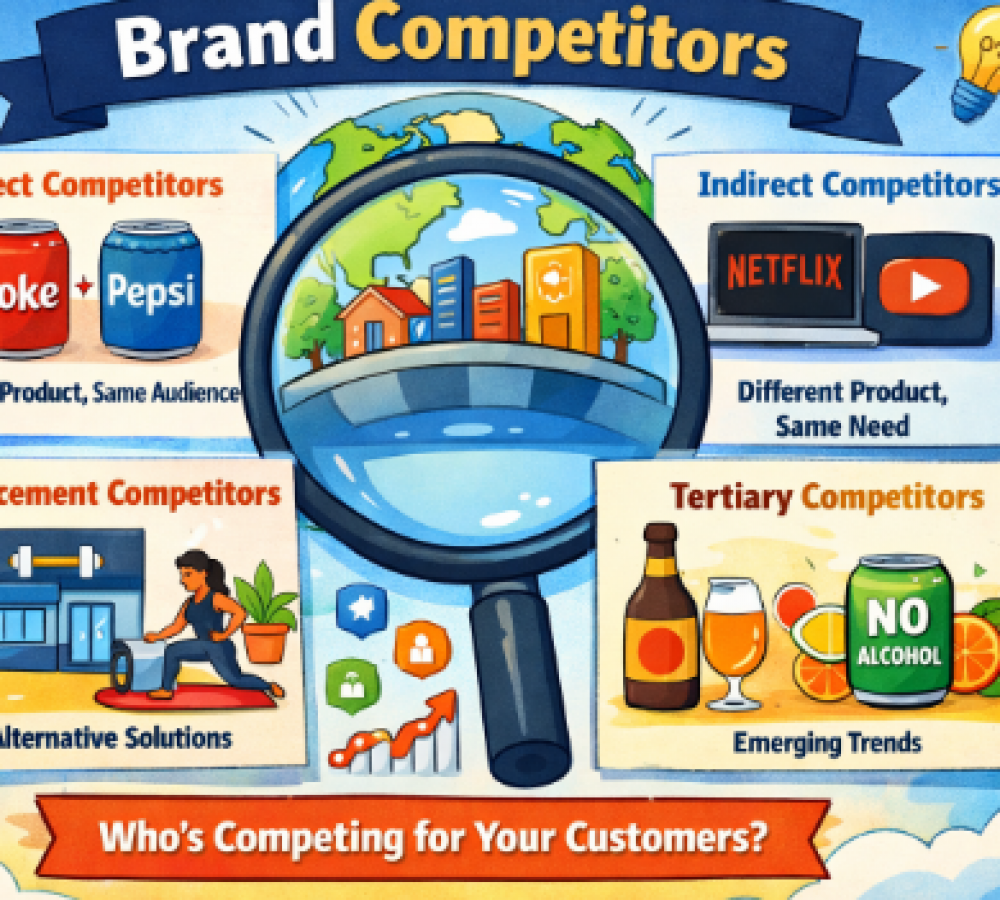
Brand competitors are businesses in your domain. They target the same or similar buyers as you. They do that by offering services or products that solve the same problem as yours does.
Brand competitors are your industry peers. They try to get hold of the same market segment as you. They may sell the same item as yours. Alternatively, they may sell something similar. But at the end, their product functions the same as yours in satisfying your customer’s needs.
Think about Coca-Cola and Pepsi. Both sell soft drinks. Both target the same audience. That makes them direct competitors.
Knowing your competitors helps you stand out in a crowded market. It shows what works and what doesn’t.
It also helps you make better marketing decisions. You learn what messages connect with people.
Most importantly, it helps you spot gaps. These gaps are chances to do something better or different.
Some competitors are obvious. Others are easy to miss. But each type matters.
Direct competitors sell the same product to the same audience.
They are the ones customers compare side by side.
Example: Netflix vs Prime Video
Both offer streaming. Both target people who want movies and shows.
If someone picks one, they often skip the other.
Indirect competitors offer different products but solve the same need.
They don’t look similar at first. But they still compete for attention and time.
An example is Netflix and YouTube One is a subscription platform. The other is free content. But both fight for screen time.
So when a user spends hours on YouTube, Netflix loses that time.
Replacement competitors offer alternative ways to solve the same problem.
They often come from a completely different category.
An example is gym vs home workouts One is a physical place. The other is done at home. But both aim to improve fitness.
A customer may switch between them based on cost, comfort, or time.
Potential competitors are new or emerging players. They may not compete today. But they can in the future.
Take the example of a startup entering the food delivery space At first, it may seem small. But over time, it can grow fast and disrupt big brands.
Ignoring them is risky.
These are brands that don’t directly compete today. They may not even look like competitors at first. However, they can become relevant as customer behavior changes over time.
In simple terms, they sit on the edge of your market. When trends shift, they move closer.
They are not immediate threats. But they are not random either.
They usually:
Over time, these differences start to shrink. And suddenly, they compete for the same customer.
| Type of Competitor | How Close They Are | Example |
| Direct | Very close | Coke vs Pepsi |
| Indirect | Moderately close | Netflix vs YouTube |
| Replacement | Alternative path | Gym vs home workout |
| Potential | Future entrants | New startups |
| Tertiary | Trend-driven | Beer vs no-alcohol drinks |
Examples make things clearer. Let’s break this down by industry.
A person may choose coffee in the morning. Or grab an energy drink. Both boost energy.
Someone may choose gaming over watching shows. That’s still a competition for attention.
One focuses on trends. The other focuses on budget and sustainability.
But both attract the same shopper.
Finding competitors is easier than it seems. But it takes a bit of digging.
Start with these steps:
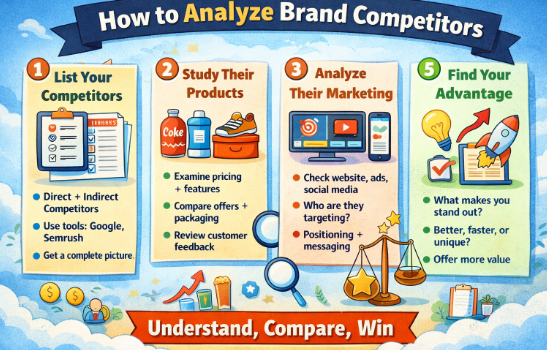
Identifying competitors is just step one. The real value comes from analysis.
Start by writing down every competitor you can find. Don’t try to be perfect here. Just aim to capture the full picture. Include:
Now go a bit deeper. Ask yourself:
You can also use tools to speed this up:
Example:
If you sell skincare, your list may include luxury brands, drugstore options, and even DIY home remedies. At this stage, more is better. You can always refine later.
Now look closely at what each competitor offers. This step is not just about features. It is about understanding why customers choose them.
Focus on:
Ask simple but powerful questions:
You can explore:
Example:
Two brands may sell the same product. But one highlights luxury and design. The other focuses on affordability and ease. That difference matters more than the product itself.
Next, look at how they communicate. Marketing shows how a brand wants to be seen. That tells you a lot. Check:
Now pause and observe patterns. Ask:
Useful tools here include:
Example:
Some fitness brands sell transformation stories. Others sell convenience. Both target the same audience, but the messaging is very different.
At this point, patterns start to show. Now it is time to organize them. List what each competitor does well. Then note where they fall short. You can break it down like this:
Strengths:
Weaknesses:
Ask yourself:
You can gather this from:
Example:
A brand may have great products but poor customer support. That gap is not small. It is an opportunity.
After all this research, one question matters most. Why should a customer choose you?
Your advantage does not have to be huge. It just has to be clear. It could be:
Ask yourself:
You can also test your ideas:
Example:
If all competitors feel complex, a simple and easy-to-use product can stand out instantly.
Here is a quick flow to remember:
Each step builds on the last one. And together, they give you a clear direction.
Below are three simple frameworks that work well for most businesses.
SWOT is one of the easiest ways to study competitors. It helps break things into four clear parts.
Here is a simple example:
Factor | Example for a Competitor |
Strength | Strong brand awareness |
Weakness | High pricing |
Opportunity | Expanding to new markets |
Threat | New low-cost startups |
Now, here’s the useful part. After filling this for competitors, do the same for your brand. Then compare. You may notice something like this:
That could be your entry point. Offer better value. Speak clearly about it. SWOT works best when kept simple. No need to overthink it.
This framework looks at the bigger picture. Not just one competitor, but the whole market. It focuses on five forces that affect competition:
Let’s simplify this with a quick view:
Force | What It Means |
Rivalry | How crowded the market is |
New entrants | How easy it is to start a similar business |
Substitutes | Alternative solutions available |
Buyer power | How easily customers can switch |
Supplier power | Control over cost and supply |
This framework helps answer one big question. Is this market easy or hard to win in?
For example, food delivery apps face high rivalry and strong substitutes. That makes growth harder and more expensive.
Perceptual mapping shows how customers view different brands. It is visual. It is simple and very powerful. You pick two factors that matter to customers. Then place brands on a chart.
Common examples include:
Here is a basic example:
Brand | Price Level | Quality Level |
Brand A | High | High |
Brand B | Low | Medium |
Brand C | Medium | High |
Now imagine this as a graph. You will notice gaps. Maybe no brand offers high quality at a mid price. That gap could be your opportunity.
This method is useful because it shows perception, not just facts.
Each framework has its own use. You don’t need to use all at once.
Many teams combine them for deeper insights. But even using one properly can give strong results.
Use this table to organize your research.
Competitor | Type | Price | Strength | Weakness |
Brand A | Direct | High | Premium quality | Expensive |
Brand B | Indirect | Low | Affordable | Basic features |
Here are some simple and useful tools to get started.
Semrush is an all-in-one marketing tool. It helps you see which keywords competitors rank for. You can also check their traffic and ads.
It is useful when you want to understand what is driving their growth.
Ahrefs is great for SEO analysis. It shows backlinks, keyword rankings, and top pages.
If you want to know why a competitor ranks higher on Google, this tool helps you figure that out.
SpyFu focuses on competitor keywords and ads. It shows which keywords competitors have used over time.
This is helpful if you want to learn from their paid and organic strategies.
SimilarWeb gives a quick view of website traffic. It shows where visitors come from, like search, social, or direct visits.
It is useful for spotting trends and comparing traffic across competitors.
Google Alerts is simple but powerful. You can track mentions of competitors or keywords.
Whenever something new appears online, you get notified. This helps you stay updated without much effort.
Brandwatch focuses on social listening. It tracks what people say about brands online.
You can see customer opinions, trends, and sentiment. This gives a deeper view beyond numbers.
Brand competitors are businesses targeting similar customers. There are four main types:
Understanding and analyzing them helps you find your edge and stand out.
Brand competitors are companies that target the same or similar customers with products or solutions that meet the same need.
Direct competitors offer the same product to the same audience.
Indirect competitors offer different products but solve the same problem.
Search your product online, check ads, explore marketplaces, and ask customers what alternatives they considered.
Examples include Netflix vs YouTube or coffee vs energy drinks. The products differ, but the need is similar.
It helps you understand the market, improve decisions, and find ways to stand out.
It should be done regularly. Markets change fast. A quarterly review is a good starting point.
Start using our A/B test platform now and unlock the hidden potential of your website traffic. Your success begins with giving users the personalized experiences they want.
Start Your Free Trial

Empowering businesses to optimize their conversion funnels with AI-driven insights and automation. Turn traffic into sales with our advanced attribution platform.
Trusted by Customers


©CausalFunnel Inc. All rights reserved.