
Free Funnel Audit
Convert more customers today!
SEO
10 mins read

SEO
10 mins read
Keyword lists can get messy very fast. You may have hundreds of terms on one sheet. Some terms mean the same thing. Some terms need different pages to rank well. That is where keyword clustering tools can help.
These tools group keywords by meaning or intent. They turn chaos into a clear content plan, help you avoid keyword overlap issues, and can save hours every week.
In this guide, you will learn the basics first. You will also get quick picks for common needs. Then you will see how we test each tool. If you also want better site actions, wish to track user paths or heatmaps, funnels, and page behavior insights, explore CausalFunnel now!
If you want a fast answer, start here. These picks match the most common SEO needs.
Do not treat these as fixed rules. Your best tool depends on your goals and workflow.
Keyword clustering means grouping keywords into small sets. Each set targets one main page intent. The keywords inside a set are closely related. Think of it like sorting a toolbox. You put similar tools in one drawer. You also label each drawer for quick work.
A good cluster often shares the same search intent. It may also share similar top-ranking pages. That is why SERP checks matter a lot.
Simple definition you can quote:
Keyword clustering groups related keywords by intent. It helps you plan pages without overlap or guesswork. You will also hear another term often. Some people say keyword grouping tools instead. Both terms point to the same core goal.
Keyword clustering helps you plan better content. It also helps Google understand your site’s topics. It makes your site easier to browse too.
Here are the biggest wins for most people.
Many “best tools” posts feel the same. They list features without real testing. That does not help serious SEO work. We used a simple and fair test approach. It focuses on results, speed, and clarity.
We used the same keyword lists for each tool. We tested both small and medium list sizes. We also checked how easy exports were.
We focused on these key areas.
Tools can guess intent wrong sometimes. So we also did a quick SERP review. We checked the top results for tricky keywords. We looked for clear intent matches or mismatches.
This step matters for real projects. It helps you avoid bad page plans later.
Here is a table that helps you compare keyword clustering tools faster. It also helps you pick without stress.
Tool Type | Clustering Method | Best For | Scale | Exports | Price Level |
SERP overlap tool | SERP-based | Highest intent accuracy | Medium to large | Strong | Medium |
Semantic grouping tool | NLP-based | Quick grouping ideas | Small to medium | Medium | Low to medium |
Hybrid tool | Both methods | Balanced workflows | Medium to large | Strong | Medium to high |
Suite platform | Mixed features | Agencies and teams | Large | Strong | Medium to high |
Free tool | Basic grouping | Testing and learning | Small | Small | Free |
This table is a guide, not a rule. Always test one list before you commit.
Choosing a tool is not only about features. It is about your daily workflow and team needs. Use this quick match guide to decide.
If you track on-page behavior, pair tools smartly. Cluster keywords, then test content with real data.
Heatmaps and funnels can show weak spots quickly. You can explore the best guidance at CausalFunnel.
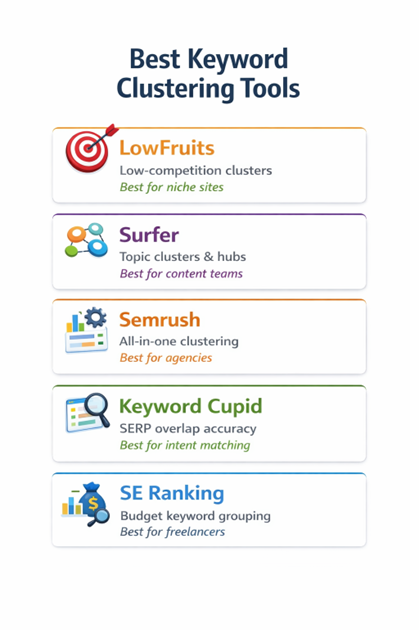
Picking a tool can feel confusing at first. Many tools look similar on the surface. But they work best for different goals. Some focus on low competition keywords. Some focus on topic clusters and content hubs. Some focus on SERP overlap accuracy.
This section makes the choice easier. Each tool review follows the same format. You will see what is best for you. You will also see how it clusters keywords. Then you get a simple workflow to follow. You also get pros, cons, and who should skip it.
Use these reviews to match a tool to your needs. Do not pick only based on brand name. Pick based on your daily SEO workflow.
Best for:
LowFruits works well for niche sites and bloggers. It is strong for finding weak SERPs quickly. It also helps build clusters around low competition terms.
How does it cluster?
LowFruits clusters keywords by SERP patterns and intent signals. It helps you spot groups that share similar search results. This supports a SERP-based keyword clustering approach.
Workflow
Use this simple flow for the best results.
What did we like?
What could be better?
Pricing snapshot
Pricing often starts with a low monthly plan. Costs can rise with heavier usage and add-ons. Always check current limits before scaling.
Who should skip it?
Skip it if you only need bulk clustering or if you want deep team workflows. In those cases, a suite tool may fit better.
Best for:
Surfer is strong for content teams and planners. It helps build topic maps and content hubs. It is useful when you want topical authority growth.
How does it cluster?
Surfer groups keywords into topic clusters. It often connects clusters to a pillar page plan. It focuses on content structure and coverage depth.
Workflow:
Try this workflow for clean results.
What did we like?
What could be better?
Pricing snapshot:
Surfer is usually priced as a premium tool. It can be a better value for teams than solo users. Consider it if content production is your main goal.
Who should skip it?
Skip it if you only want cheap clustering. Skip it if you need strict SERP overlap clustering. A SERP-based tool can feel more accurate sometimes.
Best for:
Semrush fits agencies and multi-site teams well. It works when you want one platform for many tasks. It can support clustering as part of a bigger workflow.
How does it cluster?
Semrush can group keywords inside its planning tools. It often connects clusters to page and topic ideas. It is useful for content planning and gap checks.
Workflow:
Here is a simple way to use it well:
What did we like?
What could be better?
Pricing snapshot:
Semrush is usually a higher-cost platform. It makes sense when you use many features daily. For clustering only, it may feel heavy.
Who should skip it?
Skip it if you want a simple, fast keyword cluster tool or if you only need bulk grouping on a budget.
Best for:
Keyword Cupid works well for accuracy-focused users. It is a good fit for niche site builders. It can also help agencies validate intent at scale.
How does it cluster?
It clusters keywords using SERP overlap logic. That means it compares ranking URLs for similarity. Clusters form when results overlap strongly.
Workflow:
Use this workflow for strong accuracy.
What did we like?
What could be better?
Pricing snapshot:
Pricing can vary based on usage and features. It is often fair for the accuracy you get. Check current pricing before you commit.
Who should skip it?
Skip it if you want an all-in-one SEO suite or if you need built-in content briefs. Use it as a specialist tool instead.
Best for:
SE Ranking can fit small teams and freelancers. It is useful if you want tools on one platform. It can also fit users who want budget control.
How does it cluster?
It offers keyword grouping based on SERP similarity settings. You can control grouping strength with overlap rules. It can support a basic SERP-based approach.
Workflow:
Here is a clean process for this platform:
What did we like?
What could be better?
Pricing snapshot
SE Ranking often has flexible monthly plans. It can be a good entry point for small teams. Always confirm keyword limits for your list sizes.
Who should skip it?
Skip it if you want deep content planning features or if you want the strongest clustering accuracy. In those cases, use a specialist SERP tool.
Free tools can help you start fast. They can work for small keyword lists. They can also help you learn clustering basics. But they often come with strict limits.
Here are common trade-offs with free tools.
Free tools can still be useful. Use them for small projects and early planning. Then upgrade when your workflow grows.
Best for:
KeySearch fits small list clustering and quick checks. It is good for learning and testing early ideas.
How does it cluster?
It groups keywords by similarity signals and patterns. It may not match SERP intent in every case.
How to use it well?
Follow this simple process for better output.
Main limitation
Clusters may feel broad or unclear sometimes. You often need manual edits for better accuracy.
Best for:
Zenbrief works for quick grouping and fast export. It can also help you test cluster size settings.
How does it cluster?
It groups by similarity and supports basic controls. It is best for early draft clustering.
How to use it well?
Use this flow for cleaner clusters.
Main limitation
You still need intent checks for key pages. Free tools rarely solve the intent fully.
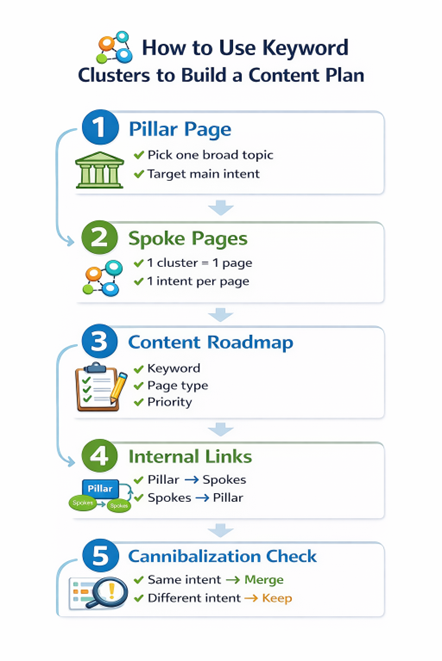
A cluster is only useful with a plan. This plan should guide writing and internal linking. It should also reduce keyword overlap.
Use this step-by-step workflow for best results:
Choose one broad topic for your pillar page. This page should cover the topic in full. It should answer the main user’s needs first.
A pillar page can target a broad keyword. It can also target a high-level intent phrase. Do not make it too narrow or too wide.
Each cluster becomes one spoke page. Each spoke should target one clear intent. Keep clusters tight and focused.
Use this quick rule for page mapping.
A roadmap turns clusters into a schedule. It helps you write in the right order. It also helps you track progress.
Include these fields in your roadmap.
Clusters can guide your internal links. Link pillar pages to each spoke page. Link spokes back to the pillar page, too. Also, link spokes to other related spokes.
This supports a clean content hub structure. It can also help users explore more pages. That can raise time on site and engagement.
Before you publish, check overlap risk. Search your site for similar page topics. If two pages match the same intent, merge them. If intent differs, keep both pages separate.
This one step can save hours later. It also protects your rankings long-term.
Clusters can go wrong very easily. Avoid these mistakes from the start.
A quick SERP check solves many issues. Do it for your top clusters every time. This habit keeps your plan clean and focused.
These tips improve results without extra tools. They also help you work faster each week.
Topical authority comes from coverage depth. You build it with a pillar and spokes plan. This makes your site look focused and helpful.
Use the pillar for broad questions. Use spokes for specific subtopics and intent.
Clusters can show what you do not have. Compare clusters to your existing pages. Any missing cluster page is a content gap. Fill those gaps in a smart order.
Start with gaps that match your offers. Then cover gaps that support the hub.
Old pages can rank better after updates. Clusters can show missing subtopics to add. They can also show better internal links to add.
Do not rewrite everything from scratch. Add missing sections and improve intent focus.
Internal links should not be random. They should guide users to related pages. Clusters give you a natural link map.
Add links where readers need next steps. That improves flow and reduces quick exits.
This step is simple and very powerful. Search for the keyword and scan the top results. Look for the main content type pattern.
Common patterns include these formats.
Match your page format to the SERP pattern. That improves your chance to rank well.
Keyword clustering tools can change your workflow. They help you plan content with less guesswork. They also help you build cleaner topic clusters.
Use this quick recap to decide.
After you publish, track real user behavior. Find pages where users stop scrolling or clicking. To fix those weak spots and improve conversions, check out CausalFunnel.
Keyword clustering tools group related keywords into clusters. Each cluster should match one main page intent. This helps you plan pages without overlap issues. These tools save time during content planning. They also help you avoid keyword cannibalization problems.
Free options can work for small lists and quick tests. Examples include tools like Zenbrief and KeySearch. They can help you learn grouping basics fast. Free tools often have limits and fewer settings. Use them for early drafts and small projects.
There is no perfect number for every niche. Most clusters work well with five to twenty keywords. The key is intent, not the keyword count. If intent differs, split the cluster. If intent matches, keep the cluster together.
Most sites can benefit from clustering. It helps with content planning and site structure. It also helps new sites build topic coverage faster. If you only publish rarely, you can cluster less often. But even small sites can use it for planning.
Start using our A/B test platform now and unlock the hidden potential of your website traffic. Your success begins with giving users the personalized experiences they want.
Start Your Free Trial

Empowering businesses to optimize their conversion funnels with AI-driven insights and automation. Turn traffic into sales with our advanced attribution platform.


