



Free Funnel Audit
Convert more customers today!
SEO
10 mins read

SEO
10 mins read
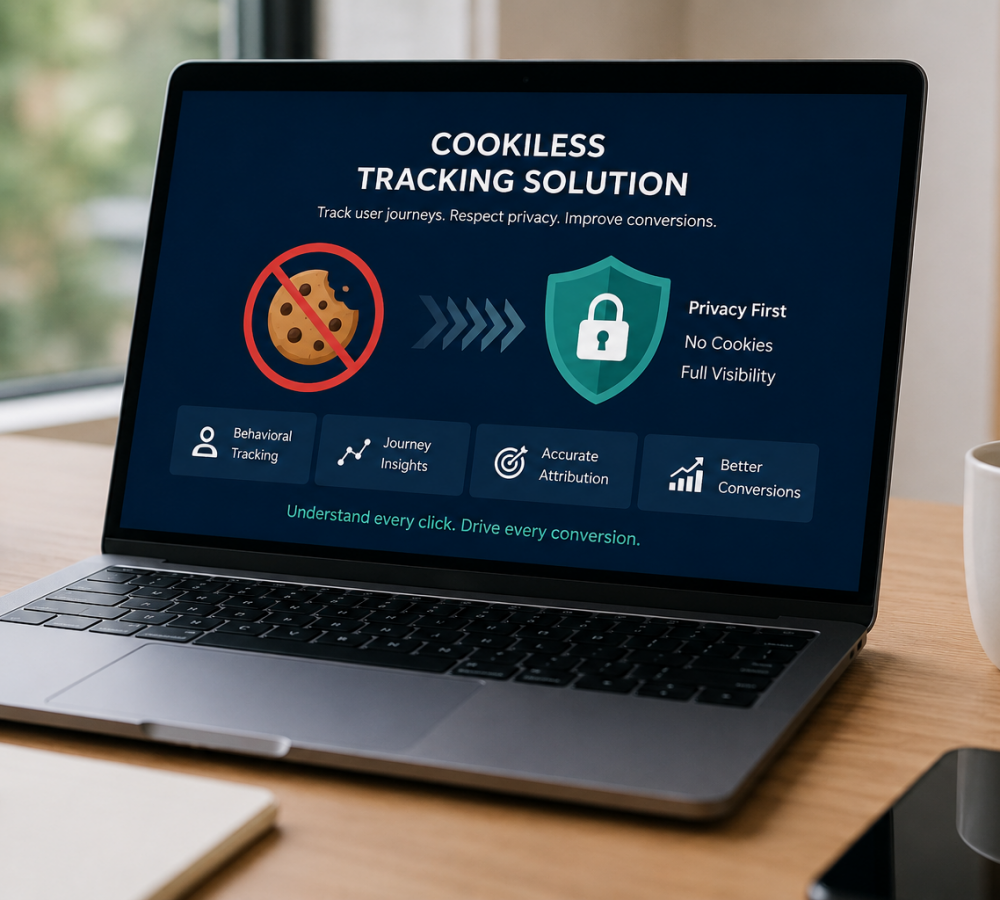
Cookies are losing their grip on the web. Browsers block them, users reject them, and regulators keep tightening the rules around them. But marketers still need to know who visits their site and what makes them buy. That gap is why cookieless tracking exists. This post breaks down what it means and why it matters now. You’ll also find the tools that can help you track visitors without a single cookie.
No, tracking cookies are not illegal on their own. What matters is how you use them and whether you have real consent. Cookies used for essential functions, like remembering a shopping cart, are usually exempt from consent rules. Cookies used for analytics, ads, or profiling are a different story. Those need clear, valid consent before they can run.
Laws like GDPR follow an opt-in model. Users must actively agree before tracking starts. Laws like CCPA follow an opt-out model instead. Tracking happens by default. But users must find an easy way to stop it. Either way, a cookie consent banner has to appear before non-essential cookies fire. If a user accepts, the cookie runs. If they decline, it should not.
This is where things get messy for businesses. Every banner creates a split between users who accept and users who leave without deciding. That split shows up later as gaps in your data.
Cookieless tracking means collecting visitor data and measuring site performance without relying on third-party cookies. It skips the idea of following one person across many sites. Instead, it focuses on what happens inside your own digital property.
There are a few common approaches. Server-side tracking moves data collection from the browser to your own servers. This keeps data accurate even when ad blockers or browser settings interfere with scripts running on the visitor’s device.
First-party data collection is another route. This is information customers give you directly, through forms, email signups, or purchase history. You build this data through direct exchanges, not passive tracking.
Privacy-preserving analytics tools take a third path. They use techniques like data aggregation to study patterns across many users, not individual behavior. No single visitor gets tracked or identified. You still see what pages perform well and where traffic comes from, just without the personal trail attached.
Third-party cookies are disappearing fast. Safari blocked them by default back in 2017. Firefox followed in 2019. Chrome has been phasing them out too. This makes old tracking methods unreliable across browsers.
Consumer trust plays a role as well. People are more aware of how their data gets used and shared online. High-profile data breaches have made users cautious. Many now actively choose brands that explain data practices clearly and offer real choices, not buried settings.
Then there is the compliance angle. GDPR, CCPA, and similar laws around the world demand explicit consent before non-essential data collection begins. Cookie-based systems that ignore this face real financial risk. Fines under these laws can reach millions of dollars. The reputational damage often lasts longer than the fine itself.
Mobile platforms have joined the shift too. iOS requires clear permission before any app can track users across other apps. Android is rolling out similar controls. None of this is optional anymore. Businesses that keep depending on cookies will keep losing visibility, one browser update at a time.
Yes, with a simple logic behind it. Most analytics tools were built to follow individuals. Connecting a first visit to a return visit, or a paid ad click to a sale, usually needed a persistent identifier. Cookies filled that role because they worked reliably across visits.
The trouble is what a cookie represents. It shows personal data tied to one identifiable device. Under privacy laws, collecting that kind of data needs a legal basis. For most sites, that basis is consent. Consent needs a banner. The banner splits your visitors into two groups. One of those groups vanishes from your reports.
Cookieless analytics tools solve this by never creating an individual record in the first place. Instead of a persistent identifier, some tools generate a temporary marker that resets every day. Thus, there is no way to link one visit to the next. Every number on the dashboard becomes an aggregate count. For example, total visitors, total pageviews, top traffic sources. That is often all a business owner actually needs to make decisions.
Because no personal data gets collected, no consent banner becomes legally necessary in most cases. That removes the need for a consent platform, ongoing audits, and ongoing legal review. At the same time, it gives visitors a cleaner browsing experience with no pop-up asking for permission before they can read a page.
Yes, several free options exist, each with a different setup and a different level of effort.
It is completely free when self-hosted, since it is open-source software you run on your own server. When configured for cookieless tracking, it uses anonymous visitor configuration hashes and not cookies. This setup can legally bypass consent banners in many regions. But it does require some technical work to install and maintain.
The tool offers a free tier that covers up to five domains. It collects lightweight, aggregated metrics through a tiny script. It never stores personal data or tracks individuals across sites. This makes it a fast option for small sites that want basic numbers without any setup complexity.
It also has a free tier, allowing up to ten million events per month. It is not cookieless by default, though. Running it compliantly without traditional cookies in strict privacy regions takes careful configuration and active consent management. This makes GA4 more work to set up correctly compared to tools built to be cookieless from day one.
For tracking to run without triggering a consent banner under laws like GDPR, it has to collect only anonymized or aggregated data. It cannot identify individual users or build detailed behavioral profiles tied to a person.
Tools that use rotating hashes or purely aggregate metrics can meet this bar without resorting to invasive fingerprinting methods. The moment a tool starts stitching together a personal profile, even without cookies, it re-enters consent territory. The safest cookieless tools stay strictly at the aggregate or session level. They are never at the individual level.
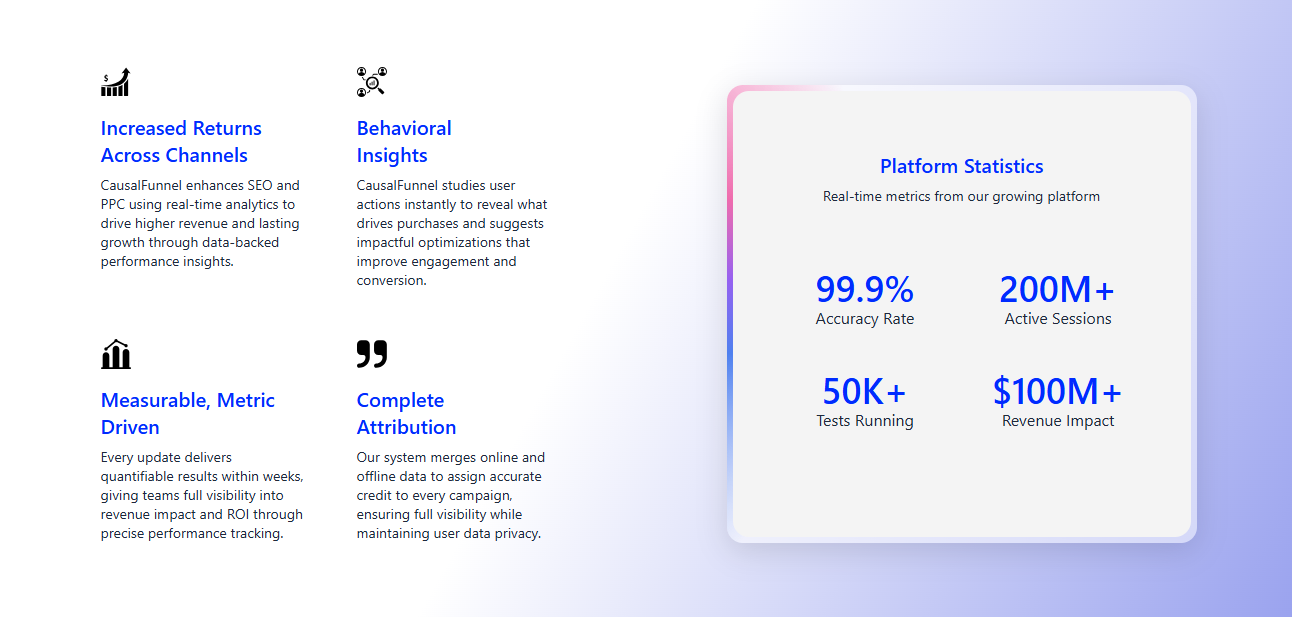
Most cookieless analytics tools stop at reporting basic traffic numbers. CausalFunnel takes a different approach. It combines cookieless tracking with attribution and conversion optimization. Thus, it gives marketers a fuller picture of what visitors do and why they leave.
CausalFunnel runs on a Cookie-Agnostic Platform, built around its DeepID technology. Instead of depending on cookies, device IDs, or a fixed IP address to know who a visitor is, the system reads behavior directly. This is important because cookies expire, get blocked, or get wiped by privacy settings. IP addresses shift constantly with VPNs and mobile networks.
DeepID keeps journey continuity intact across sessions and devices by matching behavioral patterns instead of stored identifiers. A visitor who browses on a phone or checks details on a laptop can still be recognized as one journey. This holds even when a cookie would have expired, been blocked, or been cleared between visits.
The approach works by watching what a visitor actually does on a page, not who they are. CausalFunnel reads signals like page flows, scroll patterns, clicks, hover behavior, motion trails, idle time, and CTA engagement. These small signals combine into a pattern unique to that session.
This is a meaningful shift. The system identifies the journey, not the individual. That distinction is what makes cookie-agnostic tracking a privacy-conscious alternative to identity-based methods. It never needs a name, an email, or a device fingerprint to understand where a visitor hesitates or what draws their attention.
Fragmented journeys create a real business problem. When one visitor looks like three different sessions because cookies reset, attribution breaks down. Marketing teams cannot tell which channel actually deserves credit for a sale.
CausalFunnel addresses this with cookie-agnostic attribution, connecting visitor behavior, marketing channels, and eventual conversions into one accurate path. This becomes especially valuable in environments shaped by browser privacy restrictions, cookie blocking, and consent requirements. Here, traditional tools lose the thread entirely. Budget decisions get sharper once you can actually see which campaigns drive real revenue and not guessing from incomplete data.
Tracking without cookies is only half the value. What matters is what teams do with that data afterward. CausalFunnel uses the behavioral journeys it builds to analyze funnel drop-offs, identify high-intent visitors, personalize on-site experiences, run A/B tests, and lift overall conversion rates.
This turns CausalFunnel into more than a tracking layer. It becomes a combined system for cookieless tracking, attribution, and conversion optimization. Everything is built on the same behavioral data foundation. Marketers get a single source of truth instead of stitching together separate tools for each piece.
VPN traffic is one of the toughest tests for any tracking system. Cookies do not stick, IP addresses shift constantly, and cross-domain activity often becomes invisible to standard analytics tools. CausalFunnel’s technology can track VPN users without relying on cookies, fingerprinting, or a consistent IP address. It uses the same behavior-stitching logic it applies to all traffic.
This means a privacy-conscious visitor browsing through a VPN still shows up as a complete journey in the dashboard, hesitation points and all. It is a concrete example of where traditional tracking tools lose visibility entirely, and where cookie-agnostic tracking keeps working regardless.
Cookieless tracking is no longer a future consideration. Browsers are already blocking cookies, and regulations keep raising the bar for consent. Businesses that adapt now avoid the data gaps that come with delay. CausalFunnel offers cookie-agnostic tracking that uses behavioral signals to maintain visitor journey visibility, improve attribution, and give marketers actionable conversion insights without relying on traditional cookies. That combination of privacy-safe tracking and real conversion data is what makes it worth a closer look for any team planning its shift away from cookies.
Start using our A/B test platform now and unlock the hidden potential of your website traffic. Your success begins with giving users the personalized experiences they want.
Start Your Free Trial

Empowering businesses to optimize their conversion funnels with AI-driven insights and automation. Turn traffic into sales with our advanced attribution platform.
Trusted by Customers


©CausalFunnel Inc. All rights reserved.