



Free Funnel Audit
Convert more customers today!
SEO
10 mins read

SEO
10 mins read
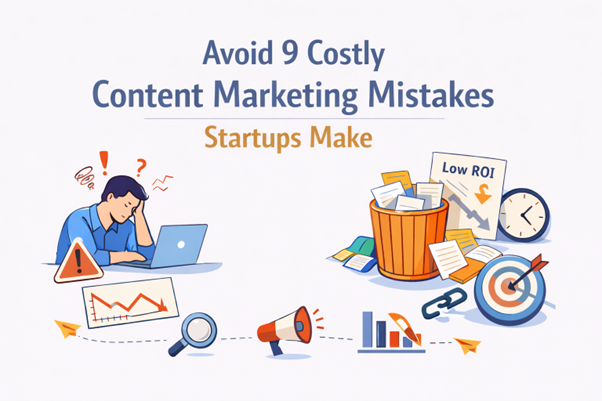
A lot of startups think that content alone will lead to consistent development. They write blogs, make videos, and then wait for results. Then nothing important occurs. The income remains the same. Leads are still not constant. It’s not the effort that’s the issue. The issue is the structure. Content marketing for startups often fails when there is no clear plan behind it. Without a defined purpose, content quickly turns into noise instead of becoming a real growth asset.
These are not minor marketing blunders. They have a direct impact on cash flow, the quality of leads, and growth over time. Strong content marketing for new businesses must turn visitors into sales. This book will show you how to transform wasted time into results that you can see.
For startups, content marketing involves creating helpful content that draws in the appropriate people and helps them reach a clear business objective. It isn’t just uploading things at random or following trends. It is a concentrated method that over time turns attention into leads and sales.
A lot of entrepreneurs replicate big companies without knowing the most important distinctions. Big firms have a lot of people working for them and budgets that might change. Startups have to operate with little money and short deadlines. Enterprise brands may try a lot of things and take losses. That danger is too high for startups. Every piece of content must help make money.
This is why many firms fail at content marketing early on. Founders put out material without a plan for their startup’s content. They write blogs without knowing what they want to get out of them. They use all of the platforms at once. They see content as a side job instead than a way to flourish.
You need to be clear and focused to use a marketing plan. Results are always uncertain when material doesn’t have a clear goal. Doing things at random wastes time and lowers your return on investment.
Here are common reasons failure happens:
Without structure, effort turns into scattered activity. With structure, effort compounds into measurable growth. The mistakes ahead will show exactly where most startups go wrong and how to correct them.

A lot of entrepreneurs solely care about how much traffic they get. They are happy about pageviews, likes, and shares. These stats appear nice on reports. They don’t often lead to actual sales. Startups must link their work to business results when they use content marketing. If material doesn’t help make money, it costs money.
Many new businesses fall into the trap of vanity metrics. For instance, a blog article may get ten thousand hits. But none of those people who came to see it book a demo. No one signs up for an email list. None of them buy anything. Traffic that doesn’t lead to action doesn’t help content ROI. It simply makes you feel better about yourself.
A structure that puts goals first prevents this from happening. Content should go through three steps: Awareness, Leads, and Money. Awareness draws the appropriate people to your platform. Leads get contact information and show interest. Revenue turns eligible leads into paying consumers. Each piece of information must clearly support one step.
Startups can’t afford to squander time and energy. There isn’t enough time or money. Every blog post, video, or guide must have a clear goal.
Use this alignment checklist:
Clear goals turn content into a strategic asset. Without them, growth remains unpredictable and unstable.
A lot of startups think they already know their audience. They make things depending on what they’ve been through. After that, they create material depending on what they think. This shortcut typically doesn’t work very well. Content marketing for new businesses only works if it meets the demands of genuine buyers.
Assumptions lead to messages that don’t match up. A startup may put out sophisticated guidelines. But their audience could still be aware of the situation. Some people need to compare things before they can make a choice. If you don’t know what stage of buyer awareness you’re at, your content won’t hit the target. Listening, not guessing, is the first step in a good startup content strategy.
You don’t need a lot of money to undertake audience research. Simple ways may help startups check their observations. The purpose is to figure out difficulties, objections, and reasons to purchase.
Use this lean research framework:
Top of funnel content should educate early-stage prospects. Middle funnel content should compare solutions clearly. Bottom funnel content should reduce risk and encourage action.
When content matches buyer intent, engagement increases naturally. When content ignores audience insight, performance drops quickly. Smart research protects time and improves conversion potential.
Startups often chase every new platform. They open accounts on five social networks at once. They start blogging, podcasting, and posting short videos together. This approach feels productive. It usually leads to weak results. A scattered content distribution strategy drains energy quickly.
Early teams work with small budgets and limited time. A bootstrapped marketing strategy requires strict focus. When effort spreads too wide, quality drops across all channels. Growth slows because nothing gets consistent attention.
The 80/20 rule applies strongly here. Around eighty percent of results come from a few focused actions. Startups should identify the small number of channels that drive most engagement. Then they must double down on those areas.
Channel selection must match buyer intent, not trends. Ask where your audience searches for solutions. B2B buyers often use search engines and LinkedIn. Younger consumers may respond better to short video platforms. Choose channels based on behavior, not popularity.
Use this prioritization checklist:
Focused execution builds momentum. Scattered execution builds frustration. Depth creates authority. Expansion comes later, not at the beginning.
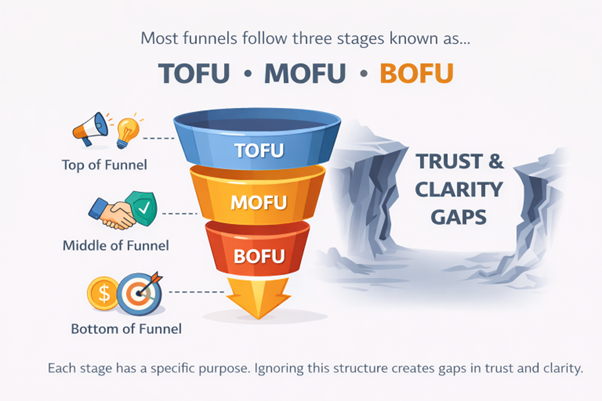
Many startups publish helpful content but see little return. The missing piece is structure. A content marketing funnel guides readers from first contact to purchase. Without it, attention never turns into revenue. Content marketing for startups must move people forward, not just inform them.
A clear content marketing funnel connects awareness, trust, and decision. Each stage answers a different question. When startups skip stages, buyers drop off early. Content marketing for startups becomes inconsistent when there is no planned journey.
Most funnels follow three stages known as TOFU MOFU BOFU. Each stage has a specific purpose. Ignoring this structure creates gaps in trust and clarity.
Top of funnel content attracts new audiences. These readers are problem-aware but not solution-ready. Startups often create only broad educational articles. They forget to capture emails or offer next steps. Without a clear call to action, traffic leaves without engagement.
Middle funnel content builds trust and comparison. Buyers now explore different options. Many startups fail to publish case studies or solution guides. They do not address objections clearly. This gap weakens confidence and slows decision-making.
Bottom funnel content supports final decisions. Buyers need proof, clarity, and risk reduction. Startups often lack testimonials or detailed product explanations. Some forget strong calls to action. Without these elements, ready buyers hesitate or leave.
A structured funnel aligns content with buyer intent. When each stage supports the next, conversions improve steadily.
Top of funnel content attracts new visitors through education and awareness. Many startups stop at this stage. They publish blog posts that answer basic questions. However, they do not offer any next step. There is no email signup, checklist, or guide. Traffic increases, yet leads remain flat. Awareness alone does not build a pipeline. Each TOFU article should include a simple capture method. Offer a related resource that solves a deeper problem. Add a clear internal link to the next stage. Small actions at this level build long-term momentum.
Middle funnel content builds trust and clarity. At this stage, buyers compare options carefully. Many startups skip case studies or product comparisons. They assume interest alone will lead to purchase. This creates doubt and hesitation. Buyers need proof and explanation. Show real results with simple numbers. Explain how your solution differs from alternatives. Address common objections directly. Provide clear examples of outcomes. Strong MOFU content moves readers closer to action. Without it, they leave to research competitors instead.
Bottom funnel content drives final decisions. These buyers are ready but cautious. Many startups forget strong calls to action. Some lack detailed product pages or pricing clarity. Others avoid testimonials or guarantees. This weakens trust at a critical moment. Every BOFU asset should remove friction. Use direct CTAs like book a demo or start a trial. Highlight benefits clearly and reduce perceived risk. Clear decision-stage content increases conversion rates quickly. Structure at this stage turns interest into revenue.
One of the most damaging assumptions in content marketing for startups is expecting fast traction. Founders influenced by paid acquisition timelines often treat content like ads: publish today, generate leads tomorrow. That expectation misaligns with how organic growth actually works. Content operates on a delayed-return model, credibility, search authority, and audience trust compound over time.
A realistic performance timeline looks like this:
The compounding effect is the core advantage. One well-ranked article can drive qualified traffic for years without incremental cost. In contrast, paid campaigns stop the moment spending pauses.
Quitting at month three eliminates the exponential return phase. Most startups abandon execution just before content begins working. This impatience disrupts startup growth marketing momentum and creates a cycle of restarting instead of scaling.
Realistic benchmarks matter. Instead of expecting revenue in 30 days, track leading indicators: impressions, keyword rankings, subscriber growth, and demo inquiries. Content ROI emerges when consistency meets time.
Patience is not passive. It is disciplined execution aligned with long-term acquisition economics.

Many founders believe publishing equals progress. They invest heavily in writing but ignore amplification. This is one of the most common startup marketing mistakes. Without a structured content distribution strategy, even strong content remains invisible. Algorithms do not reward new domains automatically. Search rankings take time. Social feeds are crowded. “Publish and pray” is not a growth plan, it is hope disguised as execution.
Effective content marketing for startups requires dual-channel distribution: organic for long-term equity and paid for controlled acceleration. Organic builds authority and compounding visibility. Paid ensures early traction, audience validation, and remarketing data. Promotion is not optional; it is part of production economics.
Below is a lean distribution checklist startups can implement immediately:
Content without distribution is sunk cost. Promotion converts assets into acquisition channels.
Many startups publish consistently but fail to measure performance beyond surface-level numbers. Pageviews alone do not indicate content ROI. Without tying engagement to pipeline contribution, content becomes a cost center instead of a growth lever. A strong startup content strategy requires metric alignment with funnel stages and revenue outcomes.
Vanity metrics create false confidence. High traffic with low engagement signals mismatch. Strong engagement with no conversion signals weak calls to action. Metrics must reveal buyer progression, not just visibility.
Here are the essential metrics startups should prioritize:
Tracking layered metrics clarifies performance gaps. When engagement metrics and conversion metrics are connected, optimization becomes systematic. Content stops being guesswork and becomes a measurable acquisition engine.
Early-stage teams often focus on volume over credibility. They publish frequently but fail to demonstrate expertise. In B2B startup marketing, authority is not optional, it directly affects trust, rankings, and conversion rates. Search engines evaluate expertise signals, and buyers evaluate risk. When content lacks proof, it feels generic. That weakens both discoverability and persuasion.
Strong content marketing for startups requires visible authority markers embedded within each asset. Startups cannot compete with brand recognition yet, so they must compete with specificity and evidence.
Common authority gaps include:
Authority signals compound impact. They improve on-page engagement, strengthen backlink potential, and increase conversion probability. In competitive categories, credibility is the differentiator between being read and being trusted.
Many founders approach content with a campaign mindset. They launch a themed series, promote it briefly, then move on. This short-term execution model conflicts with how content marketing for startups actually generates returns. Campaigns spike attention. Assets compound equity.
In startup growth marketing, durable advantage comes from accumulation. Evergreen content — material that remains relevant over time, continues attracting qualified traffic long after publication. A single well-optimized guide can generate consistent leads for years, while a time-sensitive campaign disappears once promotion stops.
The key distinction is intent:
Evergreen content focuses on foundational problems, buyer intent queries, and decision-stage education. These topics do not expire. They become part of a structured knowledge library that supports the full funnel.
Updating old posts is equally critical. Refresh statistics, improve internal links, expand sections, and align CTAs with current offers. Search engines reward content freshness when it improves quality. Conversion rates increase when messaging matches current positioning.
Building a content library also compounds authority. Each article strengthens topical depth and internal linking strength. Viral chasing does the opposite — it produces fragmented traffic without structural leverage.
Content should be treated as infrastructure, not promotion. Infrastructure appreciates in value when maintained strategically.
Correcting content marketing for startups errors requires a structured, repeatable framework. Startups cannot rely on luck or ad hoc tactics. A clear startup content strategy ensures every effort contributes to traffic, engagement, and revenue.
Follow these five steps to align content with growth goals:
This framework transforms scattered content into a growth engine. Startups that implement it systematically see compounding returns over months. By following goal-first execution, channel focus, and funnel alignment, content marketing for startups becomes predictable, measurable, and revenue-generating.

Startups don’t need to handle everything on their own. Partnering with professionals can save time and reduce costly mistakes. Experienced content marketers or agencies bring proven strategies, authority-building techniques, and efficient distribution methods.
They help implement a startup content strategy that aligns with business goals and maximizes content marketing for startups ROI. Even a short-term collaboration can provide guidance on funnel creation, keyword targeting, and audience research. Professionals ensure that content is consistent, high-quality, and measurable, while teaching founders best practices to maintain long-term success.
Content marketing for startups is a long-term growth engine, not a quick fix. Strategy matters more than volume. Focus on creating content that aligns with the funnel, addresses buyer intent, and demonstrates authority. Patience is critical to results compound over months, not weeks. Measure meaningful metrics to optimize performance and maximize ROI. By treating each piece as an asset, executing consistently, and refining over time, startups can transform content into a predictable, revenue-generating engine.
Content marketing for startups does not generate instant results. Expect early signals within 3–6 months. Consistent publishing, distribution, and optimization produce measurable ROI around 6–12 months. Patience is essential to benefit from compounding content effects.
The budget depends on goals and resources. Focus on a lean startup content strategy that maximizes high-impact channels. Prioritize quality over quantity. Invest in promotion and small-scale paid campaigns to accelerate visibility when necessary.
Outsourcing can help if internal bandwidth is limited. Freelancers or agencies should complement, not replace, strategy execution. Ensure outsourced content aligns with buyer intent, funnel stages, and authority-building requirements to avoid wasted spend.
Track meaningful metrics: lead conversions, CTA engagement, time on page, and scroll depth. Avoid vanity metrics. Attribution models clarify which content drives pipeline influence, ensuring content marketing for startups produces tangible growth.
Start using our A/B test platform now and unlock the hidden potential of your website traffic. Your success begins with giving users the personalized experiences they want.
Start Your Free Trial

Empowering businesses to optimize their conversion funnels with AI-driven insights and automation. Turn traffic into sales with our advanced attribution platform.


