



Free Funnel Audit
Convert more customers today!
SEO
10 mins read

SEO
10 mins read
Auction Insights in Google Ads shows how your ads compete in the same auctions. It compares your performance against other advertisers bidding on similar keywords. This report helps you understand visibility, pressure, and relative position in auctions.
Google Ads Auction Insights is not about conversions or direct revenue results. It focuses on competitive presence within search and shopping auction environments. The data appears only when enough auction activity exists for fair comparisons.
You can use this report to answer common competitive questions quickly. For example, you can see who appears with you most often. You can also see who ranks above you when ads appear together. This insight helps marketers avoid blind bidding decisions. It also reduces guesswork when planning budget or bid adjustments. The report supports smarter decisions through context, not assumptions.
Auction Insights works best when paired with clear campaign goals. It does not replace performance reports like conversions or ROAS. Instead, it adds a competitive lens to existing performance data.
For teams managing multiple campaigns, combining Auction Insights with deeper behavioral and funnel data can add more clarity. Tools like CausalFunnel help connect auction-level competition with how users actually move through your funnel, making it easier to spot where competitive pressure affects real business outcomes.
Auction Insights includes several metrics that describe auction behavior. Each metric answers a specific question about competition and visibility. Understanding each one prevents costly mistakes during optimization decisions.
Below are the core metrics you will see inside the report. Each metric serves a different purpose during analysis. Do not evaluate these metrics in isolation from campaign goals.
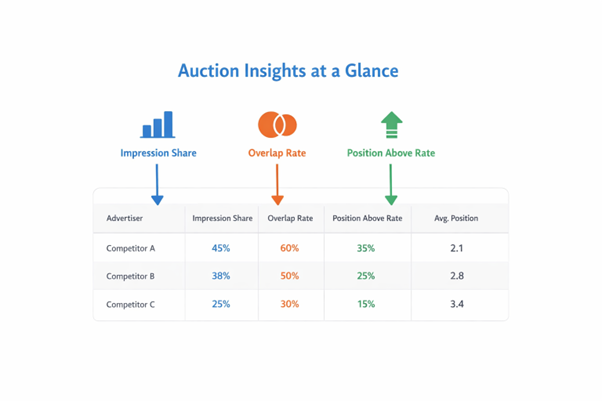
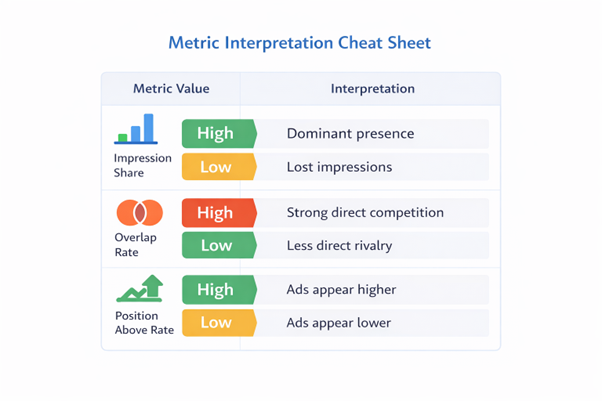
Impression share shows how often your ad appeared when it could have appeared. It is shown as a percentage of total eligible impressions. A higher impression share means stronger visibility in the auction. A lower impression share means missed opportunities due to rank or budget.
Important points to understand about impression share include:
This metric helps you measure presence, not success. Use it to understand coverage, not profitability or efficiency.
The overlap rate shows how often another advertiser appears with you. It measures shared auction participation, not ranking or dominance. A high overlap rate means frequent competition for the same keywords. A low overlap rate suggests limited direct competition overlap.
Key points to remember about the overlap rate include:
This metric helps identify true competitors within your auction space. It prevents wasting time analyzing advertisers that rarely compete with you.
The position above the rate shows how often a competitor ranks higher than you. It only applies when both ads appear in the same auction. A high position above the rate signals a stronger ad rank during overlap. This often relates to bids, Quality Score, or ad relevance.
Important interpretation points include:
Use this metric to understand relative strength during direct competition. Avoid reacting without reviewing Quality Score and bid strategies together.
The top of page rate shows how often your ad appears above organic results. The absolute top of the page rate shows appearances in the very first ad position.
These metrics describe visibility, not user engagement or conversions. They help explain where ads appear, not how users respond.
Key differences between the two metrics include:
These metrics matter more for brand visibility campaigns. They matter less for efficiency-driven performance campaigns.
Outranking share shows how often you beat another advertiser. It includes cases where you rank higher, or they do not appear.
A high outranking share indicates competitive strength in auctions. It reflects both presence and relative position advantages.
Important details about outranking share include:
This metric helps assess competitive dominance trends over time. It should always be reviewed alongside impression share metrics.
You can access Auction Insights directly inside the Google Ads interface. The steps vary slightly depending on the campaign and report type.
Follow these general steps to find the report easily:
You can also view Auction Insights at keyword or ad group levels. Availability depends on data volume and auction participation levels.
Some accounts may not see the report immediately. This usually happens when the impression volume is too low. Running campaigns longer often resolves this limitation naturally.
Always check date ranges before concluding. Short timeframes can significantly distort competitive signals.
Auction Insights becomes powerful when used for strategic analysis. It should guide thinking, not trigger instant reactive changes.
The goal is to understand patterns of competitive pressure over time. Single data points rarely tell a complete competitive story.
This section focuses on using insights wisely. The next sections explain structured interpretation methods.
Not every advertiser shown is a meaningful competitor. Some appear briefly due to testing or seasonal campaigns.
Focus on advertisers that appear consistently across time periods. Consistency signals true competition for the same audience.
Helpful filters when identifying real competitors include:
Ignoring short-term noise prevents unnecessary bid changes. It also protects budgets from reactionary spending mistakes.
If you want to know how the Auction Insights report or data set fits into a larger audit that improves quality scores, budgets, tracking, and competitive positioning, check out: The Complete Guide to PPC Audits: Optimize Your Ad Performance.
Auction Insights can inform bidding decisions carefully. It should never be the sole factor guiding budget changes.
Use the report to support, not override, performance data. Conversion data must always remain the primary decision driver.
Smart bidding considerations include:
Balanced decisions reduce wasted spend while maintaining competitiveness. Auction data adds context without replacing performance fundamentals.
For advertisers who want to connect auction visibility with actual profit impact, tools like the Return on Ads Optimizer can help prioritize bid changes based on real revenue efficiency instead of position alone.
Auction Insights can guide messaging and positioning improvements. It helps identify areas where differentiation becomes necessary.
Instead of bidding higher, improve relevance and clarity. Strong ad relevance often improves rank without higher costs.
Ways to improve ad strategy include:
Better relevance improves Quality Score over time. This reduces reliance on aggressive bidding strategies.
Read How CausalFunnel Helps You Optimise Landing Pages for Better Ad Performance and know how aligning ad and landing page experience boosts conversions and ROI.
Auction Insights is a trend analysis tool, not a snapshot tool. Looking at one week of data can easily mislead decisions.
Competitor behavior fluctuates due to:
Because of this, Auction Insights should be reviewed across multiple time ranges. Monthly and quarterly views reveal patterns that daily data cannot. A sudden spike in overlap rate may look alarming at first. But over time, you may see it return to normal levels. Reacting too quickly often leads to unnecessary bid inflation.
The smartest advertisers track directional movement, not absolute numbers.
Is a competitor gradually increasing its presence?
Is your impression share consistently declining month over month?
Those questions matter far more than short-term fluctuations.
Auction Insights becomes far more powerful when segmented correctly. Default views hide important differences between devices, locations, and intent.
You can segment data by:
Each segment tells a different competitive story.
For example, a competitor may dominate mobile auctions. But they may barely appear on a desktop. Without segmentation, that insight remains hidden. Similarly, local competitors often show a stronger presence in specific regions. Segmenting by location reveals where competition is truly aggressive.
Segmentation prevents blanket optimizations that harm performance. It allows precision instead of guesswork.
High competition does not always mean high opportunity. This is a critical mistake many advertisers make. A keyword with aggressive competitors may look important. But it may also deliver low conversion quality or poor ROI.
Auction Insights shows pressure, not profitability. You must decide whether that pressure is worth fighting.
Ask these questions before reacting:
In some cases, stepping back is the smarter move. Let competitors overspend while you focus on stronger segments.
Auction Insights helps you choose your battles wisely.
Not all auctions deserve maximum visibility. Different campaign goals require different competitive approaches.
For brand campaigns, deep impression share matters. Defending brand visibility prevents competitor conquesting. For performance campaigns, efficiency matters more. Winning every auction can destroy ROAS quickly.
Use Auction Insights to classify keywords:
Each category deserves a different bidding philosophy. Aggressive bidding makes sense for brand defence. Controlled competition makes sense for performance growth. Minimal investment makes sense for exploration.
Auction Insights supports this classification process clearly.
For structured guidance on segmenting and interpreting PPC competitive data that informs smarter bidding and budget decisions, check out Competitor Analysis Google Ads: Tools & Proven Strategies.
Automated bidding strategies often confuse advertisers. Many assume Auction Insights becomes irrelevant with automation.
That is not true.
Auction Insights helps evaluate how automation behaves in competition. It shows whether smart bidding is maintaining visibility or losing ground.
For example, you may notice:
These signals do not mean automation is failing. They indicate that the algorithm is prioritizing efficiency over visibility. The key is alignment. If your business goal matches the bidding strategy, this behavior is normal.
Auction Insights simply makes these trade-offs visible.
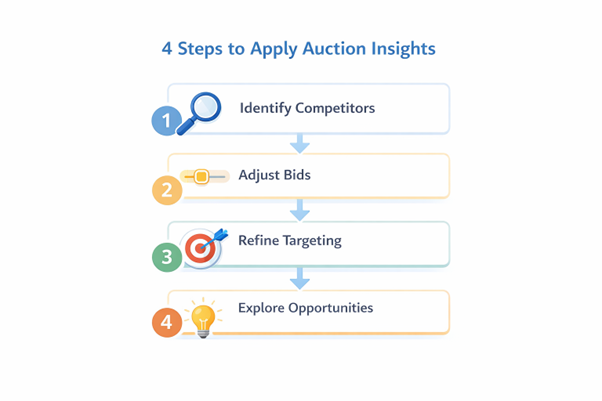
When performance drops, Auction Insights can help diagnose causes. It answers the question: Is competition the problem?
Common diagnostic scenarios include:
Scenario 1: Impression Share Drops Suddenly
This may indicate:
Scenario 2: Position Above Rate Increases
This often suggests competitors improved bids or Quality Score. It may also indicate that your ads became less relevant.
Scenario 3: Overlap Rate Increases With New Advertisers
This usually happens during seasonal surges or promotions. Not all new competitors will stay long-term.
Auction Insights helps separate internal issues from market changes.
Auction Insights indirectly supports Quality Score optimization. It highlights where relevance improvements can reduce competition pressure.
If competitors consistently outrank you despite similar bids, Quality Score is often the differentiator.
Focus on improving:
Improving Quality Score does more than reduce CPC. It improves your ability to compete without overspending.
Auction Insights confirms whether those improvements are working. A declining position above the rate often signals progress.
Auction Insights is powerful, but easily misunderstood. Avoiding these mistakes protects your account performance.
Mistake 1: Chasing Absolute Top Position
The top position is not always the most profitable. Visibility does not guarantee better results.
Mistake 2: Matching Competitor Behavior
Competitors may be unprofitable or aggressive without a strategy. Do not assume their behavior is optimal.
Mistake 3: Reacting to Short-Term Spikes
Temporary competitors often disappear quickly. Wait for consistent trends before changing strategy.
Mistake 4: Ignoring Business Context
Auction data without performance context is incomplete. Always pair it with conversion and revenue data.
Avoiding these errors turns Auction Insights into a strategic advantage.
Consistency matters more than intensity. A simple, repeatable review process works best.
A recommended monthly workflow includes:
Document insights instead of reacting immediately. Patterns become clearer over time with documentation.
This process transforms Auction Insights from a report into a strategic decision-making tool.
Auction Insights helps beyond short-term bidding decisions. It supports long-term planning when used with patience and structure. Over time, patterns reveal how competitors grow or retreat. Some brands slowly increase presence across multiple campaigns. Others appear briefly during promotions and disappear afterwards.
Tracking these movements supports smarter annual planning. You can forecast where competition may intensify next. This helps allocate the budget before pressure becomes aggressive.
Long-term data reduces emotional reactions. It encourages strategic thinking instead of constant bid changes.
Not every advertiser appearing in Auction Insights is a true competitor. Some overlap due to broad matching or temporary testing.
True competitors show consistent patterns across time. They appear frequently and across multiple campaigns. They often maintain similar impression share levels.
Temporary advertisers usually show:
Filtering out noise prevents wasted analysis time. Focus only on advertisers impacting your core business goals.
This keeps insights actionable and efficient.
Auction Insights behaves differently across match types. Understanding this difference improves interpretation accuracy. Broad matches attract wider auction participation. This increases the overlap rate and competitive variability.
An exact match reflects more intentional competition. Advertisers here usually target the same audience precisely. Phrase match sits between both extremes. It often reveals expansion-focused competitors.
Reviewing insights by match type prevents misinterpretation. It helps identify whether competition is strategic or accidental.
Not all keywords serve the same funnel stage. Auction Insights must be read with intent awareness.
Top-of-funnel keywords attract exploratory searches. Competition here is usually broader and less stable. Mid-funnel keywords show comparison behavior. Competitors here focus on visibility and positioning. Bottom-of-funnel keywords indicate purchase readiness. Competition here is intense but often more profitable.
Using funnel context prevents incorrect conclusions. It also helps prioritize optimization efforts correctly.
Auction Insights supports benchmarking, not imitation. Blindly copying competitors leads to inefficient spending. Benchmarking focuses on understanding relative position. It answers whether you are underexposed or overspending.
Healthy benchmarking questions include:
Avoid copying bids, budgets, or messaging blindly. Your business model and margins differ from those of competitors.
Auction Insights informs strategy, not replication.

Auction Insights plays a role in smarter budget distribution. It highlights where competition limits scalable growth. High competition with low returns signals caution. Moderate competition with strong performance signals an opportunity.
Budget can then shift toward efficient segments. This improves overall account stability and predictability.
Using insights this way prevents budget waste. It also protects high-performing campaigns from neglect.
Auction Insights shows who you compete against. Search term reports show why those auctions happen. Together, they create a deeper understanding. You may find competitors overlapping on irrelevant queries. This indicates match type or keyword expansion issues.
Cleaning search terms reduces unnecessary overlap. It improves relevance and Quality Score over time.
This combination strengthens efficiency without increasing bids.
Scaling introduces new competitive dynamics quickly. Auction Insights helps monitor stability during expansion. As budgets increase, new competitors often appear. Some keywords attract stronger brands at higher spend levels.
Monitoring overlap rate prevents surprise inefficiencies. It helps adjust pacing before performance declines.
Scaling becomes controlled instead of reactive. This reduces risk during aggressive growth phases.
A structured playbook ensures consistent usage. It standardizes how teams interpret and act on insights.
A strong playbook includes:
This removes guesswork from optimization. It also supports better collaboration across teams. Auction Insights becomes part of the daily operations.
Auction Insights is not a bidding weapon. It is a decision-support system for smarter advertising. Used correctly, it reduces waste and improves clarity. It helps choose where competition is worth engaging.
The goal is not to win every auction. The goal is profitable and predictable growth.
If you want a platform that connects Auction Insights with funnel behavior and competitive signals across channels, start with CausalFunnel. The platform is built for linking competitive intelligence with real performance impact.
Consistent review, alignment with performance data, and strategic patience unlock long-term competitive advantage in digital advertising.
Auction Insights in Google Ads shows how your ads stack up against others in the same auctions. You can see how often your ads appear, who shows up with you, and who is above you. It helps you understand who you are really competing with.
Yes, it still helps if the ad budget is small. You can spot keywords where big advertisers dominate and avoid wasting money there. That makes it easier to use a small budget wisely.
Sometimes yes. It may show new competitors entering your auctions or others raising their bids. That can explain drops that are not caused by changes in your own account.
Not always. Being higher does not always mean better results. Increase bids only if it makes sense for your goals and returns.
Many run short tests or stop when budgets run out. Some leave after poor results. Focus on the ones that appear regularly. Those are your real competitors.
Start using our A/B test platform now and unlock the hidden potential of your website traffic. Your success begins with giving users the personalized experiences they want.
Start Your Free Trial

Empowering businesses to optimize their conversion funnels with AI-driven insights and automation. Turn traffic into sales with our advanced attribution platform.


