



Free Funnel Audit
Convert more customers today!
SEO
10 mins read

SEO
10 mins read
Your page can have the right keywords, solid backlinks, and decent technical SEO, yet still sit on page three because the writing gives people no reason to stay. This is something that most marketers face daily.
Good SEO web writing is not about stuffing phrases into headings anymore. It is about keeping readers engaged long enough for Google to trust the page. If visitors leave after twenty seconds, rankings usually slide with them.
A lot of sites still follow old SEO best practices. Add keywords, stretch the word count, drop in a few links, and then hope Google notices. But the search changed, and reader habits changed too. People now decide in seconds whether a page feels worth their time.
Think about the last article that kept you reading. It probably felt clear, useful, and easy to scan. That is what most SEO guides miss. They teach optimization checklists, but rarely teach writing, and that gap matters now.
In this guide, we’ll address those gaps so you can write a piece that Google actually values and ranks.
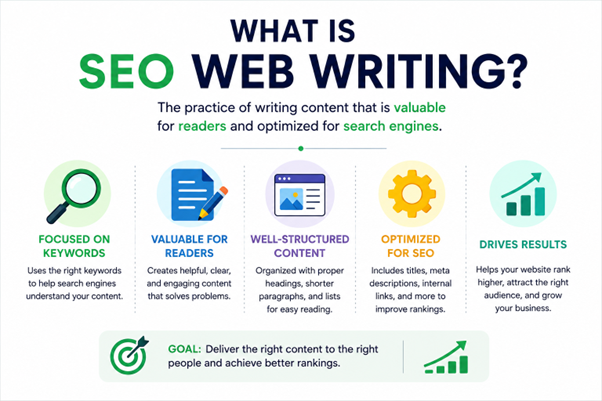
SEO web writing means creating pages that rank well on Google while still feeling easy and useful to read. Good seo web writing helps search engines understand the page, but it also keeps real people scrolling, clicking, and staying longer.
A lot of people think SEO writing is just adding keywords, but that was closer to true years ago. Now, Google has become much better at spotting pages that feel stiff, repetitive, or written only for rankings.
Think about two blog posts on the same topic. One sounds robotic and stuffed with phrases, while the other answers questions clearly, uses short paragraphs, and feels natural to read. Which one would people trust more after thirty seconds? That answer usually predicts which page performs better long-term.
Strong SEO web writing blends three things together:
It also helps pages earn more clicks and longer dwell time. Those signals matter, especially during the present time, when AI-generated filler content floods search results daily.
Good SEO writing does not sound “optimized.” It sounds helpful, and that is the difference many brands still miss.

Matching search intent is not about writing what you think the reader wants. It is about spotting what they expected to find the second they clicked your page. If that expectation breaks, rankings slide very quickly.
A page fails at search intent when readers bounce after a few seconds or never click in the first place. To fix it, the page must answer the exact question behind the search before drifting into extra detail. Google notices those patterns quickly, and so do readers.
A common example shows up in Google Search Console. A page gets 8,000 impressions but barely any clicks. The title promised one thing, but the content delivered another. That gap hurts more than weak keyword use.
Think about someone searching for “best budget hiking boots.” They do not want a history lesson about hiking gear. They want prices, comfort notes, durability, and real trade-offs near the top. If you miss delivering that information, the page loses trust instantly.
This matters even more when writing SEO content for crowded search terms. Searchers already saw ten similar headlines before yours, and if your intro rambles, they leave.
Here is the practical way to judge intent while drafting:
Google’s crawlers pay close attention to the first 100 words of a page. In fact, most ranking audits reveal the same thing. Strong pages answer early, while weak pages warm up too long.
Most writers build their outline after they decide what to say. But that is the wrong order.
Good headings do more than organize ideas. They tell Google what each section answers. A weak heading acts like a file folder label, while a strong heading sounds like a real search query. Readers move through it faster because the structure feels useful instead of academic, eventually helping dwell time too.
A lot of low-ranking articles share one ugly pattern. The headings feel broad and lifeless. Some of the examples are “Benefits of SEO,” “Why SEO Matters,” and “Content Tips.” None of those creates urgency, and none sound like something a person would search for during a real problem.
Google also scans heading relationships to understand topic depth. If every heading feels generic, the page looks shallow even when the article is long. That happens constantly with AI-assisted drafts. They might sound polished, but they say nothing.
Compare these examples:
The heading should promise an answer, and not just label a section.
The keyword density debates are mostly a distraction. What actually matters is whether your sentence reads like a sentence.
People still ruin good pages by forcing keywords into awkward spots. It sounds robotic immediately, and readers notice it before Google does. Once this is spotted, trust drops, and scroll depth usually drops too.
A simple read-aloud test catches most over-optimization. Read the paragraph slowly and think, “Would a normal person speak that way?” If the sentence sounds like a cheap ad, rewrite it.
For example, this sentence feels stiff: “Our SEO web writing services improve SEO web writing rankings through advanced SEO web writing methods.” Nobody talks like that.
Now compare it to this: “Strong SEO pages rank better when the writing feels clear and useful.” Same idea, but with a much better flow.
This is why keyword placement still matters. Just not in the old spammy way people remember from 2015.
Here are three places where keywords still fit naturally in strong pages:
In many audits, pages with lower keyword density still outrank stuffed pages because readers stay longer. Why does this matter? Because user behavior became part of the quality signal years ago.
High-quality content is not a writing standard. The actual standard is readability.
Readable SEO writing uses short, clear sentences with varied rhythm. It avoids walls of text, repetitive phrasing, and fake corporate tone. Readers should glide through the page without slowing down to decode the wording.
That sounds obvious, yet most low-ranking pages still feel exhausting after two paragraphs. The sentences drag, and every idea gets stuffed into one long line. Readers stop scanning and leave, hurting dwell time.
Google does not directly score “great writing.” It measures behavior. If visitors leave after 20 seconds, the page fails. It does not matter how perfect the keyword placement looked.
In 2026, AI-assisted content detection and Google’s helpful content signals make readable, human-sounding prose far more important than before. Pages that sound repetitive now struggle faster, especially after core updates.
Sentence rhythm matters more than most writers realize. Short sentences create momentum, while medium sentences add detail. One longer sentence can slow the pace slightly before another punch sentence resets the flow. That pattern keeps readers engaged.
Compare this:
“SEO writing is important because it improves rankings and helps businesses grow through increased search visibility and organic traffic acquisition.”
Now compare it to this:
“SEO writing helps pages rank higher. But rankings alone do not matter. People still need to enjoy reading the page.”
There’s a huge difference.
Every H2 is an answer waiting to be indexed, but most writers treat it like a heading.
Google often pulls featured snippet answers from the first sentence under a heading. That means the opening line after your H2 matters a lot. If it answers the question directly, the page has a real shot at visibility boosts.
Many weak articles waste that spot, building suspense instead of clarity. But readers and search engines hate that.
Think about how people search. They skim fast, jumping between sections. A clear first sentence helps both the reader and Google understand the section immediately.
Here is the difference:
A lot of strong SEO web writing follows this pattern naturally. The page feels easy to skim because each section solves one clear problem.
Link intentionally, or do not link at all.
Most internal links get added after the draft is done. That creates weak anchor text like “click here” or “learn more.” Those links waste context, and Google learns almost nothing from them.
Strong internal links feel baked into the sentence itself. The anchor text explains the linked topic naturally. Readers understand what waits on the other side before clicking.
For example, “learn how search intent affects rankings” works far better than “read this article.” One explains value, while the other feels empty.
Internal linking also helps with topical authority. When several pages connect around the same subject, Google better understands the depth of your site. That matters more in competitive spaces now.
This is one area where tools from CausalFunnel can help marketers spot content gaps and user behavior trends faster.
Pages with poor engagement often reveal weak linking patterns too. A smart internal link should help the reader first, and think about rankings after.
Your best SEO move in 2026 is probably not writing anything new.
A huge number of sites already own pages sitting on page two of Google. Those pages often need tiny fixes, not full rewrites. These changes could be in sections such as a stale intro, weak headings, old examples, thin answers near the top, or small updates can move rankings surprisingly fast.
Publishing a brand-new article on the same topic often creates keyword overlap instead. Then both pages struggle. Sound familiar? It happens constantly on large blogs.
Today, Google’s ranking signals favor pages that stay current more aggressively than before. Freshness alone will not save weak content, but updated relevance still matters.
Here is a simple way to decide what to refresh first:
Do not rewrite everything blindly. Keep the sections already performing well, and fix the weak spots instead.
Behavior data helps here, too. Platforms like CausalFunnel help marketers track how visitors move through content and where engagement drops. Those insights often reveal why older pages stopped climbing.
Strong rankings rarely come from clever tricks anymore. They usually come from pages that feel useful the second someone lands on them. Clear answers, natural language, smart structure, and readable sentences still beat bloated SEO formulas every time.
A lot of brands keep chasing more content when the real problem sits inside the writing itself. Weak intros, robotic keyword placement, generic headings, and stiff sentence flow quietly push readers away before the page even has a chance to rank properly. That is where strong SEO writing changes everything.
The next time a page struggles, do not just ask whether the SEO is broken. Ask whether the content actually gave someone a reason to keep reading.
SEO web writing means creating content that ranks well on search engines while still sounding natural to readers. Good SEO writing answers search questions clearly, uses keywords naturally, and keeps people engaged on the page longer.
Regular blog writing often focuses only on the topic. SEO web writing also considers search intent, keyword placement, heading structure, internal linking, and readability. The goal is not just to inform readers. It is to help the page get found first.
The best length depends on the search intent and competition. Some topics rank with 800 words, while others need 2,500. A strong page answers the question fully without adding filler just to hit a word count.
Many pages fail because the writing feels hard to read or does not match user intent. People leave quickly when the content sounds robotic, repetitive, or vague. That behavior sends weak engagement signals back to Google.
Update pages when rankings drop, search intent changes, or the information becomes outdated. Small fixes often work best first. Refresh headings, improve the intro, update examples, and tighten weak sections before rewriting the full page.
Yes, but only if the content feels useful, readable, and original. Google focuses more on quality than on how the draft was created. Thin AI-written pages with repetitive phrasing usually struggle after updates.
Start using our A/B test platform now and unlock the hidden potential of your website traffic. Your success begins with giving users the personalized experiences they want.
Start Your Free Trial

Empowering businesses to optimize their conversion funnels with AI-driven insights and automation. Turn traffic into sales with our advanced attribution platform.
Trusted by Customers


©CausalFunnel Inc. All rights reserved.