



Free Funnel Audit
Convert more customers today!

SEO
10 mins read

SEO
10 mins read
Most websites don’t fail because of bad content. They fail because no one ever finds them in search.
That’s where things get interesting. Because once you understand SEO ranking factors, everything starts to make sense. You begin to see why some pages show up on top, and why others stay buried no matter how good they are.
This guide explains SEO ranking factors in a clear and structured way. It also covers the key Google ranking factors that influence visibility today.
The focus is on simplicity and practical understanding. You will get a direct, step-by-step view of how search works. If you want deeper insights into user behavior and conversions, explore CausalFunnel for smarter optimization support.
SEO ranking factors are signals Google uses to rank pages and help decide which page shows first. They also define how visible your site becomes online. Better signals often lead to higher search rankings.
Modern Google ranking factors are more advanced than before. They now include AI-based evaluation and user behavior. Google does not rely on one single signal anymore. It uses many combined signals to judge page quality.

Appearing at the top of search engines has become more competitive than ever before. Millions of pages compete for the same keywords daily. Strong ranking factors help your page stand out, and weak signals push your page deeper in search results.
Here are the factors that directly influence rankings:
If your page ranks higher, traffic grows faster. That is why SEO is still very important.
Google follows a simple system to rank pages, but the process behind it is highly complex. It includes three main steps:
Google uses automated bots to scan websites across the internet. These bots follow links and discover new or updated pages constantly. They also check how often your site updates its content. A well-structured site helps bots crawl pages more efficiently.
After crawling, Google stores your content in its database. It organizes pages based on topics, keywords, and relevance. Only indexed pages are eligible to appear in search results. If a page is not indexed, it cannot rank at all.
Google compares indexed pages for each search query. It evaluates content quality, relevance, and user experience signals. Then it orders results based on overall value and usefulness. Pages with stronger ranking signals appear higher in search results.
Below is a quick breakdown of how it works:
Stage | What Happens | Why It Matters |
Crawling | Google finds pages | Page discovery |
Indexing | Stores page data | Search eligibility |
Ranking | Orders results | Visibility control |
This process decides your search position. That is why SEO optimization is essential today.
Google ranking factors are signals used during ranking. They help decide which page should rank higher. These include content quality, speed, and backlinks. They also include trust and user engagement signals.
Google updates these factors regularly over time. That means SEO strategies must also evolve.
Google uses multiple categories of signals:
Each factor works together as a system. No single factor guarantees top rankings.
Search is no longer just “10 blue links.” AI now shapes how results appear on Google. Google uses AI Overviews and smart summaries. These systems pick pages with strong trust signals.
This makes SEO ranking factors more important than ever. Only high-quality pages get featured in AI results.
Google now focuses on search intent first. Keywords alone cannot guarantee top ranking anymore. Pages must clearly answer user questions. They must also deliver complete and helpful information. This shift improves search quality for users. It also rewards helpful and clear content.
Without strong signals, ranking becomes very hard. Even good content may stay invisible. Strong Google ranking factors improve visibility faster. They also build long-term organic traffic.
If your site is new, SEO is critical. If your site is old, optimization is still needed.
You can improve rankings by focusing on the basics first. Strong foundations always bring better results.
Start with these steps:
Google uses many signals to rank web pages. Some signals are more important than others today. These core factors shape most search rankings:
Each factor works together for better rankings. No single factor can guarantee top positions.
Page speed is a strong ranking factor today. Slow websites often lose search traffic quickly. Google measures speed using Core Web Vitals. These metrics show real user experience quality.
Metric | What It Measures |
LCP | Loading performance |
INP | Interaction speed |
CLS | Visual stability |
Fast websites improve user satisfaction instantly. They also reduce bounce rates significantly.
Speed is now a basic SEO requirement. Without it, rankings become harder to achieve.

Google now uses mobile-first indexing by default. It checks the mobile version of your site first. This makes mobile optimization very important today. Most users browse from mobile devices now.
Mobile usability is a major SEO ranking factor. Poor mobile experience lowers your rankings quickly.
Content quality is one of the strongest ranking signals. Google prefers helpful and clear information.
This is based on E-E-A-T principles:
High-quality content builds strong SEO performance and improves Google ranking factors impact.
Good content keeps users engaged longer, which improves rankings naturally over time.
Backlinks are links from other websites that act as trust signals for Google. High-quality backlinks improve domain authority and boost search engine rankings.
Backlinks remain a key SEO ranking factor. They show that your content is valuable.
On-page SEO helps Google understand your content. It improves visibility for target keywords.
Good on-page SEO supports Google ranking factors. It makes your content easier to index. Easier indexing ensures your page is quickly discovered and added to Google’s database so it can appear in search results. Without proper indexing, your content remains invisible, no matter how good it is.
Technical SEO ensures your site runs properly. It supports crawling and indexing by Google.
Technical SEO is a foundation ranking factor. Without it, even good content may not rank.
All ranking factors work as a system. They do not function individually.
For example:
Balance is very important for SEO success. That is how Google evaluates websites today.
Factor Type | Impact Level | Importance |
Content Quality | Very High | Essential |
Backlinks | High | Authority Building |
Page Speed | High | User Experience |
Mobile SEO | High | Ranking Stability |
Technical SEO | Medium–High | Indexing Support |
Many websites fail due to weak basics. They ignore core SEO ranking factors. Common problems include:
Fixing these improves rankings quickly. Small improvements can create big changes.
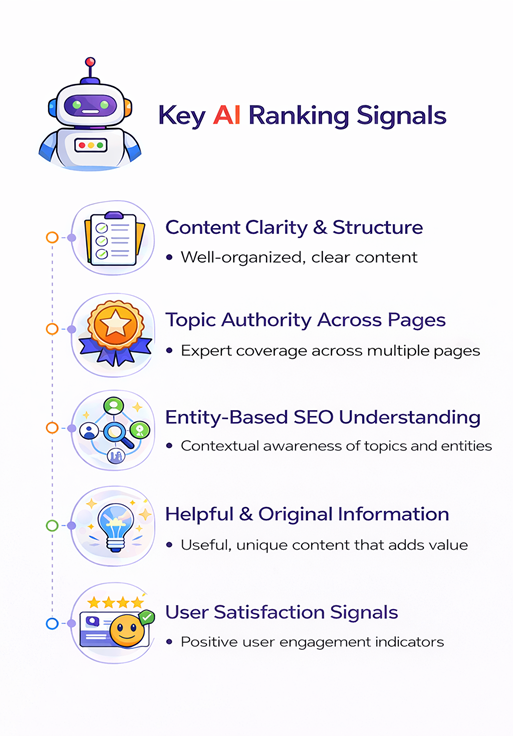
Search is no longer only keyword-based. AI now helps Google understand content deeply. This affects how SEO ranking factors are applied today. Google focuses more on meaning and context.
AI systems prefer content that answers fully. Short and unclear content ranks lower now.
AI Overviews are summaries shown in search results. They combine answers from multiple trusted pages. Google selects content based on strong ranking signals. This includes both Google ranking factors and trust signals.
To appear in AI results, content must be:
AI search rewards helpful content over keyword stuffing. This is a major SEO shift in 2026.
These advanced factors influence modern search visibility and long-term SEO growth.
Google tracks how users interact with pages. These signals affect rankings directly.
Better user experience improves SEO performance and strengthens the impact of Google ranking factors.
Topical authority means deep knowledge in one area. Google prefers websites with focused expertise.
This increases trust and search visibility and strongly supports SEO ranking factors.
Google now understands entities, not just keywords. They are people, places, and concepts. This improves search understanding deeply and boosts relevance in AI search.
Entity SEO is now a key ranking factor in modern Google ranking factors.
Strong brands rank higher in search results. Google trusts known websites more.
Brand strength supports long-term SEO growth and reduces ranking volatility over time.
Schema helps Google understand your content better and adds extra meaning to your pages.
Schema is a strong technical SEO factor that supports SEO ranking factors indirectly.
Many websites lose traffic due to simple mistakes. Avoiding them improves performance quickly.
These reduce your search visibility over time. Fixing them improves rankings faster.
Follow this simple SEO approach:
This strategy supports long-term growth. It also strengthens the impact of Google ranking factors.
SEO has evolved into a more intelligent system. It is no longer focused only on keyword placement. Modern search engine ranking factors focus on usefulness and trust. Google now prioritizes content that truly helps users.
Today’s Google algorithm ranking signals are highly advanced. They measure quality, intent, experience, and technical performance together.
To succeed in organic search, focus on these areas:
All search visibility factors work as a connected system. No single element can guarantee top positions anymore. Google evaluates pages using multiple ranking systems together. These systems reward relevance, trust, and user satisfaction.
Websites that prioritize users consistently perform better in rankings. Helpful content always wins in long-term organic growth. To improve performance and track real user behavior, you can explore CausalFunnel for smarter optimization insights.
SEO ranking factors are signals used by Google to evaluate and rank web pages. They include content relevance, page experience, backlinks, and technical performance. These search engine ranking signals determine how visible a page becomes in results.
The most important Google algorithm ranking signals include helpful content, mobile usability, page speed, Core Web Vitals, E-E-A-T, and backlink quality. These factors directly influence organic search performance.
Google uses hundreds of search ranking signals across different systems. These signals work together to evaluate relevance, authority, and user experience. No single factor alone controls rankings.
Search engine ranking factors decide how high a page appears in results. Better optimization leads to improved visibility, traffic, and engagement. Strong signals help websites achieve stable long-term rankings.
Some organic ranking factors can improve quickly with fixes. Improving speed, content clarity, and mobile experience helps immediately. However, strong rankings require consistent long-term SEO effort.
Start using our A/B test platform now and unlock the hidden potential of your website traffic. Your success begins with giving users the personalized experiences they want.
Start Your Free Trial

Empowering businesses to optimize their conversion funnels with AI-driven insights and automation. Turn traffic into sales with our advanced attribution platform.
Trusted by Customers


©CausalFunnel Inc. All rights reserved.