



Free Funnel Audit
Convert more customers today!

SEO
10 mins read

SEO
10 mins read
Have you ever wondered why your website gets traffic but no results?
You’re using all possible elements, modern fonts, designs, and images, yet your website isn’t performing the way it should. When this happens, many businesses assume that design alone will fix weak results. But that is rarely true in real business situations today.
A website revamp is not just changing colors or layout. It’s more like improving traffic quality and user experience while also aiming to increase conversions and business outcomes.
Website revamping isn’t only done when a website looks outdated. It is usually done when businesses struggle with low engagement and weak conversions. But these issues can be fixed.
In this guide, we will share tips and tricks to revamp your website with a clear and practical roadmap. And by the end, when you’re done reading this guide, you’ll have an idea about where you were going wrong and how things can be fixed.
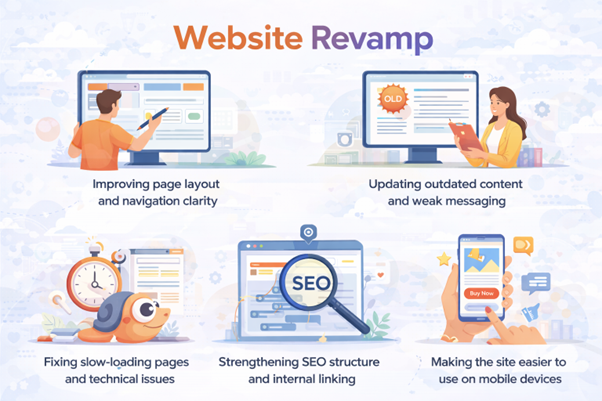
A website revamp is a complete improvement of your existing website. It focuses on performance, not just visual changes or trends. The revamp also includes updates to design, content, and structure. This also improves user experience, speed, and conversion flow.
The basic idea of a website revamp is to look at how users interact with your website. It fixes issues that stop visitors from taking action.
This can include:
Unlike a simple redesign, a revamp solves deeper problems, which include aligning your website with your current business goals.
Here is a simple example to understand it better:
Imagine you run an online service business website. Your site looks clean, but conversions are very low. Users visit your homepage but leave within a few seconds because they do not understand what you offer clearly.
After a website revamp, you make these changes:
Now users stay longer and explore more pages, clearly understand your offer, and start taking action. This is what a website revamp actually does. It improves how your website works, not just how it looks.
A good revamp turns your website into a conversion tool and not just a digital brochure that sits without results. It connects user needs with business outcomes and helps turn visitors into leads, customers, or subscribers.
So, this is something that most people mistake website revamp for, as they all sound a bit similar; however, they are not. When you clearly understand the difference, it helps you choose the right approach.
A website refresh is what it sounds like. You’re just refreshing it with the smallest level of change, focusing on light visual updates and minor improvements.
A website redesign is a bit of a step forward. Here, you change the layout, design system, and visual identity.
Finally, a website revamp is the most complete upgrade. It’s a whole new rework done on your website where you improve strategy, structure, content, and performance together.
Here is a simple comparison to make it clearer:
Aspect | Website Refresh | Website Redesign | Website Revamp |
Scope | Small visual updates and quick fixes | New layout and improved visual experience | Full strategic and functional improvement |
Impact | Limited impact on performance or conversions | Moderate impact on user engagement | Strong impact on traffic, UX, and conversions |
Changes Involved | No major changes to structure or content | Some updates to content and structure | Includes SEO, content, and technical updates |
If your site has deeper issues, a refresh will not help much. A redesign may improve looks but miss core problems. A website revamp solves both surface and deeper challenges. It gives your business a stronger and more reliable foundation.
You can’t just do a revamp any time you need. It shouldn’t be done too early nor too late. Many businesses wait too long before taking action. At the same time, others rush into changes without clear reasons or goals. A website revamp should solve real problems, support growth, not trends or just visual updates.
Here are clear signs that your website needs a revamp:
These signs often point to deeper issues in your site, and ignoring them can lead to lost traffic and missed revenue. However, not every issue requires a full revamp. Sometimes, small fixes can solve specific problems quickly.
You should know how to connect problems with business impact. If your website limits your business’s growth, a revamp becomes necessary. Doing a revamp on your website at the right time improves both user experience and results and helps your website support your next stage of growth.
Many businesses rush into a revamp without proper planning. This often leads to wasted time, money, and poor results. To get the best results, a website revamp should be strategic, not emotional or reactive. Avoiding common mistakes can save you from major setbacks.
Here are the biggest mistakes brands make before revamping a website:
Teams start redesigning without knowing what success looks like. This leads to confusion and weak results after launch. You don’t know what’s working and what’s not, and that doesn’t lead anywhere.
A better design does not fix poor messaging or weak structure. Modern design and text or sophisticated sentences don’t always cut it. Performance improves only when deeper issues are addressed.
What works for others may not work for your audience. Blind copying often leads to generic and ineffective websites. You can copy your competitors, but only choose what might work according to your business, and only use them on your website for better results.
Many sites look good, but feel confusing to navigate. Since attention span is decreasing day by day, and visitors want quick answers without scrolling much, users leave when they cannot find what they need quickly.
If your value is not clear, visitors will not convert. Messaging should guide users, not confuse them further. Usually, using high-end words and sentences does this. Make sure to keep things simple.
A revamp needs time to show real performance improvements. You can only see the growth and actual results when you give it some time. It comes from testing, learning, and optimizing consistently.
Avoiding these mistakes gives your revamp a strong foundation, helping you focus on results instead of surface changes.
A successful revamp starts with clear and structured planning. It should balance business goals with real user needs. Therefore, you need to align strategy, content, and technical execution. Each part plays a role in overall performance and growth.
A strong plan focuses on:
When these elements work together, results improve naturally. Your website becomes easier to use and more effective.
A website revamp works best with a clear step-by-step process. It helps you avoid confusion and stay focused on outcomes. This checklist covers every important stage of the revamp.
It includes planning, execution, and post-launch improvements.
Follow these steps to revamp your website the right way.
Before making changes, you need to understand current performance. A data-driven audit helps you avoid blind decisions.
You can start by reviewing how your website performs today. Look at traffic, engagement, and conversion patterns closely.
Focus on these key areas:
Use tools to gather reliable data and insights:
Identify your best and worst performing pages, as this can help you protect what works and fix weak areas. A strong audit builds a solid foundation for your revamp and ensures every decision is backed by real data.
Without clear goals, your revamp will lack direction. You need to define what success looks like early. Start by linking your website to business outcomes, focusing on goals that drive real growth and value.
Common goals include:
Use simple and measurable KPIs like ROI and CTR to track progress. Make sure your goals are realistic and time-bound, as clear goals help teams stay aligned during execution.
They also make it easier to measure real impact later.
Revamping a website should always start with the user. All in all, your website is built to solve real problems for real people. If you ignore your audience, your site will not convert well. Therefore, understanding their journey helps you design better experiences.
Start by identifying who your ideal users really are. Focus on their needs, goals, and decision behavior.
Look at these key factors:
Map your pages to each stage of the journey:
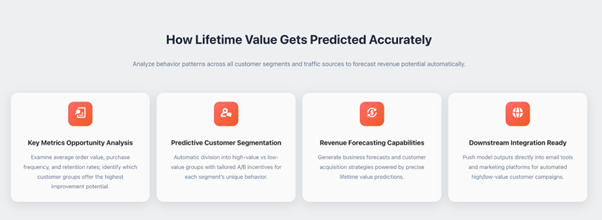
Mapping this journey manually can be difficult and time-consuming. This is where tools like CausalFunnel can help significantly. It uses AI to identify high-intent users and behavior patterns. You can clearly see where users drop off or lose interest. This makes it easier to fix weak points in your website flow. You can design pages based on real user behavior, not guesses.
When your site matches user intent, performance improves, visitors feel understood, and move forward with confidence.
A clear structure makes your website easy to navigate. It also helps search engines understand your content better.
Many websites fail because their structure feels confusing, and users get lost and leave without taking action. Start by reviewing your sitemap and page hierarchy, and make sure your structure reflects current business priorities.
Focus on these key areas:
Your key pages should include:
A strong structure improves both SEO and user experience and makes your website easier to scale in the future.
Good design is not just about how things look. It is about how easily users can interact with your website. Your website should feel simple, clear, and easy to use. Every design choice should support user action and clarity.
Focus on these key improvements:
Also, improve important interaction elements:
A better user experience reduces friction and confusion, helping users move smoothly toward conversion goals.
Many websites talk too much about themselves. This creates confusion and reduces engagement quickly. Your messaging should focus on the customer first. It should clearly explain how you solve their problems.
Start by improving your core pages:
Keep your messaging simple and direct:
To make this even stronger, use real user insights. This is where CausalFunnel adds clear value. It analyzes user behavior and intent patterns using AI. You can understand what messaging actually connects with users. Instead of guessing headlines, you rely on real data. This helps you create copy that feels relevant and clear.
Strong messaging builds trust and drives better decisions. It helps users feel confident in choosing your business.
One of the biggest risks in a website revamp is losing SEO. Many businesses lose traffic because they ignore this step. You need to protect your existing rankings carefully. Which is why SEO should be part of your plan from the start.
Follow these important steps to avoid SEO loss:
Also, monitor performance after the revamp goes live. Watch for drops in traffic or ranking changes quickly. SEO protection is not optional during a revamp process, as it ensures your hard-earned visibility stays intact.
A website revamp is not only about design and content. Technical setup plays a critical role in overall success. You need a stable and efficient backend environment. This ensures your website works smoothly after launch.
Focus on these technical areas:
Performance should also be a priority:
Technical issues can break user experience quickly. Hence, fixing them early prevents major problems later.
The final stage of your revamp is critical for success. A rushed launch can undo all your hard work. Before launching, test everything carefully across devices. Ensure your website works smoothly in real scenarios.
Run these important checks before going live:
After launch, continue monitoring performance closely. Track changes over the next 30, 60, and 90 days. Focus on key metrics such as traffic and conversions, and look for improvements and areas that still need work.
A successful launch is not the end of the process. Continuous optimization leads to long-term growth.
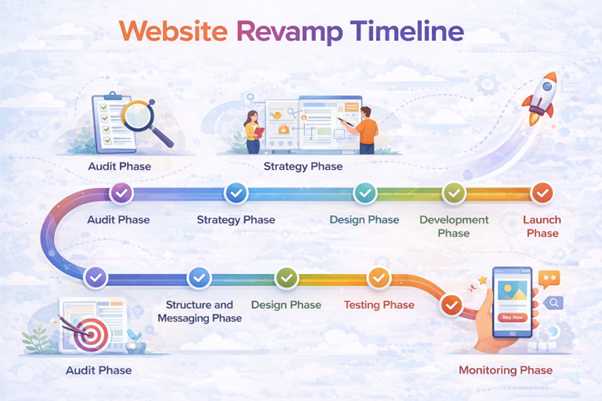
A clear timeline makes the revamp process easier to manage. It helps teams stay organized and avoid unnecessary delays. You do not need a complex plan to get started.
A simple phase-based approach works well for most projects.
Follow this basic timeline for a smooth website revamp:
This simple timeline keeps your project structured and focused, and reduces confusion during execution.
Even a well-planned revamp can fail due to simple mistakes. But avoiding these errors can save time and resources.
Here are the most common mistakes you should watch for:
Each of these mistakes can reduce your website’s impact and can also slow down your growth and performance. A successful revamp requires both strategy and execution, and avoiding these pitfalls helps you achieve better outcomes.
A website revamp is not just about making your site look better; it’s about improving how your website performs in real situations. The goal is to create a better experience for your users. This leads to stronger engagement and higher conversions.
A well-planned website revamp improves clarity and usability, protects your SEO, and supports long-term growth. When done right, your website becomes a strong business asset, helping you to attract, engage, and convert the right audience.
With CausalFunnel, you can identify high-intent users, optimize your messaging, and improve your conversion rates faster. Instead of guessing what works, you act on real user behavior insights. That is what turns a website revamp into a growth engine.
Affinity and custom affinity audiences are usually the best starting point because they balance reach and relevance.
Yes, in most cases. Affinity focuses on behavior and interests, which are more reliable than basic demographics.
Start broad enough to scale, but keep it relevant. Avoid making your audience too narrow.
It depends on your audience. Google works well for scale. Meta works for engagement. LinkedIn works for B2B targeting.
Start using our A/B test platform now and unlock the hidden potential of your website traffic. Your success begins with giving users the personalized experiences they want.
Start Your Free Trial

Empowering businesses to optimize their conversion funnels with AI-driven insights and automation. Turn traffic into sales with our advanced attribution platform.
Trusted by Customers


©CausalFunnel Inc. All rights reserved.