



Free Funnel Audit
Convert more customers today!

SEO
10 mins read

SEO
10 mins read
Customers expect smooth and easy experiences today. They notice how a brand makes them feel during every interaction, and compare brands based on experience, not just the product. One bad interaction can push them away quickly.
At the same time, businesses collect a lot of customer data daily, but most teams struggle to use that data in a useful way. Data is only helpful when it leads to clear action.
That is where customer experience analytics comes in. It helps teams understand customers and improve every interaction.
In this guide, you will learn how customer experience analytics works and how it drives better results.
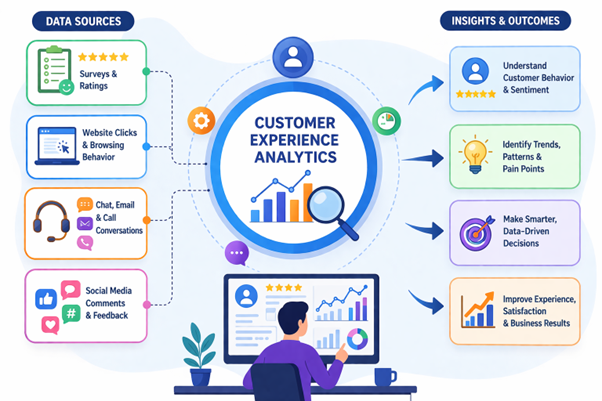
Customer experience analytics is the study of customer data from different touchpoints. It helps you understand what customers do, feel, and expect. This data, which comes from many places across the business, includes both structured and unstructured data types.
For example, it can include:
All this data is combined into one clear view to make it easier to understand the full customer picture. It also connects closely with customer journey analytics. Both help you see how customers move across different stages.
Here’s the difference between the two. Customer journey analytics shows the path customers take, and customer experience analytics shows how they feel on that path. Together, they give a complete understanding of the customer.
Now think about this for a moment. Customers have more choices than ever before. If your experience is slow or confusing, they will leave. This is why customer experience matters so much today.
Here’s how it helps businesses:
It also strengthens customer behavior analytics across channels. This helps teams understand actions, not just opinions. In simple terms, it helps you stop guessing and start making decisions based on real data.
Many people mix up these two terms at first. They sound similar but serve different purposes. Let’s break it down in a simple way.
Customer experience analytics focuses on overall customer feelings. It looks at satisfaction, feedback, and emotional signals. Customer journey analytics focuses on the path customers take. It tracks steps, clicks, and movement across touchpoints.
Here is a simple comparison:
Aspect | Customer Experience Analytics | Customer Journey Analytics |
Focus | Customer feelings and feedback | Customer actions and paths |
Data | Sentiment, reviews, behavior | Clicks, steps, drop-offs |
Goal | Improve experience quality | Improve journey flow |
Both are important and work best together, and give a complete view of the customer experience. Use customer journey analytics to find where users drop off. Then use experience analytics to fix those weak points.
To understand customers well, you need the right data. But one data source is never enough. Different sources show different parts of the experience. When combined, they create a full picture. This is where omnichannel analytics becomes important.
Here are the main data sources:
Data Source | What It Shows | Why It Matters |
Conversations | Customer issues and sentiment | Improves service quality |
Surveys | Satisfaction and opinions | Tracks customer happiness |
Behavioral Data | Clicks and purchases | Finds hidden problems |
CRM Data | Past interactions | Supports personalization |
Social Media | Public feedback and trends | Detects issues early |
Operational Data | Team performance | Improves efficiency |
These sources support strong customer insights analytics systems, and help teams see what is really happening.
Now here’s an important point to understand.
Collecting data is not the same as using it well. Many businesses already have too much data, but they still struggle to take clear action.
Why does this happen?
Because data is often scattered across tools and teams.
Common problems include:
So the problem is not data. The problem is how data is used. This is where experience management analytics becomes important. It connects data with real business goals.
Let’s make this simple. The goal is not just to collect insights, but to improve customer experience every day. To do that, you need a clear and focused approach.
Here are a few practical steps:
These steps help create better and more consistent experiences. But many teams still find this hard to do. Connecting data with action is not always easy.
This is where tools like CausalFunnel can help. They turn complex data into simple and clear insights. This makes decision-making faster and more confident.
Customer data is everywhere today, but not all data is useful in the same way. The goal is not to collect more data. The goal is to understand the right signals.
Strong customer experience analytics helps you do exactly that. It turns raw numbers into clear and useful insights.
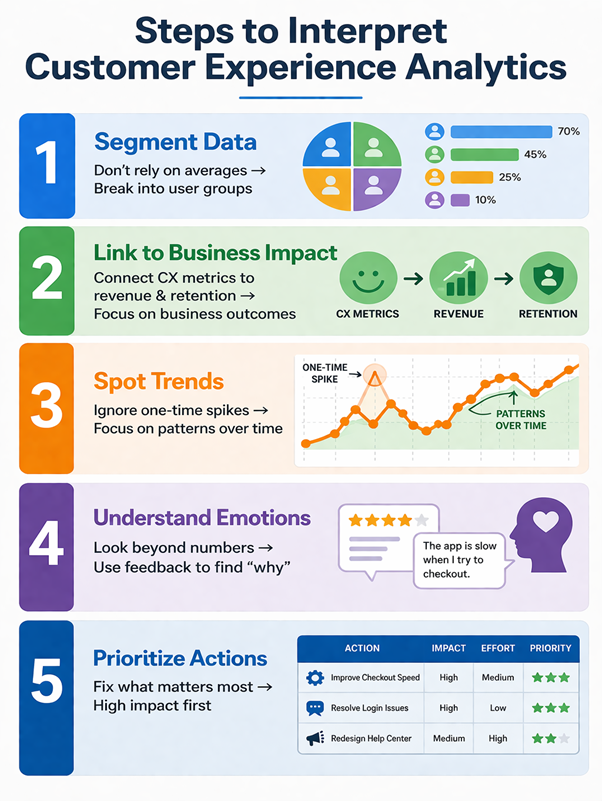
Let’s break this down into simple steps:
Many teams rely too much on average numbers. But averages can hide important details. For example, your average score may look fine, but some customers may still be very unhappy.
This is where segmentation becomes important. Instead of looking at one number, break it into groups. Look at different customer types, locations, or behaviors.
Here’s what you can segment:
This approach improves customer behavior analytics greatly. It helps you see where problems actually exist.
Here’s the key takeaway: Averages show trends, but segments show real issues.
Now think about this. Do your metrics connect to real business results?
Many teams track scores like CSAT or NPS. But they fail to link them to revenue or growth. This is a common mistake. Good customer experience analytics connects data to outcomes. It shows how experience affects business performance.
For example:
This is where predictive analytics in customer experience helps. It shows what actions will lead to better results.
So always ask one simple question: “What does this data mean for the business?”
Real-time data can feel overwhelming at times. Every small change may look like a big problem. But not every drop or spike is important.
Some changes are temporary and not worth reacting to. Others show real patterns that need attention. The key is to focus on trends, not noise.
Here’s how you can do that:
This improves your customer insights analytics approach. It helps you stay calm and make better decisions. Remember to react to trends, not one-time events.
Numbers tell you what happened. But they do not always explain why it happened. This is where emotions play a big role.
Customers may feel frustrated, confused, or even ignored. And those feelings often drive their decisions. To understand this, you need to go deeper.
Look at:
This adds depth to your experience management analytics strategy and helps you see the real reason behind customer actions.
For example, a low rating may seem like a small issue. But it may point to a deeper frustration.
When you understand emotions, you fix the real problem.
Now here’s a common mistake many teams make. They try to fix everything at once, which often leads to confusion and slow progress. Instead, focus on what matters the most. Not every issue needs immediate action. Some problems have a bigger impact than others.
Here’s how you can prioritize better:
This makes your customer data analytics efforts more effective and helps your team move faster with clear direction.
Even with good data, mistakes can happen. Here are some common ones to watch out for:
Avoiding these mistakes improves your overall strategy and allows you to use customer experience analytics more effectively.
Data should make your work easier, not harder. But without the right tools, it can feel overwhelming. This is where platforms like CausalFunnel can help. Our team of experts helps turn complex data into simple and clear insights.
This allows teams to act faster and with confidence. Instead of guessing, you rely on real data. That is the real power of analytics done right.

Strong customer experience analytics should always lead to action. Here are five simple strategies that actually work:
Every customer journey has weak spots or moments where users feel confused or frustrated. Your job is to find those moments first.
Use customer journey analytics to track user movement. Look for steps where users drop off or slow down.
Here are common problem areas:
Fix these first, as they often improve trust and conversions quickly.
Customers expect brands to understand their needs today. Generic messages no longer work well. This is where data helps you stand out.
Use customer behavior analytics to understand what users like. Then adjust your content and offers based on that data.
For example:
This makes your experience feel more personal and useful. It also supports predictive analytics in customer experience. You can act before issues even appear.
Customer experience is not one team’s job. It involves many teams working together. When teams work in silos, problems grow faster. This is where omnichannel analytics becomes very helpful. It gives all teams access to the same customer data.
This leads to:
When teams align, the experience becomes smoother.
Customers switch between channels all the time. They may start on mobile and finish on a website. Therefore, your experience should stay smooth across all channels.
Use customer journey analytics to map this behavior, and find where the experience breaks or feels disconnected.
Focus on these areas:
This creates a seamless experience for the customer.
It also improves your customer insight analytics efforts.
Customer experience is never a one-time task. It needs constant updates and improvements. This is where feedback becomes very important. Collect feedback after key customer interactions. Then use it to improve your experience step by step.
Here’s a simple process:
This creates a strong cycle of improvement and also supports better experience management analytics over time.

Now let’s talk about tools.
The right tools make your work much easier and help you understand and use data quickly.
Modern CX analytics tools offer helpful features like:
When choosing a tool, keep it simple.
Look for:
A good tool should simplify your work, not complicate it.
When used well, analytics bring strong results. It helps both customers and businesses.
Here are the key benefits:
These benefits make analytics a powerful advantage.
Even with good plans, challenges can appear. Knowing them helps you stay prepared.
Here are common issues:
Fixing these issues improves your results over time.
Customer experience is now a key part of business success, and shapes how customers trust and remember your brand. Whereas customer experience analytics helps you understand your customers better and shows where your experience needs improvement.
When used well, it removes guesswork from decisions and replaces opinions with clear and useful data. Use it with customer journey analytics for stronger results. Together, they give a full view of customer behavior.
The real value comes from taking action quickly. So, start simple and keep improving step by step. That is how great customer experiences are built.
If you want to turn insights into real business impact, explore CausalFunnel. Our team helps convert complex data into clear and actionable decisions.
Customer experience analytics studies customer data across touchpoints. It helps improve interactions and overall customer satisfaction.
Customer journey analytics tracks how customers move across channels and helps find drop-offs and improve the journey flow.
Customer experience analytics helps businesses understand customers and improve decisions. It also increases loyalty and reduces churn over time.
Businesses use CX analytics tools with dashboards and AI insights. These tools help track and improve customer interactions.
Businesses can use analytics to identify weak points and improve customer experiences.With customer data analytics, they can make smarter and more informed decisions.
Start using our A/B test platform now and unlock the hidden potential of your website traffic. Your success begins with giving users the personalized experiences they want.
Start Your Free Trial

Empowering businesses to optimize their conversion funnels with AI-driven insights and automation. Turn traffic into sales with our advanced attribution platform.
Trusted by Customers


©CausalFunnel Inc. All rights reserved.