



Free Funnel Audit
Convert more customers today!
SEO
10 mins read

SEO
10 mins read
Every marketer wants to know one simple thing. Are their campaigns actually making money?
Many campaigns generate revenue but still fail to produce real profit. This is where understanding ROAS vs ROI becomes very important. Many marketers confuse these two metrics. Both measure returns, but they show different results.
ROAS measures advertising efficiency.
ROI measures total return on investment.
Understanding these metrics helps marketers make smarter decisions.
This guide explains ROAS vs. ROI in marketing using clear, simple examples. You will learn what each metric means and how marketers use them.
Tools like CausalFunnel help marketers track campaign results and performance clearly. Good analytics tools make marketing data easier to understand.
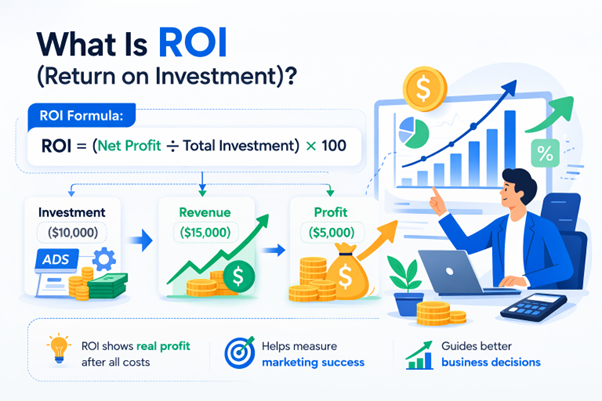
Return on Investment, also called ROI, measures profit from an investment. Businesses use ROI to understand whether spending produces real profit. Marketing teams often track marketing ROI when reviewing campaign performance.
ROI focuses on total profitability instead of campaign performance alone.
The ROI formula compares profit with total investment.
ROI = (Net Profit ÷ Total Investment) × 100
This formula shows how much profit an investment generates.
Consider a simple example:
A company spends $10,000 on a marketing campaign.
The campaign generates $15,000 in revenue.
Profit becomes $5,000 after subtracting campaign costs.
Now calculate ROI.
ROI = ($5,000 ÷ $10,000) × 100
ROI equals 50 percent.
This means the company earned a fifty percent profit on its investment.
ROI includes many different business costs. These costs help show the real profitability of marketing efforts.
Common costs included in ROI calculations include:
Because ROI includes these costs, it shows true business profitability.
Businesses track ROI to understand their financial performance. This metric helps leaders decide where to invest marketing budgets. ROI answers important questions for businesses.
Examples include:
ROI helps companies make better business decisions.
ROI works best for long-term marketing evaluation. It helps businesses measure the success of marketing strategies.
Common ROI use cases include:
Because ROI includes all costs, it shows a complete financial picture. However, ROI alone does not show advertising efficiency. That is why marketers analyze ROAS vs ROI marketing results together.
Calculating ROI manually can become complicated. Marketing costs often come from many different sources. Marketers need tools that combine campaign data with revenue data.
Platforms like CausalFunnel help marketers analyze marketing performance clearly. Our tools help measure digital marketing ROI and make smarter decisions.
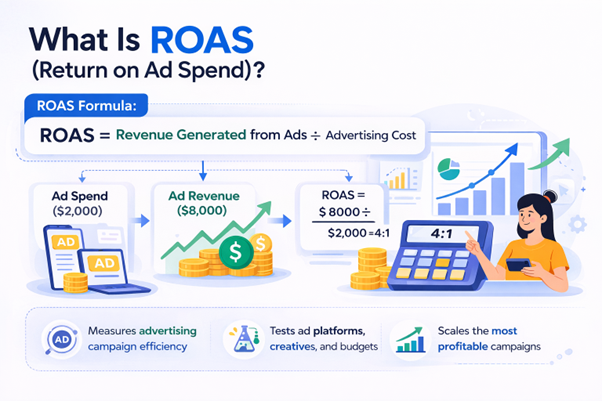
Return on Ad Spend measures revenue generated from advertising. ROAS focuses only on advertising costs. Unlike ROI, ROAS does not include other business expenses. Marketers use ROAS to measure advertising performance.
The ROAS formula compares advertising revenue with ad spending.
ROAS = Revenue Generated from Ads ÷ Advertising Cost
This formula shows how much revenue each advertising dollar produces.
Consider a simple advertising example:
A company spends $2,000 on advertising campaigns.
Those ads generate $8,000 in revenue.
Now calculate ROAS.
ROAS = $8,000 ÷ $2,000
ROAS equals 4:1.
This means each advertising dollar generated four dollars in revenue.
ROAS measures advertising campaign performance. It helps marketers understand how efficient advertising campaigns are without including other business costs. Because of this, ROAS measures campaign efficiency, not profitability.
Marketers use ROAS to improve advertising campaigns. It helps them identify which campaigns perform well.
ROAS helps marketers:
For example, marketers often compare Facebook Ads and Google Ads performance. Campaigns with higher ROAS usually receive more budget.
A good ROAS for e-commerce depends on profit margins. However, many marketers consider 3:1 ROAS a basic benchmark.
Common ROAS benchmarks include:
The best ROAS level depends on business costs and product margins.
The main difference between ROAS vs ROI involves cost coverage. ROI includes all business costs, while ROAS includes only advertising costs.
The table below explains the difference clearly.
Metric | ROI | ROAS |
Measures | Business profitability | Advertising performance |
Costs included | All business costs | Advertising costs only |
Focus | Business strategy | Campaign efficiency |
Used by | Business leaders | Marketing teams |
Understanding this difference helps marketers analyze campaign results correctly.
High ROAS does not always mean strong profitability. Advertising campaigns may generate revenue but still lose money.
Consider this example:
A campaign generates $10,000 revenue from $2,000 ad spending.
ROAS equals 5:1, which looks excellent.
However, product costs and salaries total $9,000, which leaves very little profit.
This example shows why ROAS vs ROI marketing analysis matters. Both metrics together reveal the full financial picture.
Modern marketing campaigns generate large amounts of data. Marketers need tools to analyze campaign results quickly.
Platforms like CausalFunnel help marketers track marketing performance in one dashboard. These tools combine advertising data with revenue insights to help marketers understand ROAS vs ROI more clearly.
Better insights lead to smarter marketing decisions.

Marketers often compare ROAS vs ROI when checking marketing performance. Both metrics measure returns from marketing activities. However, they answer different business questions.
ROAS measures advertising efficiency.
ROI measures overall business profitability.
Understanding the difference between ROI and ROAS helps marketers make better decisions.
One important difference in ROAS vs ROI marketing involves profit and revenue.
ROAS measures revenue generated from advertising campaigns.
ROI measures profit after all business costs are included.
This means ROI shows the true financial result of marketing investments.
Consider the example below:
A company spends $5,000 on advertising campaigns.
The ads generate $20,000 in total revenue.
The campaign produces 4X ROAS, which looks strong. However, product costs and shipping equal $17,000. The business earns only $3,000 profit.
ROI now tells a more realistic story. The campaign produced revenue, but profit stayed much lower.
This example shows why marketers study ROAS vs ROI together.
Also Read: How to Increase Revenue with CausalFunnel’s SEO Tool
Another difference in ROAS vs ROI marketing involves perspective.
ROAS focuses only on advertising campaigns.
ROI focuses on the entire business result.
ROAS answers questions about advertising performance.
Examples include:
ROI answers larger business questions.
Examples include:
Marketing teams use ROAS for daily campaign decisions. Business leaders rely more on ROI for strategy decisions.
Costs matter when comparing ROAS vs ROI.
ROAS includes only advertising spending.
ROI includes many business expenses.
These costs may include:
Because ROI includes these costs, it shows true business profitability. ROAS only measures advertising performance.
The table below shows the difference clearly:
Metric | ROAS | ROI |
Measures | Ad revenue | Business profit |
Costs included | Ad cost only | All business costs |
Focus | Campaign performance | Overall profitability |
Used by | Marketing teams | Business leaders |
ROAS is very useful for advertising decisions. However, it can sometimes mislead marketers. A campaign may show strong ROAS but still lose money. This often happens when product costs remain high.
ROI gives a clearer financial picture. But, ROI alone cannot show which ads perform best. Successful teams track ROAS vs ROI marketing metrics together.
ROAS improves campaigns.
ROI measures business success.
Modern marketing requires insights from several performance metrics. Advertisers need campaign insight and profitability insight together. Tracking both metrics improves marketing decisions.
Benefits include:
Marketing tools can simplify this analysis.
Platforms like CausalFunnel combine campaign data and revenue signals in one dashboard. This helps marketers understand ROAS vs ROI quickly.

Marketing teams use different metrics for different goals. Understanding ROAS vs ROI marketing helps marketers analyze performance correctly.
Each metric plays a different role.
ROAS helps improve advertising campaigns.
ROI measures overall profitability.
The following sections explain how marketers use these metrics:
ROAS helps marketers measure advertising efficiency. It answers one simple question:
How much revenue did advertising generate?
Marketers use ROAS when managing paid advertising campaigns.
Common ROAS uses include:
For example, a marketer runs two campaigns.
Campaign A produces 5:1 ROAS.
Campaign B produces 2:1 ROAS.
Campaign A performs better.
The marketer increases the budget for that campaign.
ROAS helps marketers make quick campaign decisions.
ROI shows the bigger picture of marketing performance. This metric reveals whether marketing produces real profit. ROI helps marketers evaluate long-term strategy.
Common ROI uses include:
A campaign may show strong ROAS but still lose money. ROI reveals this hidden problem. This is why digital marketing ROI matters for business leaders.
Many companies focus too much on ROAS. However, ROAS alone cannot show full business performance. A campaign may generate strong revenue but still reduce profits.
Consider this example:
An e-commerce store spends $3,000 on advertising campaigns.
The ads generate $12,000 revenue.
ROAS equals 4:1, which looks excellent.
However, product costs and shipping equal $10,000.
Profit becomes very small after expenses.
ROI would reveal this problem quickly.
This example shows why ROAS vs ROI marketing analysis matters. Both metrics together provide a complete view of marketing performance.
Examples make ROAS vs ROI easier to understand. These examples show how the metrics behave in real marketing work:
This situation is the best outcome for marketers.
Ads generate strong revenue, and the business also makes a good profit.
Consider this example:
A company spends $4,000 on advertising campaigns.
Those ads generate $20,000 in revenue.
Product costs and operations total $12,000.
The business earns a $8,000 profit after expenses.
ROAS equals 5:1, which shows strong ad performance.
ROI also stays positive because profit exceeds total costs.
This situation means both marketing and business strategy work well. Companies should scale campaigns that show strong ROAS vs ROI results.
This situation happens more often than marketers expect.
Ads generate strong revenue. However, the business still loses money.
Consider this example:
A company spends $3,000 on advertising campaigns.
The ads generate $12,000 revenue.
ROAS equals 4:1, which looks very strong.
However, product costs and shipping equal $11,000.
Employee salaries and tools add another $3,000.
Total expenses become $14,000.
The business loses money even with strong ROAS.
This example shows why ROAS vs ROI marketing analysis is important. ROAS alone does not show full profitability.
This situation signals serious marketing problems.
Ads generate little revenue, and the business also loses money overall.
Consider this example:
A company spends $5,000 on advertising campaigns.
The ads generate only $3,000 revenue.
ROAS equals 0.6, which shows poor ad performance.
Business expenses increase the losses. The company loses money from advertising and operations.
This situation requires fast marketing changes. Teams must review targeting, creative, and budget strategy.
This situation may look confusing at first.
Advertising campaigns perform poorly. However, the business remains profitable.
Consider this example:
A company spends $2,000 on advertising campaigns.
The ads generate $1,500 revenue.
ROAS equals 0.75, which shows weak ad performance.
However, the business earns $15,000 from organic traffic.
Operational costs remain manageable, and the business still makes a profit overall.
This example shows why ROAS vs ROI must be analyzed together. Each metric explains a different part of performance.
ROAS and ROI provide strong insights for marketers. However, these metrics cannot explain everything. Smart teams track other marketing numbers too. These numbers help explain ROAS vs ROI marketing performance more clearly.
Below are several helpful marketing metrics:
Customer Acquisition Cost shows how much it costs to gain a new customer. This metric helps marketers measure advertising efficiency. High CAC can reduce profit even with strong ROAS. Businesses should control CAC to protect profitability.
Customer Lifetime Value shows how much revenue one customer generates over time. Customers often buy more than once. High LTV allows businesses to spend more on advertising. This supports stronger digital marketing ROI.
Average Order Value measures how much customers spend per purchase. Higher-order values increase revenue without more advertising. Businesses often increase AOV through bundles and upselling. This improves both ROAS and ROI.
Conversion rate measures how many visitors complete an action. Actions include purchases, signups, or downloads. Higher conversion rates generate more revenue from existing traffic. This improves both advertising efficiency and profitability.
Cost Per Click measures the average price of each advertising click. Lower CPC allows marketers to reach more people. Lower advertising costs improve campaign performance. This often improves both ROAS and ROI.
The table below explains these marketing metrics clearly:
Metric | What It Measures | Why It Matters |
CAC | Cost to acquire one customer | Controls marketing spending |
LTV | Customer revenue over time | Shows long-term value |
AOV | Average purchase value | Increases revenue per order |
Conversion Rate | Successful visitor actions | Improves marketing efficiency |
CPC | Cost per ad click | Helps control advertising budget |
Tracking these metrics improves marketing decisions.
Many marketers misunderstand campaign performance data. Avoiding common mistakes improves ROAS vs ROI marketing analysis.
Below are several mistakes marketers should avoid:
Some marketers focus only on advertising results. They track ROAS but ignore business expenses. This hides the true profitability of campaigns. ROI must include all business costs.
High ROAS does not always mean strong profit. Product costs and operational expenses reduce profitability. Always compare ROAS with ROI before scaling campaigns.
Some campaigns produce small first purchases. However, customers may return later. Ignoring LTV may lead to poor marketing decisions.
Some marketers measure campaign performance too quickly. Customers often take time before buying products. Longer analysis periods give more accurate insights.
Understanding ROAS vs ROI helps marketers evaluate marketing results clearly. ROAS measures advertising efficiency and revenue generation. ROI measures profitability after business expenses. Both metrics are important for marketing analysis.
Successful teams analyze ROAS vs ROI marketing results together. Analytics tools help marketers understand performance data easily.
Platforms like CausalFunnel help teams analyze campaign data in one dashboard. Better insights lead to smarter campaigns and stronger business growth.
ROAS measures revenue generated from advertising campaigns. ROI measures profit after subtracting all business expenses. Both metrics provide different insights for marketers.
ROAS helps marketers measure advertising efficiency. It shows how much revenue advertising generates. This helps marketers improve campaign performance.
Many e-commerce businesses aim for 3:1 ROAS or higher. Strong campaigns often reach 4:1 or 5:1 ROAS. However, the best number depends on product margins.
High ROAS measures revenue, not profit. Product costs and business expenses reduce profitability. ROI shows the true financial result.
Marketing analytics tools help track campaign data across channels. Platforms like CausalFunnel combine campaign and revenue data. This helps marketers analyze ROAS vs ROI marketing performance more accurately.
Start using our A/B test platform now and unlock the hidden potential of your website traffic. Your success begins with giving users the personalized experiences they want.
Start Your Free Trial

Empowering businesses to optimize their conversion funnels with AI-driven insights and automation. Turn traffic into sales with our advanced attribution platform.
Trusted by Customers


©CausalFunnel Inc. All rights reserved.