



Free Funnel Audit
Convert more customers today!
SEO
10 mins read


SEO
10 mins read
Most lawyers didn’t go to law school to become marketers. But today, your next client is searching Google before they ever call anyone.
The firms showing up at the top are not always the best lawyers. They are simply the best at content marketing for lawyers.
So what does that mean for your firm? It means the way you share information online directly affects how many clients you get. It affects whether people trust you before they even meet you.
Content marketing for lawyers is not about writing articles for fun. It’s about creating the right content, for the right people, at the right time. It works differently for legal professionals than for any other industry. The stakes are higher. The trust bar is higher. And the buying decision takes longer.
This guide covers 7 proven strategies that actually work for law firms. Here is what you will learn:
Let’s get into it.
Content marketing for lawyers is about creating and sharing useful information online. The goal is to attract potential clients and build trust with them over time. It includes blog posts, videos, guides, emails, and social media content.
But legal content marketing is not the same as marketing for a retail brand or a restaurant. There are three key differences that set it apart.
First, lawyers must follow strict advertising ethics rules. The ABA Model Rules 7.1 through 7.3 govern how attorneys can promote their services. Your content must be accurate, not misleading, and ethically sound. This limits certain tactics that other industries use freely.
Second, legal clients have a much higher trust threshold. Someone hiring a lawyer is dealing with something serious. It could be a divorce, a criminal charge, or a business dispute. They need to feel confident in you before they pick up the phone.
Third, the buying cycle for legal services is longer. People don’t hire a lawyer the same day they start researching. They read, compare, and think. Your content needs to nurture that process over weeks or even months.
These differences make attorney marketing strategy more nuanced. But they also make it more powerful. Quality legal content compounds over time. A well-written guide published today can bring in leads two years from now. Paid ads stop the moment you stop paying. Good content does not.
The legal services industry is one of the most searched categories on Google. Millions of people search for legal help every single month. If your firm does not show up, a competitor does.
Law firm digital marketing has shifted dramatically in recent years. Referrals still matter. But they are no longer enough on their own. Here is what the data tells us:
These numbers are not just interesting. They are urgent.
Law firm lead generation has moved online. The firms investing in content right now are building an asset that grows over time. The firms ignoring it are falling further behind every month.
This is not about fear. It’s about opportunity. Content marketing for lawyers gives your firm a chance to compete on expertise, not just budget. You do not need the biggest ad spend. You need the most helpful, trusted content in your market.

These seven strategies are not random tips pulled from a generic marketing blog. They come from what consistently works across law firm niches. From personal injury to family law to corporate practice, these approaches drive real results.
Each strategy builds on the one before it. Together, they form a complete attorney content strategy. You do not need to launch all seven at once. But the more you implement, the stronger your results will be.
Most law firms create content about themselves. Their awards, years in practice, case results. So, what’s the problem? Their ideal client does not care about any of that yet.
Before anything else, you need to know exactly who you are writing for. That starts with building legal audience personas.
A persona is a detailed profile of your ideal client. It’s not just demographics. It goes deeper than age and location. Here is what a strong legal persona includes:
When you know this, everything changes. Your blog posts answer real questions. Your videos speak to real fears. Your emails feel personal, not generic.
A clear persona turns your content from noise into answers. And answers are what bring clients to your door.
Blogging is not just something you do to look active online. A well-built law firm blog is both an SEO asset and a client education tool. Done right, it works for you around the clock.
Here is how to build a blog that actually performs:
Legal blog writing should always serve the reader first. If your client walks away more informed, they are more likely to trust you with their case.
A consistently updated blog is one of the smartest investments in content marketing for lawyers. It generates traffic without ongoing ad spend. And that traffic compounds over time.
People hire lawyers they trust. And trust is hard to build through text alone. Video changes that.
When someone watches you speak on camera, something shifts. You stop being a name on a website. You become a real person. That matters enormously in legal content marketing.
Here are three types of video that work especially well for law firms:
Where should these videos live? Post them on YouTube for search visibility. Embed them on your homepage and practice area pages. YouTube is the second largest search engine in the world. Many legal questions get answered there before Google.
Even a smartphone-quality video beats no video at all. What matters is that you show up, speak clearly, and answer real questions.
You can write the best content in your market. But if no one finds it, it does not matter. That is where law firm SEO comes in.
SEO and content are not two separate things. They are two halves of the same strategy. Here is what your legal content needs to rank:
Law firm SEO should never be treated as separate from content marketing for lawyers. They are inseparable. One without the other underperforms. Together, they create compounding visibility that paid ads can never replicate.
Email is not just for e-commerce businesses. For law firms, it’s one of the highest-converting tools available. Why? Because your email list is made up of people who already know you exist.
Law firm digital marketing often overlooks email. That is a missed opportunity. Here are three email strategies that work well for attorneys:
How do you build your list? Use website opt-in forms. Offer a free downloadable guide “What to Do After a Car Accident” or “Your Divorce Checklist.” Host a webinar and collect registrations. These tactics drive real client acquisition for lawyers without spending money on ads.
Blog posts are great for timely topics. But long-form guides are your authority pillars. They are the content that tells Google and your clients that you are the expert in your field.
There is a clear difference between a 600-word blog post and a 2,500-word comprehensive guide. One answers a question. The other owns a topic.
Here is why long-form content matters for legal thought leadership:
Long-form authority content is the backbone of sustainable content marketing for lawyers. It earns trust from search engines and potential clients at the same time. No other content type does both as effectively.
Creating great content is only half the job. The other half is getting it in front of the right people. Most law firm content strategies fail at distribution not creation.
The channel you choose should match where your ideal client actually spends time. Here is a practice area breakdown:
Channel-matched distribution is what transforms content marketing for lawyers from an expense into a real client acquisition system. Stop broadcasting everywhere. Start showing up consistently where your clients are already looking.
A lot of law firms invest in content and then measure the wrong things. Follower counts and post likes feel good. But they do not pay your staff.
Here are the five metrics that actually tell you if legal content marketing is working:
Tracking these metrics consistently is what allows you to improve your content marketing for lawyers strategy over time. You stop guessing. You start making decisions based on real data.
Even well-intentioned firms make these mistakes. Knowing them in advance saves you time, money, and frustration.
Avoiding these mistakes is the difference between content marketing for lawyers that drives real results and content that simply takes up server space. Small corrections in your approach lead to compounding improvements over time.
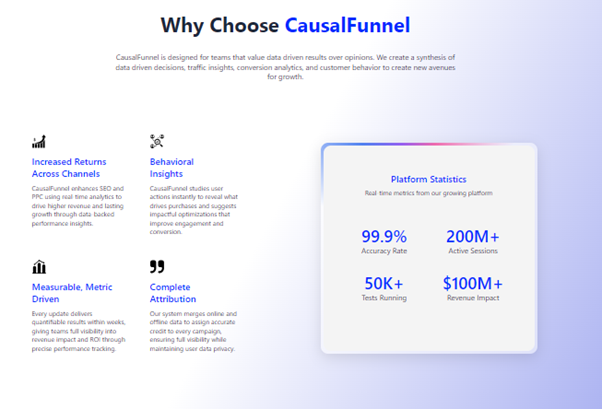
Creating strong content is only half the equation. The real power of Content Marketing for Lawyers comes from optimizing how visitors interact with that content.
AI-driven behavioral analytics tools like CausalFunnel help law firms understand who is engaging, what they are reading, and when they are ready to convert.
Instead of treating every website visitor the same, behavioral tracking analyzes signals such as:
For example, someone who revisits a “Car Accident Claim Process” page twice in one week is likely closer to hiring an attorney than a casual reader. Behavioral tools flag these users for targeted engagement.
Once high-intent visitors are identified, personalized prompts can be triggered, such as:
A/B testing can further refine results. For instance:
This ensures content doesn’t just attract traffic it converts it.
High-value resources such as:
can be gated through optimized landing pages. Behavioral analytics reveals which resources drive the most inquiries and which blog posts generate the strongest leads.
This creates a measurable funnel from article → landing page → consultation.
While tools provide data, professional strategy ensures results.
Experienced marketers:
Without strategic oversight, even strong traffic can underperform.
When properly executed, behavioral optimization bridges the gap between publishing legal content and generating signed cases making every piece of content work harder for the firm.

Schedule your Free week trial
Lawyers earn trust by knowing the law better than anyone else in the room. But winning online requires a different kind of expertise.
The seven strategies in this guide are not theories. They are the exact framework we use with law firms across the country. From building audience personas to distributing content on the right channels every piece works together.
Your competitors are publishing right now. Every week they do and you do not is a week they pull further ahead in search results.
If you are ready to stop losing potential clients to firms with weaker cases but stronger content, it’s time to act. Content marketing for lawyers is not optional anymore. it’s how modern law firms grow.
Schedule Your Free Content Strategy Session and let’s build a strategy that brings the right clients to your firm consistently.
Content marketing for lawyers means creating useful online content to attract and educate potential clients. It includes blogs, videos, guides, and emails that build trust and drive leads to your firm.
Most firms see measurable organic growth within three to six months of consistent publishing. SEO is a long-term strategy. The results compound over time and far outlast any paid campaign.
Budgets vary by firm size, market competition, and goals. Small firms can start with $1,500 to $3,000 per month. Larger firms in competitive markets often invest $5,000 or more monthly for meaningful results.
You can handle it yourself if you have the time and consistency to publish regularly. Most attorneys do not. An experienced legal marketing agency brings strategy, SEO expertise, and reliable execution without pulling you away from billable hours.
Long-form practice area pages, blog posts targeting client questions, and FAQ content perform best for law firm SEO. Video content also helps with engagement and local search visibility.
Start using our A/B test platform now and unlock the hidden potential of your website traffic. Your success begins with giving users the personalized experiences they want.
Start Your Free Trial

Empowering businesses to optimize their conversion funnels with AI-driven insights and automation. Turn traffic into sales with our advanced attribution platform.
Trusted by Customers


©CausalFunnel Inc. All rights reserved.