



Free Funnel Audit
Convert more customers today!
SEO
10 mins read

SEO
10 mins read
Strong content marketing is not about traffic alone. It is about turning readers into real leads. These 10 proven content marketing lead gen tactics focus on trust, clarity, and smart positioning. You will learn how to attract the right audience and guide them toward action. If done right, your content will not just inform, it will convert.
Key Takeaways
You’re publishing blog posts every week. Traffic is growing. But leads? Barely any.
This is the most common frustration in content marketing lead gen. And it’s not a content quality problem. It’s a system problem.
Creating content alone is not a strategy. Without the right infrastructure, even great content produces zero leads. You need more than just words on a page.
Here are the most common reasons content fails to generate leads:
Fix these first. Then the tactics in this article will actually work.
Most definitions make this sound complicated. It’s not.
Content marketing lead gen is a system that attracts the right people through valuable content. It then moves them toward sharing their contact information. That’s it.
What makes it different from traditional outbound lead generation? With outbound, you interrupt people. You cold call. You run ads. You chase leads. With content marketing lead gen, leads come to you. They find your content through search, social, or referrals. They trust you before you ever speak to them.
Think of it like this. A great salesperson builds trust before asking for the sale. Content marketing does the same thing but at scale, around the clock, without a sales team.
The result is a compounding inbound lead generation engine. Every piece of content you publish keeps working for months or years. That’s what makes this approach more sustainable than paid advertising.
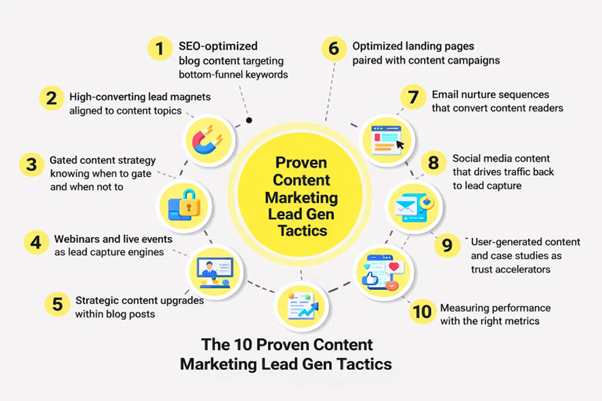
Not every tactic works the same way for every business. But these 10 are proven across industries and business sizes.
The key is combining them into a connected content funnel, not running them in isolation. Here’s a quick overview before we go deep:

Most marketers write blog content for awareness. That’s fine for traffic. But it rarely generates leads.
The highest-converting blog content targets bottom-of-funnel (BOFU) keywords. These are keywords people search when they’re close to making a decision. They signal purchase intent, not just curiosity.
Here’s the difference:
The second reader is ready to act. They’re comparing options. They’re looking for solutions. That’s who you want landing on your pages.
How to find BOFU keywords for your business:
Pro Tip: Use an AI-powered SEO tool to analyze keyword intent, uncover content gaps, and identify commercial-value queries. These platforms help you prioritize decision-stage keywords instead of chasing high-volume informational traffic.
One strong BOFU article paired with a compelling lead magnet can outperform ten awareness posts. Focus on intent first. Traffic without intent will not generate pipeline.
A lead magnet is an offer that trades value for contact information. Most marketers know this. But most marketers also get it wrong.
The biggest mistake? Creating one generic lead magnet for your entire website. A single eBook titled “The Ultimate Marketing Guide” doesn’t convert well. It’s too broad. It feels impersonal.
The highest-converting lead magnets are hyper-specific to the content the reader just consumed.
Here’s why this works. A reader just finished your blog post on email marketing tactics. They’re engaged. They’re interested in that specific topic. Now you offer them a “30-Day Email Marketing Calendar Template.” The conversion rate jumps because the offer matches exactly what they need right now.
Lead magnet formats ranked by conversion potential:
One aligned lead magnet per blog post is the goal. You don’t need dozens. You need the right one in the right place.
Gating content is one of the most debated topics in content marketing lead generation. Should you put your best content behind a form? Or give everything away for free?
The answer depends on two things: funnel stage and content depth.
Here’s a simple framework to guide your decision:
Gate It | Don’t Gate It |
Original research and data reports | Blog posts and articles |
Comprehensive step-by-step guides | Social media content |
Templates and done-for-you tools | Podcast episodes |
Webinar replays with exclusive insights | Short videos |
In-depth case studies with real metrics | Infographics |
The rule of thumb: If the content took significant effort to produce and deliver deep, specific value, gate it. If it’s meant to build awareness and drive traffic, keep it open.
There’s also an SEO factor to consider. Gated content can’t be indexed by Google. So gating your best blog posts means losing organic traffic. That’s rarely worth it.
Use ungated content to attract. Use gated content to capture. Both have a role in a strong lead generation strategy.
A webinar is not just a content format. It’s a three-stage lead generation system.
Most people think of webinars as a way to share knowledge. That’s true. But the real power is in the structure around the event before, during, and after.
The 4-step webinar lead gen process:
Webinar registrants are among the highest-intent leads in any content marketing lead gen strategy. They raised their hand and committed time. That signals real interest.
You don’t need fancy production. A simple, valuable 45-minute session on a specific problem your audience faces is enough.
Tactic 5 Strategic Content Upgrades Within Blog Posts
A content upgrade is a step above a standard lead magnet. It’s an inline offer inside a specific blog post that directly extends the value of that post.
Here’s the difference:
Content upgrades convert at 3–5x the rate of sidebar or footer opt-in forms. The reason is simple: the offer is perfectly timed and perfectly relevant.
How to create a content upgrade:
Example: A blog post titled “How to Write a Cold Email” includes an online offer for “50 Cold Email Templates Ready to Use.” The reader is already interested in the topic. The upgrade is an obvious yes.
This is one of the most underused tactics in content marketing lead generation. No competitor page covers it in depth. That’s exactly why it works so well. Few marketers are doing it right.
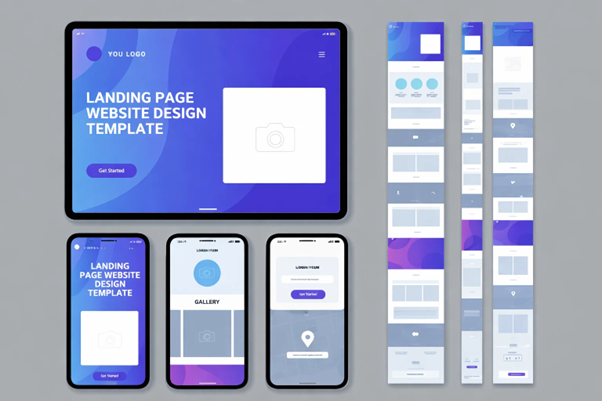
Here’s a mistake that kills content marketing lead gen results. You create great content. You add a strong CTA. And then you send readers to your homepage.
Your homepage is designed for everyone. A landing page is designed for one specific offer. That difference matters enormously for conversion rates.
Think of it this way. Your content is the pipeline. Your landing page is the bucket. If the bucket has holes, it doesn’t matter how much water flows in.
5 landing page elements that increase conversion:
Pairing strong content with a dedicated landing page is one of the highest-leverage moves in your lead generation strategy. It doesn’t require more content. It just requires better infrastructure.
Getting a lead is just the beginning. A new subscriber who downloaded your checklist is not ready to buy yet. They need more value, more trust, and more time.
That’s what an email nurture sequence does. It continues the conversation your content started.
A proven 5-email nurture sequence framework:
Each email maps to a stage of the buyer journey. The sequence moves from “interested” to “ready to act” without pressure.
This is where content marketing lead generation becomes a real revenue engine. The content attracts. The sequence converts.

Social media is not a lead generation channel by itself. It’s a traffic amplification layer that sends qualified audiences back to your lead capture assets.
This distinction matters. Chasing likes and follows on social media rarely builds your email list. But using social media to drive traffic to your blog posts and lead magnets? That works.
Platform-specific guidance:
The content repurposing formula:
You don’t need to create new content for every platform. Repurpose what you already have. Drive everything back to one place on your lead capture page.
You can say your product is great. Your customers say it is ten times more powerful.
User-generated content (UGC) and case studies serve a dual purpose. They generate organic reach through community participation. And they accelerate trust with leads who are in the consideration stage.
Here’s why this matters for lead gen specifically. A prospect who has been reading your content is educated. They understand the problem. Now they need proof that your solution works for someone like them. That’s what UGC and case studies deliver.
Three formats that work:
The key difference between this tactic and simply collecting reviews is strategic placement. Put case studies on landing pages. Embed video testimonials near form submissions. Share UGC during the consideration stage of your email nurture sequence.
Proof placed at the right moment turns warm leads into ready buyers.
You can’t improve what you don’t measure. But most marketers track the wrong things.
Page views tell you about reach. They don’t tell you about results. The goal of content marketing lead gen is leads and revenue not traffic for its own sake.
Here’s the distinction that matters most:
6 KPIs every content marketer should track:
Metric | What It Measures | Benchmark |
Content-to-lead conversion rate | % of content visitors who become leads | 1–5% |
Lead magnet download rate | % of page visitors who download | 3–10% |
Email open rate (nurture sequence) | Engagement quality of captured leads | 25–40% |
Cost per content-attributed lead | Efficiency vs. paid channels | Track vs. paid |
Content-influenced pipeline | Revenue influenced by content touchpoints | Track MoM growth |
Organic lead share | % of total leads from organic content | Target 30%+ |
Review these metrics monthly. Look for patterns. Which blog posts generate the most leads? Which lead magnets convert best? Double down on what works and cut what doesn’t.
This is where conversion rate optimization becomes part of your content workflow not an afterthought.
How to Build a Full Content Marketing Lead Gen Funnel
Ten tactics are only powerful when they work together. A connected content funnel is what separates a lead generation system from a collection of random tactics.
Every content funnel has three stages. Each stage needs a different type of content. Each stage serves a different audience intent.
Top of Funnel (TOFU) Attract
This is awareness content. The goal is reaching people who have the problem but don’t know your brand yet.
Middle of Funnel (MOFU) Engage
This is considered content. The goal is building trust with people who know your brand and are evaluating solutions.
Bottom of Funnel (BOFU) Convert
This is decision content. The goal is converting engaged leads into customers.
Build your content calendar across all three stages. Most businesses publish only TOFU content and wonder why leads don’t convert. The middle and bottom stages are where the magic happens.
Map your buyer persona to each stage. Understand what questions they’re asking at each point. Then create content that answers those questions at exactly the right moment.
Modern content marketing performs best when behavioral intelligence replaces assumptions with measurable insight. By leveraging AI-driven, cookie-agnostic tracking powered by first-party data, marketers can identify high-intent visitors and convert engagement into qualified pipeline. Instead of focusing only on traffic metrics, this approach prioritizes buying signals and revenue impact.
Key advantages include:
This structured, data-driven system transforms content from an awareness tool into a predictable lead generation engine.
Common Content Marketing Lead Gen Mistakes to Avoid
Even experienced marketers make these mistakes. Recognizing them early saves months of wasted effort.
Here’s the truth about content marketing lead gen. It rewards patience.
The businesses winning with content today started building 12 to 18 months ago. They published consistently. They optimized relentlessly. They treated every piece of content as a long-term asset, not a short-term campaign.
Unlike paid ads, content doesn’t stop working when you stop spending. A well-optimized blog post keeps ranking. A great lead magnet keeps converting. An email sequence keeps nurturing all without ongoing ad spend.
That’s the power of treating content marketing lead generation as a compounding system. Every tactic in this article adds a new layer to that system. Each layer makes the whole thing stronger over time.
Start with one tactic. Do it well. Then add the next.
Ready to put these tactics into action? Build your first high-converting landing page and pair it with the blog content you’re already publishing. Start capturing leads from the traffic you’re already getting.
Expect a realistic timeline before you start. Your content will begin indexing within 4–8 weeks of publishing. Early traffic usually appears around the 3–4 month mark. Meaningful, consistent lead volume typically takes 6–9 months to build. The timeline depends on your domain authority, content quality, and how aggressively you promote. Plan for a 6-month runway before evaluating whether your strategy is working
Bottom-of-funnel blog posts, gated original research, and topic-aligned lead magnets consistently outperform general awareness content. The key difference is intent. High-traffic content attracts readers. High-converting content attracts buyers. A blog post targeting a BOFU keyword with a specific lead magnet will generate more leads than ten informational posts with no capture mechanism.
The core tradeoff is speed versus sustainability. Paid lead generation delivers fast results but stops the moment you stop spending. Content marketing lead gen builds assets that compound over time. A well-ranked blog post keeps generating leads for years at zero additional cost. Studies show content-attributed leads cost 60–80% less than paid leads over a 12-month period. You invest more time upfront. You save significantly in the long run.
No. A lean team of one or two people can build an effective content marketing lead gen strategy. The key is prioritizing depth over volume. One well-researched, conversion-optimized blog post per week beats five thin posts with no strategy. Focus on fewer pieces. Make each one count. Use repurposing to extend reach across platforms without creating new content from scratch every time.
Start using our A/B test platform now and unlock the hidden potential of your website traffic. Your success begins with giving users the personalized experiences they want.
Start Your Free Trial

Empowering businesses to optimize their conversion funnels with AI-driven insights and automation. Turn traffic into sales with our advanced attribution platform.
Trusted by Customers


©CausalFunnel Inc. All rights reserved.