



Free Funnel Audit
Convert more customers today!
SEO
10 mins read

SEO
10 mins read
Content marketing can help brands grow traffic and sales. But you need a way to measure real results. That’s where content marketing KPIs come in. These key performance indicators show if your content is working. Good KPIs help you see what content performs best. They show you what to improve next.
Every business needs clear goals. KPIs let you track progress toward those goals. Without KPIs, you guess and hope your content works. With KPIs, you measure and improve strategy. This makes your marketing stronger every month.
This article explains content marketing KPIs step-by-step. You will learn how to choose the right metrics through real examples. You will also learn how to track results over time.
For more tools to track your digital marketing goals, visit CausalFunnel. You can use our dashboards and reporting tools to see trends and patterns fast.
Let’s start with the basics.

Content marketing KPIs are measurable numbers. They show how well your content is performing. KPIs are not just data; they show results tied to your goals.
For example, you might want more website visits. You might also want more leads or sales. A KPI shows how close you are to your goal. If you want more traffic, page views can be a KPI. If you want more leads, form submissions can be a KPI.
KPIs must be clear and simple to measure. This helps you take action. If a KPI shows weak performance, you can fix it. If it shows strong performance, you can do more of the same.
Content marketing KPIs are different from content metrics. Content marketing metrics are raw numbers that do not always tie to goals. For example, likes on a post are a metric. They tell you something about attention. But they do not always tie to your bigger goals.
KPIs are tied to business goals like:
KPIs must be tied to growth or revenue. If they do not tie to outcomes, they are not good KPIs.
Think of KPIs as goals with numbers attached. They help you focus on what matters most. Good content marketing KPIs answer the question: Is this working for business growth?
Content marketing KPIs are more than numbers. They are proof of results that show if your marketing is helping your business grow.
Here are the top reasons these KPIs matter:
Businesses use content marketing KPIs to evaluate results across their digital strategy. These KPIs often tie into larger digital marketing KPIs, which include channels like email, SEO, paid ads, and referrals.
For example, a business might set a KPI for organic traffic growth. Another might set a KPI for video watch time or newsletter signups. All of these are valid as long as they tie to real business goals.
You can track KPIs using dashboards, analytics tools, and reports. To make this easier, tools on CausalFunnel help you track metrics from multiple platforms. These tools help convert raw data into clear KPI results.
A KPI must follow a few basic rules:
If your KPI does not meet these rules, it is not a strong KPI.
You might be tracking metrics that are not KPIs. This happens when you track numbers that do not tie to goals. For example:
These are useful signals, but they are not always tied to business outcomes. They become useful when linked to an end goal like lead generation or sales.
Let’s take a real example. Imagine you write blog posts to grow email subscribers. Your KPI could be:
Number of email subscribers gained from blog traffic
This KPI ties directly to your business goal of growing your email list. It is measurable and also easy to track.
Now let’s talk about how to choose the right KPIs for your needs.
Choosing the right KPIs can feel hard at first. But the process becomes clear with steps. Good KPIs must match your goals. They must help you measure success clearly. They must not just be numbers.
Follow these steps to choose strong KPIs:
Ask yourself what your business wants to achieve.
Write your main goal in one sentence. This helps you pick metrics that matter.
Match your KPI to your goal.
Avoid metrics that do not tie to goals. For example:
These are interesting, but not always tied to outcomes.
Your KPI must be easy to collect and analyze. If your KPI is hard to measure, you will avoid tracking it.
Good KPIs are easy to access in analytics tools. Tools like those at CausalFunnel can pull many KPIs into one place. You can see your progress without logging into multiple dashboards.
Your KPI needs a number to hit. Example:
Targets must be realistic and based on past performance. Past data helps you set achievable numbers.
Your KPI choices may change over time. Review them monthly or quarterly. If a KPI no longer matches your goals, adjust it. KPIs must evolve with your strategy.
Also Read: Content Marketing vs Native Advertising: Which One Works Best?
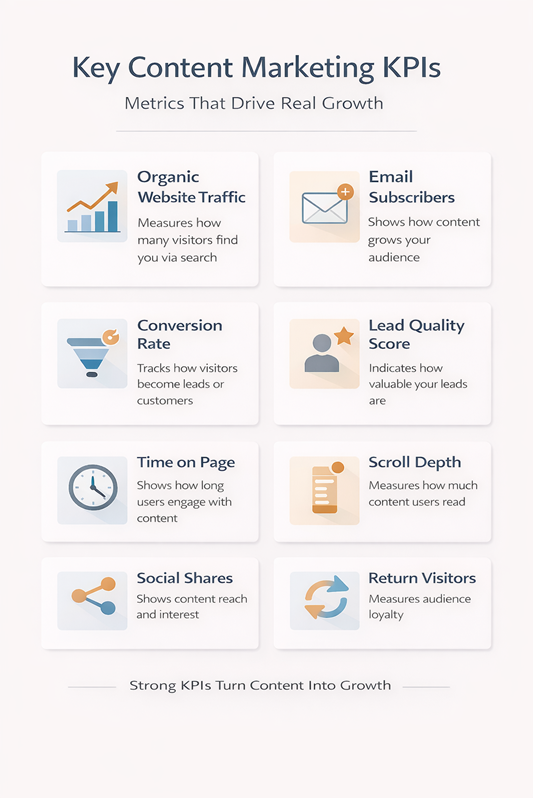
Now that you know how to pick KPIs, let’s look at key ones to track. These KPIs work for most content strategies.
Why it matters:
Organic traffic shows if your content attracts search users.
How to track:
Use analytics tools to watch monthly organic visits.
What it tells you:
This KPI shows whether your content is ranking on search engines.
Why it matters:
Growing an email list gives you direct access to your audience.
How to track:
Segment signups from content pages only.
What it tells you:
This KPI shows how compelling your content is. Good content makes people subscribe.
Why it matters:
Conversion rate shows how many visitors take action.
How to track:
Divide conversions by page views.
What it tells you:
It shows if your content leads to business goals.
Why it matters:
Not all leads are equal. Some are more likely to buy.
How to track:
Use lead scoring from CRM or marketing tools.
What it tells you:
This KPI tells you if your content attracts the right audience.
Why it matters:
Longer pages often mean better engagement.
How to track:
Use analytics tools for average time on page.
What it tells you:
This KPI shows if readers stay and read your content.
Why it matters:
Scroll depth shows if users read most of the content.
How to track:
Use tools that measure scroll tracking.
What it tells you:
It shows how engaging your content is.
Why it matters:
Shares help content reach new audiences.
How to track:
Count shares from social platforms.
What it tells you:
This KPI shows content interest and reach growth.
Why it matters:
Returning users show loyalty and interest.
How to track:
Track returning visitor stats in analytics.
What it tells you:
This KPI shows whether people come back to your content.
Also Read: Smart Content Objective Examples for a Winning Marketing Plan
Tracking KPIs can be easy if you use the right tools. Doing it manually slows you down. Choose reliable tools that capture data from multiple channels at once.
Platforms like Google Analytics are common, but they require manual setup. You need custom dashboards and filters.
This is where KPI dashboards help.
A dashboard shows all KPIs in one place. You do not need to switch tools. Dashboards like those available at CausalFunnel combine data from many sources. You can see your KPIs in one view.
Benefits of dashboards:
Dashboards make tracking faster and clearer. They help you spot problems early, so that you can fix them fast.
You should set alerts for key changes in performance. Alerts tell you when a KPI changes sharply. This helps you react fast.
For example:
Alerts help you stay proactive, not reactive.

Seeing examples helps you understand how KPIs work in real campaigns. Let’s look at simple case ideas.
Goal: Grow monthly blog visits
KPI: Increase organic traffic by 20% in 3 months
Tracking: Use dashboards to watch weekly visits
Result: You see trends and adjust topics
This example shows how a simple KPI gives clear focus.
Goal: Build a newsletter list
KPI: Gain 500 new subscribers in one quarter
Tracking: Tag content pages that push signups
Result: You test different content types to improve signups
This example shows how KPIs help you refine strategy.
Benchmarks help you know if your KPIs are strong. Benchmarks are baseline numbers you compare to.
You can set benchmarks using past data. If last quarter you gained 100 email subscribers, then a benchmark could be 150 this quarter.
Here are common benchmarks:
Benchmarks are not rules. They are guides to help you set goals.
Track your KPIs weekly for quick actions. Then review them monthly for strategy shifts.
Weekly tracking helps you:
Monthly review helps you:
Many tools help you track KPIs. Some are free, others cost money.
Here are the types of tools you need:
Platforms like CausalFunnel help you combine all these data types. They can pull data from many sources into one view, which saves time and increases accuracy.
When tools work together, you spend less effort finding data.
Measuring KPIs is more than tracking numbers on a sheet. You need to understand what the numbers mean for your strategy. A number alone does not tell the full story. You must connect the KPI result to your goal clearly.
For example, organic traffic growth means more users found your content. But unless those users take action, traffic alone is not enough. So always tie KPIs to actions that benefit your business. That is how you know your content makes an impact.
Here is how to measure KPI success most effectively:
Your benchmark gives context to your KPI results. If organic traffic grew by 5 percent, is that good or weak? Without a benchmark, you can’t know clearly. Always compare your results against past performance and targets.
A one-time spike can be accidental or seasonal. A trend over time tells you more about real performance. Weekly, monthly, and quarterly views help you spot trends. Trends guide you on what to change or repeat.
One KPI rarely tells the whole story. For example, more traffic but lower conversion means visitors leave early. Check the conversion rate and time on the page with traffic together. This helps you see performance from multiple angles.
Dashboards make measurements less confusing and more visual. You can see multiple KPIs in one view at once. Dashboards help your team absorb data faster. Tools at CausalFunnel show KPIs clearly. These tools pull data from many channels into one screen.
A KPI report must be shared with your team often. Reports keep everyone aligned on results and next steps. Your report should show KPIs, trends, and actions taken. Share reports weekly or monthly, depending on your needs.
Poor performance is not bad if it teaches you something. A KPI that misses the target shows a problem or gap. Here is how to handle it:
Check Your Goal Again
Sometimes your goal was too big or too small. Make sure your KPI still matches your business objective.
Look for Root Causes
Find why the KPI is low. Look at related KPIs to dig deeper.
For example, if conversions dropped, check traffic quality first. Low-quality traffic rarely converts well or stays long.
Test Small Improvements
Run small experiments to improve results. Try new topic formats or calls to action. Don’t guess what will work; test to see actual results.
Track Changes Closely
When you make a change, watch KPI trends closely. Your next report will show if the test helped or not.
KPIs should guide your next steps. Here are common actions based on KPI insights.
If Organic Traffic Is Low
If Engagement Is Low
If Conversions Are Weak
If Time on Page Is Low
If Return Visitors Are Few
These actions help your content improve over time. KPIs must lead to action, not just measurement.
Also Read: 11 Steps to Build a Powerful Content Marketing Framework
Many marketers confuse metrics with KPIs. This confusion leads to weak measurement and wasted effort.
So let’s clarify the difference in simple terms.
Content marketing metrics are raw numbers.
Examples include:
These only show data without context.
Content marketing KPIs are numbers tied to goals.
Examples include:
KPIs show progress toward business results. Metrics only show data without actual insight.
When metrics become tied to a meaningful business goal, they can become KPIs. This makes them useful for decision-making and planning.
Benchmarks help you know what good performance looks like. Here are practical benchmark ranges based on many industries.
Organic Traffic Growth Benchmarks
Email Subscriber Growth Benchmarks
Conversion Rate Benchmarks
These numbers are not exact rules. Every business is different, and benchmarks should adjust over time.
Use these numbers to guide your targets. Track results against them every month or quarter.
Tracking KPIs can be simple with the right tools. Good tools save hours of manual tracking every week. You need tools that pull data from many platforms.
Here are essential tool types for KPI tracking:
Dashboards are especially helpful for busy teams. They show insights without switching tabs or logins.
You can connect your data sources easily with dashboards. Platforms like CausalFunnel bring all KPI data into one view. This makes it easy to spot trends and share reports.
Benefits of good KPI tools include:
Tools let your team focus more on improvement. You spend less time pulling data manually.
Content marketing KPIs are not nice-to-have numbers. They are essential signals that guide strategy and action. Good KPIs show success and help you improve results fast.
Don’t track numbers just for the sake of tracking. Always tie them to real business goals you care about. Your KPIs should help you answer one question:
Is my content driving real business outcomes?
If a KPI does not help answer that question, drop it. Focus on fewer KPIs with stronger value and clearer insight. Use dashboards, benchmarks, and regular reviews to stay on track. Keep sharing KPI reports with your team so everyone aligns toward goals.
Finally, remember this:
What you measure grows.
KPIs bring clarity to your content strategy and help you win.
Think of content marketing KPIs as proof that your content works. They are numbers tied to real results. If content helps your business grow, the KPI shows it. If it doesn’t, you’ll see that too.
Content marketing KPI is important because posting content is not enough. You need to know what it’s doing. KPIs show what brings traffic and what turns readers into leads. That’s how you improve ROI over time.
Metrics are surface-level numbers that include page views, likes, and shares. They look nice, but don’t tell the full story.
Whereas, content marketing KPIs connect to business goals like leads, conversions, and revenue.
While choosing the right content marketing KPI, start with one simple question:
What do I want more of?
Traffic? Email subscribers? Or sales?
Now match one KPI to that goal and keep it focused. Too many KPIs create confusion.
If you are a beginner, keep it basic:
These content marketing KPIs show real growth.
Start using our A/B test platform now and unlock the hidden potential of your website traffic. Your success begins with giving users the personalized experiences they want.
Start Your Free Trial

Empowering businesses to optimize their conversion funnels with AI-driven insights and automation. Turn traffic into sales with our advanced attribution platform.
Trusted by Customers


©CausalFunnel Inc. All rights reserved.