



Free Funnel Audit
Convert more customers today!

SEO
10 mins read

SEO
10 mins read
People search online every day for answers, products, and services. Each search reflects a need, and businesses that understand these patterns can respond better. This is where user search behavior analysis becomes essential.
It helps businesses see how users search, what they click, and how they interact with content. By analyzing this behavior, companies can uncover clear patterns to guide smarter marketing decisions.
User search behavior analysis focuses on:
If you want deeper marketing insights, explore strategic guidance at CausalFunnel. Our data-driven approach connects search insights with measurable growth.
Search intent analysis in digital marketing depends on recognizing intent types. Each type reflects a different stage of awareness that demands different content formats.
Informational intent focuses on learning and discovery. Users search for answers to questionsby using phrases like “how” or “what.”
These users are in early research stages, looking for guidance and helpful explanations. Your content here should be educational and clear. Blog posts and guides perform well here, while structured answers improve search intent alignment.
Navigational intent occurs when users seek a specific website that they already know of and want direct access to. This intent shows brand awareness. For these visitors, search results must display clear page titles, and landing pages should load quickly and clearly.
Strong brand visibility supports this behavior.
Transactional intent is where users are ready to act. When someone searches for terms like “buy,” “sign up,” or “get started,” they’re showing clear purchase intent.
At this stage, they want quick answers and a simple path forward. Landing pages should be direct, persuasive, and focused on strong calls to action.
This is where user search behavior analysis helps most: it identifies high-intent keywords so you can target users who are ready to convert.
Commercial investigation happens right between research and buying. At this stage, users are comparing products or services, reading reviews, and looking closely at their options before making a decision.
They’re not ready to purchase yet, but they are close. That’s why your content should clearly compare features, highlight benefits, and address common concerns. Trust signals like case studies, testimonials, and real results help build confidence and move them forward.
When intent is this clear, search behaviour in digital marketing becomes much easier to manage. Content feels more focused, engagement improves because expectations are met, and there’s far less guesswork involved.
In turn, user search behavior analysis becomes more accurate and aligns your strategy more closely with real user needs.
User search behavior analysis works best when you follow a clear plan. If you track random metrics without structure, it quickly becomes confusing and unproductive. A simple, organized process leads to stronger marketing results and better decisions.
Search behaviour in digital marketing improves when every step connects directly to business goals. The framework below keeps the process practical and easy to apply.
Start by gathering real search data. Use search engine reports and your website’s internal search logs to see what people are typing.
Look for patterns in repeated phrases. Pay close attention to high-volume and high-intent keywords. Notice the questions users ask most often, and track changes in online search patterns each month.
This step shows you what your audience truly wants. It removes guesswork and replaces assumptions with facts.
Search data tells you what people want. Behavior data tells you what they do next.
After users click, study how they interact with your site. This is where user behavior analytics becomes valuable.
Focus on key signals such as:
A high bounce rate may mean your content does not match search intent. Longer dwell time usually suggests strong alignment. A low CTR might point to weak titles or meta descriptions.
User search behavior analysis brings these signals together. It helps you see the gap between what users expect and what they actually experience.
Next, organize your keywords by intent.
Separate them into informational, transactional, and navigational categories. Also, look for commercial investigation searches where users compare options before buying.
Search behaviour in digital marketing depends on clear intent grouping. When you organize keywords this way, content planning becomes much easier.
For example:
When intent is mapped correctly, content becomes more relevant and effective.
Every search fits into a stage of the marketing funnel.
Early searches usually show curiosity or research. Later searches show readiness to decide or purchase.
Group your queries into:
This mapping supports customer journey planning and improves conversion rate optimization. It also makes search behaviour in digital marketing more measurable.
You can clearly see where users leave the funnel and where improvements are needed. Fixing weak transitions often leads to noticeable gains.
Once you understand the patterns, start improving your content.
Update headings so they match real search queries. Improve internal links to guide users smoothly. Make sure pages load quickly and work well on mobile devices. Add strong, clear calls to action. Simplify sections that feel complicated.
User search behavior analysis helps you make these changes with confidence. Instead of guessing, you improve based on evidence.
Businesses looking for structured optimization support can explore CausalFunnel, where analytics and action steps are combined into clear growth plans.
Search trends change, so do user expectations.
That’s why ongoing monitoring is important. Review performance monthly or quarterly. Test new headlines, layouts, and calls to action. Compare engagement levels before and after updates.
Behavioral data analysis should be continuous. Small improvements over time create stronger long-term results.
When you treat user search behavior analysis as an ongoing process, your strategy stays relevant, competitive, and aligned with real user needs.
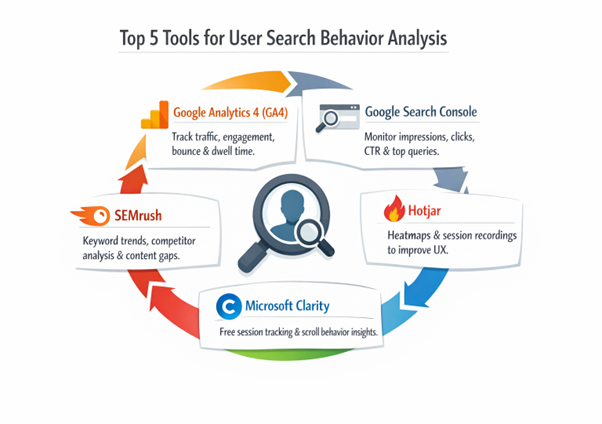
Using the right tools makes analyzing user behavior much easier. They turn raw data into clear, visual insights and reveal patterns far faster than manual tracking.
Search behaviour in digital marketing depends heavily on these tools. Each one serves a specific purpose, so it’s important to choose the right tools based on your business goals.
Here are some of the most effective platforms:
For a fully integrated SEO and behavior tracking system, explore CausalFunnel. Our team builds data-driven growth frameworks that connect search insights with measurable business results.
Below is a quick comparison of key tools:
Tool | Core Purpose | Key Insights Provided | Ideal Use Case |
Website performance tracking | Engagement rate, dwell time, conversion paths | Funnel tracking and conversion analysis | |
Search visibility monitoring | Impressions, clicks, average position, CTR | SEO performance and query optimization | |
Visual user interaction analysis | Heatmaps, scroll tracking, and session recordings | UX improvement and layout testing | |
Behavioral session tracking | Click behavior, rage clicks, scroll depth | Identifying usability issues | |
Keyword and competitor research | Search intent data, keyword gaps, ranking trends | Content strategy and competitive SEO planning |
This structured comparison helps marketers choose tools wisely. It aligns search behaviour in digital marketing with measurable insights by using multiple tools together to improve user search behavior analysis accuracy.
Basic tracking shows surface-level behavior only. Advanced analysis reveals deeper user motivations clearly. Top SEO teams rely on layered behavioral insights.
User search behavior analysis becomes stronger with advanced methods that connect data with strategic decisions. They improve both rankings and user satisfaction.
Below are high-impact techniques used by experts.
Advanced methods provide deeper clarity. They move beyond simple metric tracking and connect behavioral insights with real growth outcomes.

Search engines aim to rank content that satisfies user intent. When your content aligns with what users expect, long-term visibility improves.
User search behavior analysis strengthens SEO in several ways:
Search behaviour in digital marketing becomes measurable through these engagement signals. Marketers can track performance, refine weak pages, and strengthen high-performing content using real data.
Understanding how people search online is essential for any business. It shows what users want, helps you create content that answers their questions, and improves conversions. Paying attention to search intent, engagement, and user behavior helps you make smarter marketing decisions. Behavior trends change over time, so reviewing and adjusting your strategies regularly is key to staying effective.
If you want to turn these insights into real business growth, visit CausalFunnel. Our team can help you use search data to improve content, attract the right audience, and build lasting online visibility.
User search behavior analysis is simply understanding how people search online: What do they type, click, and read? How do they move through your website? These answers show what your audience truly wants.
User search behavior analysis is important as it helps you stop guessing. You create content people are already looking for, attract visitors who actually matter, and turn more of them into customers.
Most searches fall into four simple categories.
There are simple tools that make this easy.
Search trends do not stay the same. Your audience’s needs will change over time. So, review your data every month or quarter. Small updates regularly lead to big results.
Start using our A/B test platform now and unlock the hidden potential of your website traffic. Your success begins with giving users the personalized experiences they want.
Start Your Free Trial

Empowering businesses to optimize their conversion funnels with AI-driven insights and automation. Turn traffic into sales with our advanced attribution platform.
Trusted by Customers


©CausalFunnel Inc. All rights reserved.