



Free Funnel Audit
Convert more customers today!

Ads
10 mins read

Ads
10 mins read
Scaling ads sounds simple in theory: you increase the budget and expect more results. However, scaling without structure often destroys performance.
If you are wondering how to scale Facebook ads safely, this guide will help. You will learn when to scale and when to wait. You will also learn how to protect profitability during growth. A strong Meta ads scaling strategy focuses on profit first. It does not chase impressions or vanity metrics, but protects your margin while increasing conversions.
Scaling the wrong way can reset learning. It can increase CPA without warning, and also drain your creative performance quickly.
This guide explains the right process clearly. Here, you will get structure, not random tactics.
Many advertisers scale too early. That is the fastest way to lose stability. Before increasing spend, check these signals carefully.
If these signals are missing, wait. Scaling unstable campaigns creates bigger losses. When learning resets, costs often increase quickly. That is why patience protects performance. A smart Meta ads scaling strategy begins with stability. Stability gives the algorithm clear data signals.
If you think your campaign is ready to scale, stability usually looks like consistent daily conversions, a steady CPA within your target range, and predictable engagement metrics like CTR and frequency. Minor day-to-day fluctuations are normal, but large swings in performance indicate it’s too early to increase spend.
If you increase the Facebook ad budget during chaos, results worsen. Scaling only works when performance is predictable.

You cannot scale blindly without understanding your numbers first. Many advertisers rely only on ROAS. That metric does not tell the full story. If you want to scale Facebook ads profitably, focus on blended metrics.
The Marketing Efficiency Ratio measures total revenue divided by total ad spend.
It includes all channels, not only Facebook.
Here is a simple breakdown:
Metric | What it Measures | Why it Matters When Scaling |
ROAS | Revenue from Facebook divided by Facebook spend | Shows platform-level efficiency |
MER | Total business revenue divided by total ad spend | Shows true business profitability |
ROAS can drop during scaling, but that does not always mean performance is bad. If your MER stays healthy, scaling may still be profitable. That is why advanced advertisers track both metrics.
When you expand audiences, efficiency naturally declines. You move from high-intent users to broader segments. This does not mean scaling failed. It means you are reaching colder prospects.
A strong Meta ads scaling strategy accepts slight ROAS drops. It protects the overall margin using MER targets. If your blended performance remains profitable, scaling is working.
There are two primary ways to scale campaigns. Both methods serve different purposes.
These are:
Most accounts use both methods together. However, each requires a different approach.
Vertical scaling means increasing the budget on existing winners. You scale what already works well. This is the safest starting point. However, it must be done carefully.
Never double budgets overnight without testing. Sudden increases can trigger learning resets.
Instead, follow this safe framework:
This method protects your Facebook ads learning phase. It allows the system to adjust gradually.
If performance holds steady, continue scaling slowly. If CPA spikes sharply, pause adjustments immediately.
Campaign Budget Optimization shifts spend automatically across ad sets. It favors top-performing ad sets in real time.
CBO works best when:
CBO can support vertical scaling efficiently. However, test carefully before large increases.
If you want expert help managing advanced scaling systems, check out CausalFunnel for structured support. Scaling becomes easier with strong data foundations.
Horizontal scaling focuses on expansion. You reach new audiences instead of raising budgets only. This method increases reach and acquisition volume. It works well after vertical stability is achieved.
Start by duplicating winning ad sets. Then adjust targeting in controlled ways.
You can test:
Each duplication should test one variable only. Testing too many changes creates confusion. A proper Meta ads scaling strategy isolates changes clearly. Clear testing gives better data insights.
Audience expansion requires fresh creativity. Old creatives fatigue quickly in new segments.
Focus on:
Creative drives scaling more than targeting today. That is why Facebook ad creative testing is critical. Without a creative refresh, scaling slows down quickly.
Many advertisers increase budgets emotionally. They react to one good performance day. Scaling must follow a repeatable system. It cannot depend on random momentum.
Common mistakes include:
If you want predictable growth, structure matters. Random changes destroy performance signals. That is why disciplined advertisers win long term.
If you prefer expert guidance instead of trial and error, consult specialists at CausalFunnel. Professional strategy prevents costly scaling mistakes.
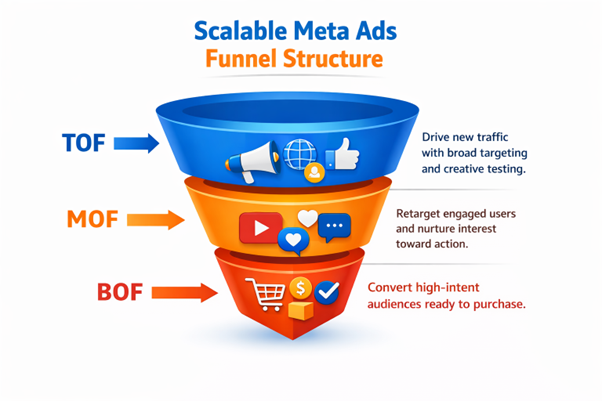
A messy account cannot scale efficiently. Clean structure improves control and measurement. You should organize campaigns by funnel stage. This helps manage budget and creative focus better.
A simple funnel structure supports controlled expansion.
Top of Funnel (TOF) focuses on cold audiences. This is where scaling volume usually happens.
TOF targeting examples include:
TOF scaling increases new user acquisition. This is where horizontal scaling of Facebook ads thrives.
Middle of Funnel (MOF) retargets engaged users. These users already showed interest earlier.
MOF audiences include:
Bottom of Funnel (BOF) targets high-intent users. These users are close to converting.
BOF often includes:
Scaling must respect funnel balance. If TOF increases without MOF support, conversion rates drop.
A structured Meta ads scaling strategy aligns budgets with funnel stages. Each stage supports the next stage properly.
Exclusions protect your budget from overlapping waste. Overlapping audiences increase CPM and hurt efficiency. Before you increase the Facebook ad budget, audit your exclusions carefully.
Check these areas first:
Exclusion errors often cause invisible budget waste. Many scaling failures start with targeting overlap. If performance drops unexpectedly, review exclusions before adjusting budgets.
Creative drives most scaling success today. Targeting is less powerful than it was before. If you want to scale Facebook ads profitably, your creative system must stay active.
Scaling increases audience exposure quickly. That means ad fatigue appears faster.
Focus on structured testing cycles. Do not change everything at once.
Test these variables one at a time:
Facebook ads creative testing should follow clear hypotheses. Each test must answer one performance question.
For example:
Without organized testing, scaling becomes unstable.
Creative angles support horizontal scaling strongly. New audiences respond differently to messaging. If one angle works for fitness users, another may work for productivity-focused users. When you expand Facebook ad audiences, adjust your creative positioning accordingly.
Here is a simple creative scaling model:
This method keeps scaling systematically.
Scaling requires close daily monitoring. However, avoid emotional overreactions.
Check these metrics consistently:
If frequency rises above 3 quickly, creative fatigue may be starting. If CPM increases sharply, audience expansion may need adjustment. A disciplined Meta ads scaling strategy tracks blended performance weekly. Daily monitoring should focus on early warning signs.
The Facebook ads learning phase affects scaling stability. Major changes often restart learning.
These actions commonly trigger resets:
To avoid resets:
Learning resets increase CPA temporarily. That is why slow scaling protects stability.
Broad targeting has become more powerful recently. The algorithm now performs better with larger data sets. When scaling horizontally, broad audiences allow deeper optimization. However, creativity must be strong. Weak creative fails in broad environments.
If you test broad targeting, ensure your conversion volume supports optimization. This approach strengthens the advanced Meta ads scaling strategy execution.
Not all budgets should move to one campaign. Balanced allocation reduces risk.
A simple allocation example:
TOF campaigns focus on cold audiences and are typically broad targeting, lookalike audiences, or open targeting designed to bring in new prospects. MOF campaigns retarget users who have engaged with your content, such as website visitors, video viewers, or add-to-cart users. BOF campaigns focus on high-intent users close to conversion, like cart abandoners, checkout initiators, or past product viewers.
This structure keeps acquisition flowing steadily. It prevents retargeting from drying up later. When you increase the Facebook ad budget, allocate new spend primarily to prospecting campaigns. Retargeting usually does not require aggressive scaling.
As performance grows, your testing must grow with it.
Introduce structured experiments such as:
These tests improve confidence in scaling decisions and reduce dependence on platform-reported attribution.
If your team lacks advanced testing frameworks, consider consulting professionals at CausalFunnel.
Scaling without testing is guesswork. Testing builds confidence and predictability.
Scaling should follow a repeatable operating system. It should never depend on emotion or luck.
A repeatable scaling system includes:
If these systems are missing, growth becomes unstable quickly. When you follow a structured Meta ads scaling strategy, results become more predictable over time.
Before scaling any campaign, review this checklist carefully. Use it as a control system. It protects your performance during growth.
If any of these signals fail, pause scaling. Fix stability before increasing spend.
Controlled increases protect algorithm stability. Large jumps often reset optimization cycles.
This checklist supports a structured Meta ads scaling strategy. It removes emotional decision-making from the process.
Many advertisers sabotage performance unknowingly. Small errors can create large cost increases. Understanding these mistakes prevents wasted budget.
Doubling spend overnight seems attractive. However, it often damages performance stability. The algorithm needs gradual adjustments. Large increases trigger learning resets frequently.
If you increase the Facebook ad budget aggressively, expect temporary CPA spikes.
Platform ROAS does not show the full business impact. It can easily mislead scaling decisions. Always compare ROAS vs MER weekly. Blended metrics show real profitability trends.
Audience overlap increases CPM significantly. It also reduces data clarity. Check exclusions regularly during expansion phases. Overlapping prospecting campaigns waste spend quickly.
Creative fatigue limits scaling potential severely. Frequency rises, and CTR drops quickly. If engagement declines consistently, introduce new creative angles immediately.
Facebook ads creative testing must continue during scaling. Stopping testing limits long-term growth.
Digital advertising continues evolving rapidly. What worked two years ago may fail today. A modern Meta ads scaling strategy relies on automation and data clarity.
Broad targeting now performs better than narrow interest stacking. The algorithm optimizes more effectively with larger data sets. When scaling horizontally, broad targeting often supports stable growth.
However, creative quality must stay strong. Weak messaging fails in broad audiences quickly.
Customer lists improve targeting accuracy significantly. Upload high-quality data for lookalike expansion. First-party data strengthens scaling confidence. It supports better audience matching overall.
Campaign Budget Optimization distributes spend automatically. It shifts budget toward better-performing ad sets.
CBO works best after stable testing phases. Avoid launching it during early campaign learning. When used correctly, it supports the vertical scaling of Facebook ads efficiently.
Platform attribution may overstate performance sometimes.
Incrementality testing shows true lift impact.
You can test this through:
This approach builds confidence before major scaling moves.
Sustainable scaling requires long-term discipline. One good month does not guarantee stability.
Create a repeatable scaling workflow including:
This system reduces emotional decisions. It protects performance during unpredictable market shifts. If scaling feels chaotic inside your account, a professional strategy can create structure.
Scaling is a controlled growth process. It should never be random or reactive.
To scale Facebook ads profitably:
A disciplined Meta ads scaling strategy balances data and patience. It prioritizes profit over vanity growth metrics. When structure guides every decision, scaling becomes sustainable instead of stressful.
For expert guidance and structured scaling support, visit CausalFunnel and optimize your campaigns efficiently.
You should wait at least 3 to 7 days. The campaign must show stable CPA and conversions. Do not scale during the learning phase. Stable data gives better scaling confidence. If performance fluctuates daily, wait until the results level out first.
The safest method is vertical scaling. Increase the budget by 10 to 20 per cent, and wait at least 48 hours before scaling again. Monitor CPA and ROAS closely after changes. Small steps reduce algorithm disruption. Large jumps often hurt performance stability.
Start with one profitable campaign first. Focus on stable cost per acquisition. Use vertical scaling before expanding audiences. Then test horizontal scaling carefully. Track blended metrics instead of platform ROAS alone. This creates a safer growth structure.
Your campaign should meet these conditions:
If these signals are strong, you can begin scaling gradually.
Budget increases can reset the learning phase. The algorithm needs time to adjust. Scaling too fast causes instability. Audience saturation can also increase costs. Reduce the budget slightly if CPA spikes sharply. Then scale again more slowly.
Start using our A/B test platform now and unlock the hidden potential of your website traffic. Your success begins with giving users the personalized experiences they want.
Start Your Free Trial

Empowering businesses to optimize their conversion funnels with AI-driven insights and automation. Turn traffic into sales with our advanced attribution platform.
Trusted by Customers


©CausalFunnel Inc. All rights reserved.