



Free Funnel Audit
Convert more customers today!
SEO
10 mins read

SEO
10 mins read
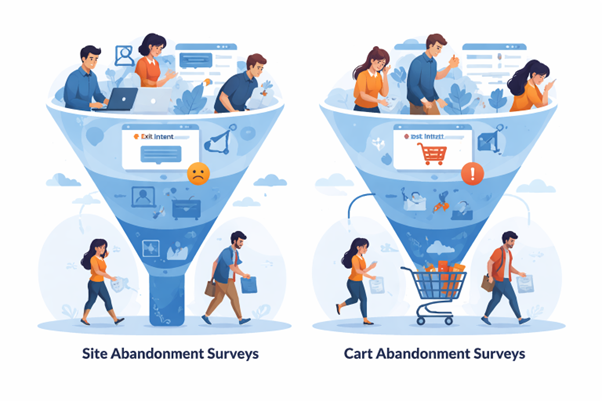
Site abandonment surveys vs. cart abandonment surveys differ in one critical way. One explains why visitors leave early. The other reveals why ready-to-buy users walk away at the last moment.
It shapes what questions get answered, what problems get fixed, and how much revenue gets recovered. Many teams pick one tool, set it up, and expect magic. Then months later, the same question lingers in meetings. “Why are people still dropping off?”
The answer often sits in the wrong type of survey.
A site abandonment survey is a short question that shows up when a visitor is about to leave a website. They did not do anything important there. It is usually triggered by exit intent. This means the system detects signs that the user is about to leave the page.
On desktop, this often happens when the mouse moves quickly toward the close button or browser tab. On mobile, it can be triggered by fast scrolling back or inactivity. It is also shown when the user tries to exit the page.
These surveys usually appear as on-site popups or small widgets. The question shows directly on the same page. The user does not need to go anywhere else. Some tools also send follow-up emails. But on-site surveys give faster and more honest answers.
Site abandonment surveys target all visitors. This includes new users and returning users. It also targets people who stay for only a few seconds. That makes the reach wide. However, the feedback can be mixed since users are at different stages.
For example, a visitor may land on a homepage. They may scroll for a few seconds, and leave. Without a survey, the reason stays unknown. The page might feel confusing. It might load slowly. Or it may not match what the user expected. A site abandonment survey helps uncover that reason in a simple way.
A cart abandonment survey shows up when a user adds items to their cart but leaves without buying. It only triggers after a clear buying action. So, the intent is already high.
These surveys are based on cart activity tracking. The system checks if a user adds a product but does not complete the checkout. If they leave, the survey can appear on the screen. Sometimes, it can be sent later through email.
On-site surveys show instantly when the user tries to exit. Email surveys appear later when the user has more time. Both methods are used. But on-site feedback is usually quicker and more direct.
Cart abandonment surveys focus on users who are very close to buying. They have already picked a product and started checkout. So when they leave, something specific blocks them.
It could be a high shipping cost or a long checkout process. It could even be missing payment options. Sometimes it is trust issues at the final step.
These answers are usually clear and short. Users often say things like “shipping was too expensive” or “checkout took too long.” This makes it easier to find and fix real problems that affect sales.
In simple terms, this survey captures the final reason a customer did not complete the purchase even after showing strong intent.
Factor | Site Abandonment Surveys | Cart Abandonment Surveys |
Trigger point | Exit during browsing | Exit after adding to cart |
Audience | All visitors | High-intent users |
Stage | Early journey | Late journey |
Questions answered | Why users don’t explore | Why users don’t buy |
Insight type | UX, clarity, relevance | Pricing, friction, trust |
Volume | High | Lower but richer |
Revenue impact | Indirect | Direct |
Site abandonment surveys focus on users who are still exploring. These users may not fully understand the product yet. Alternatively, they may not feel convinced enough to continue. So the insights here are mostly about clarity and usability. On the other hand, cart abandonment surveys deal with users who already showed strong intent. They added items to the cart. It means interest is already there. So the feedback becomes more about final blockers like price or checkout issues.
The biggest difference shows up in revenue impact. Site abandonment surveys give indirect signals. They help improve pages and overall user experience. But the effect on revenue is gradual. This is because the users are still early in the funnel. Cart abandonment surveys, however, connect directly to lost sales. When someone leaves the cart, it often means a near-purchase was missed. Fixing those issues can quickly improve conversions. This is why this stage is often seen as more revenue-sensitive.
Another key difference lies in the type of insights collected. Site surveys mainly uncover UX problems or unclear value propositions. These are top-of-funnel issues. Cart surveys, in contrast, focus on pricing concerns and hidden friction in checkout. They consider trust gaps at the final step. These are bottom-of-funnel problems that directly affect buying decisions.
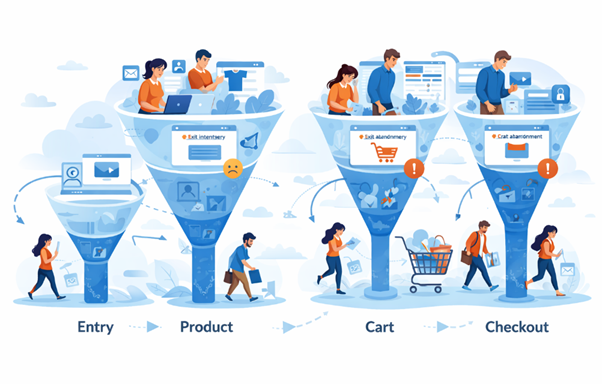
Every website follows a simple flow:
Think of it like walking into a store. Browsing is like wandering the aisles. The cart is picking items. The checkout is standing at the counter.
Each stage has its own doubts. At the browsing stage, the thoughts sound like this:
At the cart stage, the tone shifts:
Surveys map directly to these moments.
Miss one stage, and the picture stays incomplete.
Analytics tools show behavior. They show clicks, scrolls, drop-offs. But they stay silent on intent.
A heatmap might show users leaving a page. But it won’t explain why.
Did the message feel off? Was the design confusing? Did the price seem too high?
That silence leads to assumptions. Assumptions lead to wasted fixes.
Take the example of a SaaS landing page. It sees high traffic but low engagement. The team assumed the CTA was weak. They changed colors, text, and placement.
Nothing changed. Then a simple exit survey asked one question: “What stopped you today?”
The top answer was unexpected. “Not clear what this tool actually does.”
The issue wasn’t the button. It was the clarity that it failed to provide to the visitor. This insight guided further action.
Site abandonment surveys uncover early-stage friction. The kind that stops users before they even think about buying. These insights often feel broad. But they are critical.
Here’s what typically shows up:
Think about a first-time visitor. They land, skim, and hesitate. Common thoughts on their mind are:
“Is this even for me?” “Will this solve my problem?” “Do I want to spend more time here?”
If those questions go unanswered, they leave. Without a survey, those reasons stay hidden.
Cart abandonment surveys go deeper. The answers are sharper because the intent is stronger.
These users already decided they like the product. Something else stopped them.
Common insights include:
In this stage, the internal questions in the mind of the visitor shifts. Common doubts include:
“Is this worth the total cost?” “Can I trust this payment process?” “What if I find it cheaper elsewhere?”
These are not casual doubts. They are final blockers. Fix them, and conversions move fast.
Site abandonment surveys bring volume. They capture more users. They reveal early problems.
Cart abandonment surveys bring precision. They capture fewer users, but the insights link directly to lost revenue.
So which matters more?
It depends on where the problem sits. If traffic is high but users don’t explore, site surveys matter more.
If users reach the cart but don’t buy, cart surveys take priority.
Both matter. But not at the same time.
Certain signals point clearly to the need for site-level insights. Look for patterns like:
These signs suggest early friction. Typical scenarios include:
At this stage, the big question is: “Why aren’t people staying?”
Sometimes, a blunt question like this helps: “Is this site even making sense to visitors?”
Cart-level surveys become essential when users show intent but fail to convert.
Clear signals include:
This stage is more focused. Users already said yes to the product. Now they hesitate.
Typical decision thoughts look like:
“Is this price fair?” “Do I trust this site with my card?” “Is there a better deal out there?”
These are high-stakes moments. Even small fixes here can lead to big revenue gains.
Relying on only one type of survey often leaves gaps in understanding user behavior. A better approach is to use both site abandonment and cart abandonment surveys together. This gives a full view of the customer journey. It includes from the first visit to the final checkout.
A simple way to start is by mapping the full funnel first. This helps place surveys at the right points.
Typical funnel stages look like this:
Once this is clear, surveys can be placed at natural exit points. For example, a site abandonment survey works best on entry and product pages. A cart abandonment survey works best after users add items to the cart but leave without buying.
Now comes the setup process. A practical step-by-step flow usually looks like this:
Timing also matters. A good starting point is to run site abandonment surveys first for at least two to four weeks. This helps collect enough early-stage data. After that, cart abandonment surveys can be introduced. They will capture late-stage friction. Running both together after this phase gives a complete picture of where users drop off and why.
A sample workflow looks like this in practice. First, a visitor lands on a product page and leaves without clicking anything. A site abandonment survey appears asking why they did not continue. Next, another user adds a product to the cart but exits during checkout. A cart abandonment survey triggers and asks what stopped the purchase. Over time, both sets of responses are grouped and reviewed together.
The quality of answers depends on the quality of questions. Keep them simple and easy to answer.
For site abandonment:
For cart abandonment:
Avoid long forms. No one wants to fill a survey while leaving.
Many teams rush into tools without thinking through strategy. That leads to wasted time and poor insights.
Common mistakes include:
Before signing any contract, pause and ask: “Are the right questions being asked at the right moment?”
Choosing a tool is not just about features. It’s about fit. Start with the basics.
Also consider this.
These questions often get overlooked. But they matter because the right answers save time and cut wasted spending. It turns feedback into real growth instead of just more data sitting in a dashboard.
For site abandonment surveys, tools that focus on behavior tracking and on-page feedback work best. These tools help capture why users leave before they even reach product pages.
Some commonly used options include:
For cart abandonment surveys, the focus shifts toward purchase intent and checkout friction. These tools help understand why users hesitate right before payment.
Site abandonment surveys vs. cart abandonment is not a competition. It’s a sequence.
One explains why users never engage. The other explains why they almost buy but don’t.
Together, they tell the full story. That story answers the real question behind every drop-off.
Not just what happened, but why it happened. So before picking a tool or signing a contract, ask one thing.
Are you trying to fix the beginning of the journey, or the final step where money is lost?
Exit intent surveys appear when a user is about to leave any page on a website. They target all visitors, even if they never added anything to the cart. Cart abandonment surveys appear only after a user adds items to the cart and leaves before buying. Exit intent focuses on browsing issues, while cart surveys focus on purchase barriers.
A site survey should have only one to two questions. Short surveys get more responses. Long surveys feel like work and get ignored. The goal is to understand why users leave quickly. Simple questions like “What stopped you today?” work best. Keeping it short helps capture honest and fast feedback from visitors.
A good cart abandonment rate usually ranges between 60% and 70%. This means most users still leave before buying, which is normal in e-commerce. Rates lower than 60% are strong. Higher than 70% means there may be issues in pricing, checkout steps, or trust. Small fixes can improve conversions quickly.
Yes, both surveys work best together. Site surveys help understand early drop-offs during browsing. Cart surveys explain why users leave at the final step. Using both gives a full view of the customer journey. This helps fix problems at each stage and improves overall conversion rates in a structured and clear way.
Start using our A/B test platform now and unlock the hidden potential of your website traffic. Your success begins with giving users the personalized experiences they want.
Start Your Free Trial

Empowering businesses to optimize their conversion funnels with AI-driven insights and automation. Turn traffic into sales with our advanced attribution platform.
Trusted by Customers


©CausalFunnel Inc. All rights reserved.