



Free Funnel Audit
Convert more customers today!
SEO
10 mins read

SEO
10 mins read
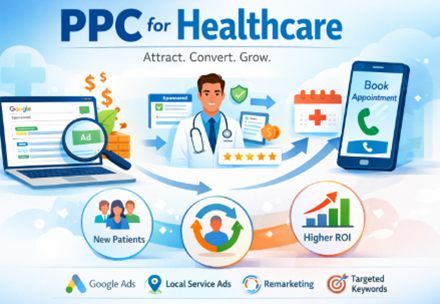
Healthcare marketing has changed a lot in recent years. Patients now search online before choosing a provider. This shift makes PPC for healthcare one of the most effective growth strategies today.
If you want faster patient bookings, this guide will help you. We will cover strategy, costs, and real results in simple terms.
PPC stands for pay-per-click advertising. You pay only when someone clicks your ad.
In healthcare, PPC helps clinics and hospitals appear on search results. These ads show when patients search for treatments or services.
Here is how the process usually works:
Each click costs money, but it brings potential patients.
Healthcare PPC requires more care than other industries.
Because of these factors, strategy matters much more.
PPC is powerful because it connects you with patients instantly.
Your clinic can appear on top within hours of launching ads. Organic SEO usually takes months to show results.
Most people clicking healthcare ads need help quickly. They are not just browsing casually.
You can track every click, call, and booking clearly. This helps you understand what works and what needs improvement.
PPC works for different types of providers:
Factor | PPC | SEO |
Speed | Immediate results | Slow growth |
Cost | Pay per click | Long-term investment |
Results | Predictable | Compounding over time |
Both methods work best when used together.
Understanding the journey helps you improve results.
The process usually looks like this:
Search intent → Click → Landing page → Booking
Each step must work well for conversions.
Different patients search for different reasons.
High traffic does not always mean more patients. Right intent brings better conversions and lower costs.

Different ad formats serve different goals.
Ad Type | Best For | Example Use |
Google Search Ads | High-intent leads | “dentist near me” |
Display Ads | Awareness | Brand visibility campaigns |
Remarketing Ads | Re-engagement | Bringing back website visitors |
YouTube Ads | Education | Explaining treatments |
Social Media Ads | Discovery | Promoting services |
Call-Only Ads | Direct bookings | Emergency services |
Using only one format limits your reach. Combining formats improves both awareness and conversions.
Local Service Ads are becoming very important in healthcare marketing. If you are targeting patients in the US, you should not ignore them.
These ads appear at the very top of search results. They usually show above regular Google Ads listings.
Local Service Ads are pay-per-lead ads, not pay-per-click ads. You only pay when a patient contacts you directly.
These ads show key details upfront, which builds instant trust.
They usually include:
This format makes it easier for patients to choose quickly.
Patients often want quick and trusted options. LSAs are designed exactly for that behavior.
Here is why they perform well:
Because of this, LSAs often generate high-quality leads.
Understanding the difference helps you use both formats better.
Feature | Local Service Ads | Google Search Ads |
Pricing Model | Pay per lead | Pay per click |
Placement | Top of results page | Below LSAs |
Trust Signals | Reviews and verification badge | Limited trust signals |
Click Behavior | Direct calls or messages | Website visits |
Both formats are useful, but LSAs focus more on direct conversions.
LSAs work best for certain situations.
However, LSAs are not available for every specialty or location. Availability depends on Google’s supported categories.
You can improve performance with a few practical steps.
Faster response times often improve your lead quality.
A structured approach gives better results. It ensures that every stage, from targeting to tracking, works together efficiently. This reduces wasted spend and improves overall campaign performance.
Start with how patients actually search online.
Use simple and common phrases instead of medical jargon.
Examples:
Focus on local and service-based keywords.
Location targeting is very important in healthcare PPC.
These steps ensure your budget reaches the right audience.
Your ad copy must feel clear and trustworthy.
Key elements of a good ad:
Patients prefer ads that feel reliable and easy to understand.
Sending users to your homepage reduces conversions.
Instead, create focused landing pages for each service.
Include the following:
Matching the ad and landing page improves trust and results.
Tracking helps you measure real performance.
Track these actions:
Tracking is important because it shows what actually works. Without tracking, you cannot improve your return on investment.
Bidding is one of the most important parts of PPC campaigns. It decides how much you pay and how often your ads show.
If you ignore the bidding strategy, your costs can rise quickly. At the same time, the right approach can improve results without increasing the budget.
A bidding strategy tells Google how to spend your budget. It controls how much you are willing to pay for clicks or conversions.
Different strategies work for different goals and stages.
Most healthcare campaigns move through three main strategies over time.
Strategy | How It Works | Best For |
Manual CPC | You set the cost per click manually | Beginners and testing phase |
Maximize Conversions | Google automatically gets more conversions | Scaling campaigns with data |
Target CPA | Google aims for a specific cost per patient | Stable campaigns with clear goals |
Each option has its own purpose depending on your campaign maturity.
Manual CPC gives you full control over your bids. You decide how much you want to pay for each click.
This is useful when you are just starting your campaigns.
Why it works well initially:
However, manual bidding requires regular monitoring and adjustments.
Once you have some data, automation becomes helpful. Maximize Conversions uses machine learning to get more leads.
Google adjusts bids automatically based on user behavior.
When to use this strategy:
Still, you should monitor performance regularly to avoid wasted spend.
Target CPA focuses on cost efficiency. You tell Google how much you want to pay per patient.
The system then tries to maintain that cost level.
Benefits of Target CPA:
This strategy works best when your campaign has enough historical data.
Switching strategies too early can hurt performance. A step-by-step approach usually works better.
Typical progression:
This flow helps you balance control and automation.
Many advertisers struggle because of simple mistakes.
Avoiding these mistakes can improve stability and results.
If you are running ads, you should understand Quality Score clearly. It directly affects how much you pay and where your ads appear.
Many clinics ignore this, but it has a big impact on results.
Quality Score is a rating given by Google to your ads. It usually ranges from 1 to 10 for each keyword.
A higher score means your ads are more relevant and useful.
Google uses this score during the ad auction process. It helps decide your ad position and cost per click.
Healthcare keywords are often expensive and highly competitive. Because of this, even small improvements can save money.
A better Quality Score can:
So, instead of spending more, you can optimize better.
Google uses three main factors to calculate your score.
Factor | What It Means | Why It Matters |
Expected Click-Through Rate (CTR) | Likelihood of users clicking your ad | Higher CTR improves ad performance |
Ad Relevance | Match between keyword and ad copy | Better relevance improves rankings |
Landing Page Experience | Quality and usefulness of your page | Good experience increases conversions |
Each factor plays an important role in your campaign success.
Let’s say two clinics target the same keyword.
Even if Clinic B bids more, Clinic A may still rank higher. This happens because Google rewards relevance and user experience.
Improving your score is not complicated if you follow a clear process.
Avoiding these mistakes can quickly improve performance.
Fixing these issues often leads to better scores and lower costs.
Costs in healthcare PPC depend on several important factors. Competition, location, and specialty all influence pricing significantly.
In general, healthcare advertising is more expensive than most industries. This happens because patient value is higher and competition is strong.
Healthcare keywords often have high competition in the US market. Because of this, cost per click can increase quickly.
Here are general CPC ranges across industries:
However, these ranges become more specific when you look at specialties.
Different specialties have very different costs. Some services are more competitive and bring higher revenue.
The following ranges are based on commonly reported industry benchmarks and campaign data. Actual numbers may vary based on location and competition.
Specialty | Typical CPC Range |
Dental Implants | $50–$150 per click |
LASIK Eye Surgery | $40–$100 per click |
Dermatology | $20–$60 per click |
Primary Care | $5–$20 per click |
High-ticket treatments like dental implants often cost more per click. At the same time, they also generate higher revenue per patient.
On the other hand, primary care keywords usually cost less. However, they may require higher volume to generate meaningful returns.
There are clear reasons behind these differences.
Understanding this helps you set realistic expectations.
Your monthly budget depends on your goals and service focus. Smaller clinics can start with modest budgets and scale gradually.
Here are realistic starting points for US healthcare providers:
Practice Type | Monthly Budget | Expected Leads |
Small Clinic | $1,000–$3,000 | 20–50 leads |
Mid-Size Practice | $3,000–$10,000 | 50–150 leads |
Multi-Location Hospital | $10,000+ | 150+ leads |
Actual results will vary based on targeting and campaign quality.
CPA means cost per acquired patient. It shows how much you spend to generate one booking.
Typical CPA range in the US:
Higher-value services usually have higher CPAs. Even then, they often remain profitable due to higher patient lifetime value.
Lowering CPA is key to improving profitability over time. Small improvements in targeting and optimization can make a big difference.
Here are practical ways to reduce your costs:
Over time, better optimization leads to lower costs and stronger returns.
Return on investment depends on several important factors. However, you can still estimate performance using industry benchmarks.
Healthcare PPC can deliver strong results when campaigns are set up properly. Many clinics see consistent growth once optimization improves over time.
Most healthcare providers aim for a minimum return that justifies ad spend.
Higher ROI usually comes with better targeting and strong conversion funnels.
Understanding these numbers helps you set realistic expectations.
Metric | Typical Benchmark |
Click-Through Rate (CTR) | ~1.79% average |
Conversion Rate | 2%–5% average |
ROI Target | Minimum 3:1 |
These benchmarks are based on commonly reported US healthcare advertising data. Actual performance can vary depending on specialty and competition.
Let’s break this down in a simple way.
Each metric plays a role in your overall success.
You can calculate ROI using a simple formula.
ROI = (Revenue – Ad Spend) ÷ Ad Spend
For example, if you spend $1,000 and earn $3,000, your ROI is 3:1.
Several elements directly impact your returns.
Even small improvements in these areas can increase profitability.
Better results come from consistent optimization.
As your campaigns improve, your ROI usually grows steadily.
Mistakes can waste your budget quickly.
Problem: Ads attract irrelevant traffic
Fix: Use specific and local keywords
Problem: Users get confused and leave
Fix: Use dedicated landing pages
Problem: You cannot measure results
Fix: Set up tracking for calls and forms
Problem: You lose most potential patients
Fix: Optimize for mobile devices
Problem: Budget gets wasted on irrelevant clicks
Fix: Add keywords you want to exclude
Fixing these issues improves performance quickly.
Running healthcare ads comes with strict responsibilities. You are not just marketing a service, you are handling sensitive patient trust.
Let’s break this down in a simple way so it feels manageable.
Healthcare advertising is different from other industries. Patient data is sensitive and legally protected in many cases.
If you ignore compliance, you risk more than wasted ad spend.
So, getting this right is not optional.
In the United States, healthcare marketing must follow HIPAA rules. HIPAA stands for Health Insurance Portability and Accountability Act.
It protects patient health information, also called PHI.
Protected Health Information includes any data linked to a patient.
If your ads or tracking tools handle this data, HIPAA applies.
Many clinics unknowingly violate HIPAA while running ads.
Here are common mistakes you should avoid:
For example, showing ads like “We know you need diabetes treatment” is not allowed.
You can still run effective campaigns while staying compliant.
Focus on services, not personal health situations.
Disclaimers help you stay transparent and compliant.
They also build trust with potential patients.
You should place disclaimers on landing pages, not inside tight ad copy.
Each advertising platform has its own healthcare policies. Understanding them helps you avoid ad rejections.
Google allows healthcare ads but applies strict restrictions.
Google also limits remarketing for sensitive health topics.
Meta takes a stricter approach to health-related ads.
This means your messaging must stay general and respectful.
Remarketing can be risky in healthcare campaigns.
If not handled carefully, it may reveal sensitive user intent.
Safe approach:
Here is a quick checklist you can follow before launching campaigns.
Both strategies have unique advantages.
Factor | PPC | SEO |
Speed | Fast results | Slow growth |
Cost | Pay per click | Investment over time |
Long-Term Value | Stops when ads stop | Builds lasting traffic |
Best Use | Quick bookings | Brand authority |
Using both PPC and SEO together works best. PPC brings quick results, while SEO builds long-term growth.
Certain situations make PPC more useful.
In these cases, PPC provides immediate visibility.
Small changes can improve performance quickly.
Consistency is key to better results.
Let us look at a simple case.
A local dental clinic had low online visibility. They struggled to get consistent patient bookings.
This example shows how the right strategy drives real growth.
This decision depends on your time and experience.
Hiring experts often leads to better ROI over time.
PPC is one of the fastest ways to grow a healthcare practice.
It brings high-intent patients directly to your clinic. Results are measurable and scalable with the right strategy.
Costs can be high, but returns often justify the investment. Success depends on proper planning and continuous optimization.
If you want faster patient growth, PPC is worth considering seriously. Starting with a small budget and testing campaigns is a smart first step.
A proper audit or consultation can help you avoid mistakes early. Taking action today can bring consistent patient bookings tomorrow.
A negative keyword is a search term that prevents your ads from appearing. It blocks searches that are not relevant to your product or service.
For example, a paid CRM software company may block words like:
This helps avoid clicks that rarely convert into customers.
There is no fixed number of negative keywords for every campaign. Most campaigns use dozens or even hundreds of negative keywords.
Large accounts often maintain shared lists with 100-300 negative keywords. These lists help filter irrelevant searches across multiple campaigns.
Yes, negative keywords significantly improve PPC campaign performance. They prevent ads from appearing for irrelevant searches.
This leads to several benefits:
Over time, campaigns become more efficient and profitable.
Negative keyword lists should be reviewed regularly. Most PPC experts check search term reports every week. Regular updates help discover new irrelevant search queries. Adding those keywords prevents future wasted clicks. Continuous optimization improves campaign targeting and performance.
Start using our A/B test platform now and unlock the hidden potential of your website traffic. Your success begins with giving users the personalized experiences they want.
Start Your Free Trial

Empowering businesses to optimize their conversion funnels with AI-driven insights and automation. Turn traffic into sales with our advanced attribution platform.
Trusted by Customers


©CausalFunnel Inc. All rights reserved.