



Free Funnel Audit
Convert more customers today!
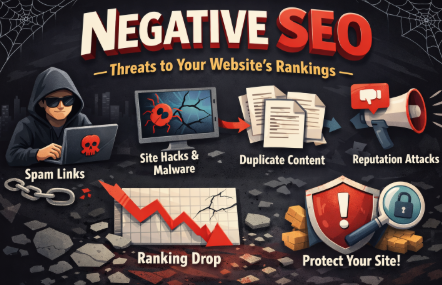
SEO
10 mins read

SEO
10 mins read
Negative SEO still matters because the web is more automated than ever. Bots are cheap. Tools are easy to access. Attacks can scale fast.
In simple words, negative SEO means trying to hurt someone else’s website rankings on purpose.
It is not about ranking your own site. It is about damaging another site.
People still use it because it is low risk and hard to trace. Most attacks look like normal spam. That makes intent hard to prove.
Search engines like Google still struggle with intent. Their systems see data patterns, not motives. A bad link and a bad actor look the same to an algorithm.
Who is most at risk:
Bad SEO is usually poor strategy or mistakes. Negative SEO is intentional harm.
Negative SEO is a deliberate attempt to damage a website’s rankings using manipulative tactics.
It is different from black-hat SEO. Black-hat SEO tries to rank your own site using tricks.
Negative SEO tries to sink someone else’s site.
It is different from algorithm penalties. Penalties are system responses. Negative SEO is human-driven sabotage.
Three clear categories exist:
Negative SEO always falls into the attack category.
Search engines rely on trust systems. Trust systems can be exploited.
Key reasons it still works:
According to IBM’s cybersecurity research, automation and bot networks now power most digital attacks. This same automation model is used in SEO sabotage.
These attacks target your backlink profile.
Common methods include:
These attacks aim to poison trust signals.
These attacks target your content signals. Common methods include:
These attacks confuse indexing and ownership signals.
These attacks target site infrastructure. Common methods include:
These attacks damage site health and trust.
These attacks target brand trust. Common methods include:
These attacks damage perception and authority.
These attacks target user signals. Common methods include:
These attacks confuse ranking systems.
Watch for these signals:
This is a real system you can use. It is simple and practical and works in real projects.
You cannot detect attacks if you have no baseline. So step one is always measurement.
This is your clean reference point. Track and store:
Save this data. This is your normal state.
Now you watch for abnormal change. Daily checks:
Define what a real spike means:
If you see this, it is not normal growth.
Once a month, do a full audit.
Checklist:
This is where slow attacks get caught.
These numbers matter. They help remove guesswork.
Red flag:
Example:
If you get 20 links a week normally,
200+ links is a danger signal.
Red flag:
Healthy profiles are mixed. Branded. Natural. Diverse.
Red flag:
This is common in spam networks.
Red flag:
Low trust clusters are toxic signals.
Google Search Console is your first warning system. But only if you know how to read it.
Manual Action:
Algorithmic Action:
This section shows:
If anything appears here, act fast. This is not SEO. This is a security threat.
Watch for:
These often follow technical attacks.
Automation removes human delay. You cannot watch data 24/7. Systems can.
Ahrefs setup:
This gives early warning.
Semrush setup:
These are the red flags. They are the indicators of potential harmful backlinks, spammy sites, or sudden suspicious activity that could hurt your SEO.
Setup alerts using search syntax:
Examples:
This catches:
Regular monitoring with Google Alerts helps you respond quickly to issues and protect your brand reputation before problems escalate.
There is a big difference between negative SEO and Google penalties
Algorithmic actions are system-based. Manual actions involve human review. Negative SEO is external harm.
False positives happen often in SEO tools. Recovery paths are different for each case.
Build natural trust buffers.
Core actions:
Protect ownership signals.
Core actions:
Lock your systems. Cloudflare reports that bot traffic now forms a large part of malicious web activity. This directly affects SEO manipulation risks.
Core actions:
Defend brand trust. Actions to take include:
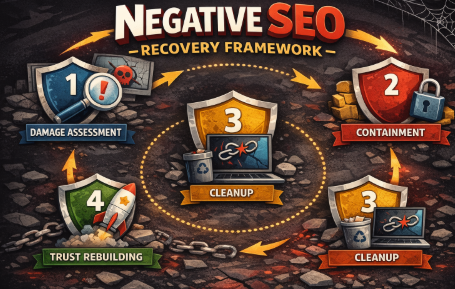
Recovery is not one action. It is a system that runs in phases. Each phase has clear goals, timelines, and steps.
This phase is about clarity.
You cannot fix what you cannot see.
Start with hard data.
Not feelings.
Not guesses.
Track the following:
This gives you a full damage map.
This phase is about stopping spread.
Not fixing everything.
Just stopping new damage.
Start with the worst threats first.
Emergency disavow setup
Security hardening
Traffic and bot blocking
Campaign pause
You cannot clean while leaks are open.
Now you clean slowly and safely.
This phase is about precision.
Not speed.
Outreach before disavow
Start with removal requests.
Subject: Link removal request
Hi,
Our site has a link on your website that we did not create.
Please remove it from the page.
Thank you for your help.
Subject: Follow-up on link removal
Hi,
This is a follow-up request to remove the link to our website.
We did not authorize it.
Please confirm once removed.
Thank you.
Subject: Final request for link removal
Hi,
This is our final request to remove the unauthorized link.
If not removed, we will disavow the domain.
Thank you.
Do not rush.
Safe pace:
Duplicate content removal
Ownership protection
Use Search Console tools:
This restores index hygiene.
This is the healing phase. Trust must be rebuilt slowly.
Publishing rhythm:
Focus on:
Safe acquisition methods:
Build real visibility:
Support trust through:
These are soft trust signals. But they matter.
Recovery is not instant.
Realistic timeline:
Speed depends on:
These are realistic benchmarks:
Get expert support if:
Sometimes recovery needs deep technical and forensic SEO work.
Disavow only when needed. Use it when:
Do not use it when:
Panic disavowing causes harm. Strategic disavowing protects trust.
Yes. It is growing. Reasons:
Let’s see how negative SEO looks in real life.
Attack timeline
In 2014, Ginger Software was hit with a massive spam attack. Over 44,000 spammy backlinks were created in about one month. The links came from low-quality sites, spam blogs, and fake pages. Anchor text was unnatural and over-optimized.
Detection method
The team noticed:
The backlink velocity was the key signal. Growth was not natural. Patterns showed automation.
Recovery steps
They took structured action:
Final outcome
Results after recovery:
This case proved one thing clearly: Negative SEO can trigger real penalties if left unmanaged.
Attack timeline
During the Penguin 3.0 update period, Jellyfish Agency analyzed a client case. The site was hit with more than 1,700 toxic backlinks. Links came from:
Soon after, rankings dropped sharply.
Detection method
Signals that exposed the attack:
Pattern analysis confirmed it was not organic growth.
Recovery steps
The recovery process was clean and structured:
Final outcome
Clear recovery metrics:
This showed that cleanup plus trust rebuilding works.
Attack timeline
A mid-size ecommerce site was targeted in late 2024. The attack included:
Within weeks, organic traffic dropped.
Detection method
The SEO team detected:
A backlink audit confirmed coordinated manipulation.
Recovery steps
They used a phased system:
Final outcome
Measured recovery results:
This case proves recovery is possible with systems, not panic.
High-risk groups:
The more visible you are, the higher the risk.
Common myths:
All are false.
Helpful categories:
Tools help, but systems matter more.
Tool Name | Price | Key Features | Best For | Limitations |
Google Search Console | Free | Backlink data, index status, manual action alerts, search performance reports | Basic backlink monitoring | Updates weekly, not real-time; limited backlink detail |
Google Analytics 4 | Free | Traffic trends, user behaviour, conversion data | Traffic patterns & anomalies | No direct backlink analysis; needs setup |
Ahrefs | $99/mo (starts) | Backlinks, keyword tracking, site explorer, updates multiple times daily | Deep backlink & SEO analysis | Costly for small sites; learning curve |
Semrush | $139.95/mo (starts) | Backlink audit, keyword tracking, site audits, competitor analysis | All-in-one SEO & marketing suite | Overwhelming for beginners; price |
Moz Pro | Varies (from ~$99/mo) | Link explorer, ranking tools, site audits | Small to mid-size SEO teams | Backlink database smaller than Ahrefs |
Majestic | Varies | Trust Flow, Citation Flow, backlink history | Link trust & historical signals | Limit |
Negative SEO is digital sabotage. It overlaps with cybercrime and involves fraud, impersonation, and deception. In many regions, it falls under cybercrime law. The FTC and cybercrime agencies treat digital sabotage as a legal offense.
Evidence preservation matters. Logs, links, and timestamps matter.
It is the act of harming a competitor’s rankings on purpose.
Yes. It works when systems are weak.
Yes. If defenses are poor.
Look for patterns, not single changes.
Only when used carefully.
Not reliably at intent level.
Start using our A/B test platform now and unlock the hidden potential of your website traffic. Your success begins with giving users the personalized experiences they want.
Start Your Free Trial

Empowering businesses to optimize their conversion funnels with AI-driven insights and automation. Turn traffic into sales with our advanced attribution platform.
Trusted by Customers


©CausalFunnel Inc. All rights reserved.