



Free Funnel Audit
Convert more customers today!
SEO
10 mins read

SEO
10 mins read
Many people mix up landing pages and websites. Both live online and both show business information. Both can sell products and collect leads. Both can appear in search results.
So, people assume both things work the same way. This belief creates weak marketing strategies. This guide shows where each one fits so you can choose the right structure.
A website is a collection of connected web pages. It usually lives under one main domain name and represents a brand or business online.
A website builds long term brand presence. It supports organic traffic growth through SEO. A website creates trust with visitors over time. It also works as an information hub for users.
Search engines treat websites as authority systems. They evaluate structure, content depth, and consistency. Websites show topical coverage and expertise signals and are designed for indexing at scale. Crawl depth helps search engines understand structure.
Topical authority is important for your SEO. It comes from consistent publishing and builds trust across related keyword clusters. Topical authority shows expertise in specific subject areas. Search engines reward structured content ecosystems.
Websites pass authority through internal linking. Landing pages benefit from strong domain trust. Content pages feed value into conversion pages. This creates a natural SEO hierarchy.
So, strong websites make landing pages rank easier.
Websites serve multiple user journeys.They support research and learning stages and help users compare options clearly. They build trust over long timeframes and attract stable organic traffic streams.
As you can see, a website supports full user journeys. It connects awareness, trust, and decision stages and acts as the foundation for SEO growth.
A landing page is a single focused web page. It is built for one specific goal. Essentially, a landing page asks users to take one clear action.
Search engines see landing pages as intent driven assets. They treat them differently from blogs and content pages. Landing pages usually target narrow and specific queries. They focus more on action than information. Because of this, search engines evaluate them on intent match. Relevance and clarity matter more than content depth here.
Conversion SEO focuses on actions, not just rankings. It means designing pages for user decisions. It connects keyword intent with user behavior and aligns search traffic with conversion goals. Traffic quality matters more than traffic volume.
Many landing pages get crawled but not indexed well. This is because of their thin content. These pages provide little informational value.They don’t have external links as well. Thus, they often lack trust signals. Search engines need value signals to rank pages. Low authority pages struggle in competitive search results.
Landing pages act as funnel entry points. They guide users toward one clear action.
They convert traffic generated by SEO content and work best inside structured funnels. They should support the website, not replace it.
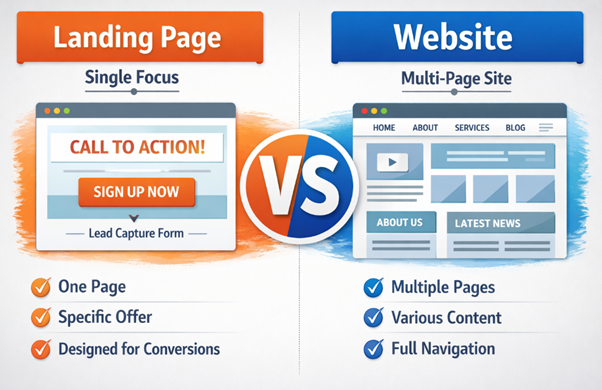
Before comparing features, it helps to understand the purpose behind design. Landing pages remove distractions to protect conversions. This is not a design trend or visual style choice. It is a behavioral strategy based on user psychology. Less navigation creates fewer decisions for users. Fewer decisions increase the chance of action.
Websites work in the opposite way. They must support many user journeys at once. Some users want information and learning while others want trust and credibility or comparison and validation. Therefore, websites need structure, depth, and navigation.
Each structure serves a different growth goal. One focuses on speed and action. The other focuses on trust and long term growth.
Factor | Landing Page | Website |
Purpose | Conversion | Information and trust |
Structure | Single page | Multiple pages |
Navigation | Limited or none | Full navigation |
SEO role | Campaign SEO | Long term SEO |
Traffic sources | Ads, email, social | Search and referrals |
Content depth | Focused | Broad |
User intent | Action based | Research based |
This difference changes how search engines explore content.
Internal links help search engines understand importance and hierarchy.
Authority flow strengthens rankings across the entire domain.
User intent defines what people want from a search. Informational queries look for knowledge and learning. Examples include queries like “what is SEO strategy” or “how funnels work.” These searches need content, depth, and explanation.
Transactional queries focus on taking action. Some examples arw “book demo software” or “buy CRM tool.” These searches expect offers, forms, and clear next steps.
Commercial queries focus on comparisons and decisions. Examples include searches like “best email marketing tools” or “top CRM platforms.” These users are close to buying but still evaluating options.
Sending informational users to landing pages causes confusion. Users leave because their questions stay unanswered. Bounce rates increase and rankings drop over time.
Sending transactional users to blogs also creates problems. Users struggle to find conversion actions quickly. This reduces lead quality and conversion rates.
SEO suffers because intent mismatch hurts engagement signals. Conversions suffer because users feel friction. Both traffic quality and trust decline together.
Google Search Console shows real search queries. It reveals how users actually find your pages. Query language clearly shows user intent.
Use this data to decide page structure. Match blogs to informational queries. Match landing pages to transactional queries. Match service pages to commercial queries.
This method improves rankings and conversions together. It creates alignment between SEO and user needs.
Websites usually sit at the top of funnels. They create awareness and early trust signals.
Landing pages sit closer to funnel bottoms. They focus on action and decisions.
Websites educate and guide users forward. Landing pages close conversions and capture leads.
Together they form one growth system. Separation breaks funnels and limits performance.
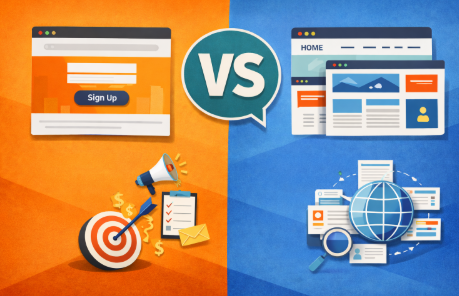
Startups use websites to build early brand trust. These sites explain vision, mission, and product value clearly. Blogs and content pages attract early organic traffic. At the same time, startups use landing pages for lead capture. For example, a startup may run ads to a demo signup page. Meanwhile, the website builds credibility through content and storytelling.
E-commerce brands use websites for full product catalogs. These sites support browsing, filtering, and category exploration. They help customers research products and compare options. However, landing pages promote specific offers or discounts. For example, holiday ads may drive traffic to a deal page. Meanwhile, the website handles long term organic traffic growth.
Service businesses use websites for credibility building. These sites show testimonials, certifications, and service details. They help users research before making contact. Landing pages handle inquiries and lead generation. For example, ads may drive users to a booking form. Meanwhile, the website builds trust through content and reviews.
SaaS companies use websites for education and discovery. These sites host blogs, documentation, and feature pages. They attract organic traffic from problem-based searches.
At the same time, landing pages handle trial conversions. For example, ads may drive traffic to a free trial page. Simultaneously, the website builds authority and long term visibility.
Creators use websites to build authority and trust. These sites showcase expertise, content, and achievements. They attract audiences through search and sharing. Landing pages support direct conversions and offers. For example, a creator may promote a course page. Meanwhile, the website builds long term audience growth.
Agencies use websites for reputation and credibility. These sites highlight case studies and service expertise. They attract organic leads through SEO content.
Landing pages support lead funnels and campaigns. As an example, ads may drive users to consultation pages. An agency website website builds trust and long term demand.
Landing pages and websites should never compete with each other. Instead, they should work together as one system. Each plays a different role in growth. One builds authority and trust. The other converts intent into action.
When they connect properly, growth becomes predictable. Traffic quality improves across channels. Conversions become easier to scale. SEO performance becomes more stable over time.
Websites build domain authority through content. Blogs, guides, and resources attract organic links. Search engines treat these pages as trust signals. This authority does not stay on one page.
Internal linking spreads that value across the site. Service pages receive authority from blog content. Landing pages receive authority from service pages. This creates a clean SEO hierarchy.
High-authority pages support conversion pages. Landing pages rank easier when authority flows correctly. This reduces reliance on paid traffic. Organic conversions become more achievable over time.
Strong SEO starts with content.Blogs attract users through informational searches. They help brands show expertise, build trust, and stay visible early in the buyer journey. These users are not ready to convert yet. They are learning and researching problems.
Next, service pages guide the journey. They introduce solutions and positioning and build trust and credibility. They move users closer to decisions.
Finally, landing pages close conversions. They remove distractions and focus on action. They capture leads and sales and turn traffic into revenue.
This funnel looks like this in practice:
Internal links guide both users and search engines. They show which pages matter most. Internal links define importance and hierarchy.
Content pages link to service pages. Service pages link to landing pages. Landing pages receive authority signals.
This structure improves crawl efficiency. It strengthens rankings across the domain and improves conversion performance.
Without internal linking, authority stays isolated. Landing pages struggle to rank alone and growth becomes slower and expensive.
Some businesses use only landing pages. They skip building a full website and depend fully on paid traffic.
This creates long term problems. Organic growth becomes almost impossible. Trust signals remain weak and search engines see low authority domains.
Traffic costs increase over time. Conversion costs rise as competition grows. Scalability becomes difficult to sustain.
Without content and authority, SEO cannot grow. Without SEO, marketing becomes expensive. Without trust, conversions slow down.
This is why websites matter. They support long term growth and reduce dependency on paid traffic. Websites create sustainable traffic systems.
Websites handle organic discovery. They attract search traffic naturally and support learning and research journeys.
Landing pages handle campaign traffic. They capture ad, email, and funnel traffic. These pages focus on action and speed.
This separation creates clarity. Users get the right experience. Search engines get the right signals and conversions become more consistent.
Full funnel SEO connects content and conversions. It links awareness to action and connects trust with revenue.
Websites build visibility and authority. Landing pages monetize that visibility. Funnels turn traffic into business growth.
This is not a design strategy. This is a growth system. It’s how scalable brands operate.
When both work together, SEO compounds. Traffic quality improves naturally and conversions become more efficient. Growth becomes stable and predictable.
Neither one is better alone. Websites win for long term SEO. Landing pages win for conversions.
Websites build authority and rankings. Landing pages drive actions and leads. Websites attract traffic volume. Landing pages improve traffic quality.
Authority and action must balance. Growth needs both sides working.
A landing page works better for conversions and quick actions. It focuses on one goal and removes distractions. However, a website works better for long term SEO growth. It builds authority, trust, and organic traffic over time. Therefore, each serves a different business purpose.
A landing page cannot replace a full website. It lacks content depth and trust signals. Search engines need structure and authority systems. Users also need credibility and information. Without a website, long term growth becomes difficult.
Landing pages help conversion focused SEO efforts. They improve user actions and lead generation. However, they do not replace content SEO. Websites still handle authority and discovery. Both must work together for growth.
A landing page does not need its own domain. Most perform better on strong domains. Shared authority improves rankings and trust. Standalone domains require heavy promotion. Domain strategy should support authority flow.
Landing pages can work without websites short term. This is because paid traffic can generate early results. But long term growth becomes expensive. SEO becomes almost impossible to scale. Websites provide sustainability and trust.
Start using our A/B test platform now and unlock the hidden potential of your website traffic. Your success begins with giving users the personalized experiences they want.
Start Your Free Trial

Empowering businesses to optimize their conversion funnels with AI-driven insights and automation. Turn traffic into sales with our advanced attribution platform.


