



Free Funnel Audit
Convert more customers today!

SEO
10 mins read

SEO
10 mins read
If your goal is better results from ads, use the right match types to control who sees your ads. Use the right bid adjustments to control how much you pay for each click.
That concept drives almost every high-performing Google Ads campaign. Yet most advertisers treat these as separate tools. That is where money leaks out.
Let’s break it down in a way that actually helps you make better decisions.
Match types decide when your ads show. Think of them as a filter. They tell Google how closely a search must match your keyword for your ad to appear.
For example, someone searches for “best running shoes.” Your ad may or may not show depending on your match type.
Bid adjustments decide how much you’re willing to pay for certain users.
They let you increase or decrease bids based on factors like device, location, or time of day.
Without both, campaigns drift. Either traffic is too loose, or spend is too high.
A lot of campaigns fail for one simple reason. They focus on traffic but ignore cost control. Or they control costs but ignore targeting.
Imagine this scenario:
You use broad match only. Traffic pours in. Clicks look great. But conversions? Not so much.
Now ask yourself. “Is this traffic really relevant?”
Or flip it. You use only the exact match. You get great conversions. But volume stays low.
Then comes the question. “Am I missing opportunities?” This is why combining both is not optional. It is the backbone of profitable campaigns.
What it does
Broad match shows your ads for searches related to your keyword, even if they are not exact.
Example keyword: running shoes
Your ad may show for:
When to use it
Risks
Broad match can pull in unrelated searches.
What it does
Phrase match shows ads when the search includes the meaning of your keyword.
Example keyword: “running shoes”
Your ad may show for:
But not for:
When to use it
Control vs reach
The phrase match sits in the middle. It gives enough control without killing reach.
If unsure where to begin, start here.
What it does
Exact match shows ads only for searches that closely match your keyword.
Example keyword: [running shoes]
Your ad may show for:
But not for:
When to use it
Cost vs performance
Exact match often cost more per click. But conversions are usually stronger.
So is this worth the higher cost per click? In many cases, yes. Because the intent is clear.
Match Type | Reach | Control | Cost | Conversion Potential |
Broad Match | High | Low | Lower CPC | Low to Medium |
Phrase Match | Medium | Medium | Moderate | Medium |
Exact Match | Low | High | Higher CPC | High |
Bid adjustments are percentage changes applied to your base bid.
They allow you to say:
Example:
Base bid: $1
Mobile adjustment: +20%
New bid: $1.20
Bid adjustments look simple on the surface. Change a percentage and move on. But in real campaigns, small changes here can shift results fast. The key is to stop guessing and start reacting to real behavior.
Let’s go through them one by one.
People behave very differently across devices. Some browse on mobile and convert later on desktop. Others complete everything on their phone.
You must thus know where your users actually convert. Start by checking your device report.
What usually works as a starting range:
Example
If mobile conversions are twice as high as desktop, a +25% adjustment is reasonable. But if mobile traffic is high and conversions are weak, pulling bids down by -20% can save budget quickly.
Some cities convert well. Others drain the budget. This is often the fastest way to improve ROI.
What to look for:
Actionable ranges:
Example
If one state brings in most sales at a low cost, pushing bids up by +30% there can scale results. At the same time, cutting bids by -30% in low-performing regions helps control waste.
Time changes behavior more than expected. A user searching at noon is not the same as one searching at midnight.
So pause and think: “When do people actually take action?”
What usually works:
Example
If most conversions happen between 9 AM and 5 PM, increasing bids by +20% in that window makes sense. Late-night clicks often cost money but do not convert. So, reducing bids by -40% overnight can help.
Some users convert better. Others just browse.
What can be adjusted:
Actionable ranges:
Example
Income targeting can also help. If higher income groups convert more, increasing bids there can improve ROI.
If your campaign includes call extensions or call ads, you can adjust bids for users more likely to call.Find out whether the calls lead to real business?”
If yes, this adjustment matters.
What to do:
Example
A service business may find that phone calls convert better than form fills. In that case, pushing bids higher for call interactions can drive better leads.
Bid adjustments do not just add up. They multiply.
Simple example:
So the final bid becomes $1.56, not $1.50. This stacking effect can increase bids quickly.
To stay safe:
A simple guideline:
Match types do not just affect traffic. They affect cost and performance.
Broad match spreads across many searches. Competition varies. Costs fluctuate. Exact match targets competitive, high-intent keywords. That drives the CPC up.
But conversions often justify the cost.
Ask yourself: “Would I rather pay less for weak traffic or more for strong buyers?”
This is the core strategy most people miss.
Look at:
Once data is strong, begin adding in broad match carefully.
Use it to find new opportunities.
Block irrelevant searches. This step alone can save thousands.
Here are realistic scenarios.
Action:
Action:
Action:
These are not random numbers. They come from real patterns seen in campaigns we have managed for our clients across industries in the U.S.
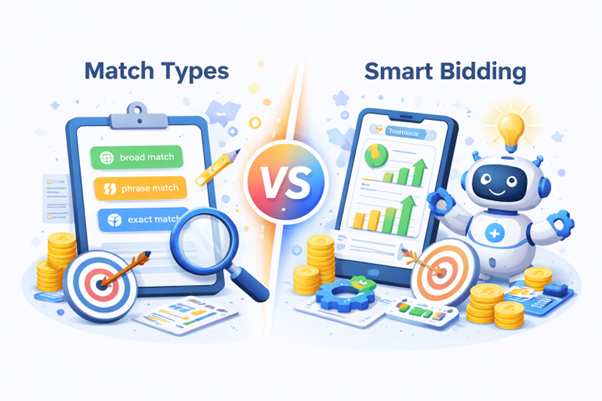
Smart Bidding is Google’s way of letting the system adjust bids for you. It uses machine learning to decide how much to bid for each auction. But it only works well when the setup is right.
Smart Bidding looks at signals you cannot fully track on your own. These include:
It then adjusts bids in real time. But only when enough data is available.
Strategy | Goal | When to Use |
Target CPA | Get conversions at a set cost | When you know your ideal cost per lead |
Target ROAS | Maximize revenue return | For eCommerce with clear revenue tracking |
Maximize Conversions | Get as many conversions as possible | When starting to scale |
Maximize Conversion Value | Focus on higher-value conversions | When some sales are worth more than others |
Maximize Clicks | Get more traffic | For awareness or early testing |
Target Impression Share | Show ads in top positions | For brand visibility |
Smart Bidding is only as good as the data it gets.
A good rule to follow:
Without this, the system struggles. It cannot learn patterns. It starts guessing instead of optimizing. That leads to unstable results.
Google now pushes a clear combination:
Broad match + Smart Bidding
Here’s why it works:
But this only works when enough conversion data exists. Without data, broad matches can pull in weak traffic. Smart Bidding cannot fix it.
Switching too fast can hurt results. A smoother transition works better.
Here is a safer path:
Smart Bidding is not always the right choice. There are situations where manual control works better:
That depends. If there is strong data, Smart Bidding can outperform manual efforts. It reacts faster and sees more signals.
But if data is weak, automation can drift.
A simple way to think about it:
If there is still doubt, test both. Run one campaign with Smart Bidding. Keep another manual. Compare results over time.
Most campaigns focus on what to target. But strong campaigns also focus on what to block. That is where negative keywords come in.
Just like regular keywords, negatives also have match types. Each one behaves a bit differently.
This blocks a search only when it matches your keyword exactly.
Example: [free shoes]
Use this when you want very precise control.
This blocks searches that contain your keyword phrase in the same order.
Example: “free shoes”
This is useful when a phrase clearly signals bad intent.
This blocks searches that include all your keyword terms, in any order.
Example: free shoes
It gives wider blocking but can still miss some variations.
Earlier, negative keywords had a gap. Misspelled searches could still slip through.
That changed in 2025. Now, close misspellings are also blocked automatically.
So if “free shoes” is added as a negative keyword, common misspellings of that phrase will also be filtered out.
This leads to cleaner traffic and fewer wasted clicks.
Brand control used to take time. It required long negative keyword lists. Now, brand exclusion lists simplify this.
They allow:
For example, a campaign targeting “running shoes” can avoid showing for a competitor brand without adding dozens of variations.
This saves time and improves targeting accuracy.
Negative keywords do not behave exactly like regular keywords. Here is what really happens:
Positive Match Type | Negative Impact |
Broad match keywords | Negatives help control unwanted traffic |
Phrase match keywords | Negatives refine search intent further |
Exact match keywords | Negatives block edge cases and variations |
In simple terms:
Even the exact match type is not fully “exact.” Variants can still show. That is where negatives help.
Start early. Do not wait.
Ask yourself often: “Are these clicks actually useful?” If the answer is no, a negative keyword is probably needed.
A few important updates in 2025 changed how Google Ads campaigns behave.
Enhanced CPC was officially deprecated on March 31, 2025. Campaigns using it were moved to Manual CPC.
This change removed the small layer of automation that used to adjust bids in the background. Now, bids stay exactly where they are set. This is so unless changed manually or switched to a Smart Bidding strategy.
So what does this mean in real terms?
Should manual control be kept, or should Smart Bidding be used instead?
If the account has enough conversion data, Smart Bidding can often perform better. If not, Manual CPC still gives stable and predictable control.
Google has been pushing automation further with AI Max. This is often linked with Search Max campaigns.
These systems rely less on strict keyword matching. Instead, they use machine learning to understand intent and decide when ads should appear.
This leads to a few clear shifts:
This can feel like a loss of control at first. “Is the system making too many decisions on its own?”
That concern is valid. However, when enough data is available, these systems can find patterns that are hard to spot manually.
A balanced approach works best:
This update made campaign control much simpler.
Brand lists can now be applied across broad, phrase, and exact matches. That means fewer workarounds and cleaner targeting.
Here is what changes in practice:
For example, a generic keyword like “running shoes” can avoid showing for competitor brands without building complex negative keyword lists.
This saves time and reduces wasted spend.
Earlier, negative keywords did not always block misspelled searches. Now they do.
So if a negative keyword like “free shoes” is added, close misspellings will also be filtered out.
This leads to:
All these updates point in the same direction. Google is moving toward more automation. But it is also giving better tools to guide it.
Should you keep everything automated, or should you keep control in key areas? Most high-performing campaigns do not pick one side. They mix both.
They use automation where it adds value. They step in where precision matters.
Here is a step-by-step plan.
Block irrelevant searches early.
Choose a reasonable starting CPC.
Check data weekly.
Not every hour. Not every month.
Leads to wasted spend.
Allows irrelevant traffic.
Leaves money on the table.
Data needs time.
Ask: “Am I reacting too fast?”
Balance is key.
Manually adjusting bids works, but it takes time and constant attention. CausalFunnel’s Ads Optimizer simplifies this by using causal AI to understand what actually drives conversions, not just surface-level patterns.
For example, instead of just increasing bids on mobile because conversions look higher, it identifies whether mobile truly causes more conversions or just assists them. You can explore how this works in detail here. See how smarter bid decisions can improve ROI without constant manual tweaks.
There is no single best option. Exact match works well for high intent. Phrase match is great for balance. Broad matches help with discovery. The best choice depends on goals and data.
Adjust bids when performance data shows clear trends. Increase bids for strong results. Reduce them where conversions are low.
Yes, but less. Smart bidding handles many adjustments automatically. Manual changes still help in early stages or low-data campaigns
Broad matches often lead to lower CPC but weaker intent. Exact matches usually cost more but bring better conversion rates.
Yes. Many campaigns use a mix. This approach balances reach, control, and performance.
Start using our A/B test platform now and unlock the hidden potential of your website traffic. Your success begins with giving users the personalized experiences they want.
Start Your Free Trial

Empowering businesses to optimize their conversion funnels with AI-driven insights and automation. Turn traffic into sales with our advanced attribution platform.
Trusted by Customers


©CausalFunnel Inc. All rights reserved.