



Free Funnel Audit
Convert more customers today!
SEO
10 mins read

SEO
10 mins read
Dentists, like many other businesses, operate in a competitive landscape. Every city has more than a handful of dental clinics. In this case, how can you pull a steady stream of patients?
It’s exactly here that Google Ads can help. The advertising platform lets you reach new patients. These people are in dire need of dental services. The moment they find your ad, it is just a matter of a few seconds before they call or fix an appointment.
Ready to harness the power of Google Ads for dentists to grow your business this year? This blog will tell you everything you need to know.
You need Google Ads to harness high-intent patients swiftly.
Here is why Google Ads are essential for dentists
Dental clinics face a lot of competition. Google ads give you rapid visibility at the top of the search pages. This is important because people usually only look at the top search results.
Patients searching for dentists usually have urgent needs. The following search query is an example of this immediate need. “Toothache won’t stop.’ it means that they are already in the booking stage of the funnel.
Over half of patients use mobiles to discover brand information. Google ads for dentists ensure that your service is found on mobiles.
You can limit ads to be shown to certain service areas. This ensures better utilization of your budget. You can direct it to potential local patients.
AI tools make way for automated ad placement. This placement is highly effective. It lets you enhance patient acquisition.
Dentists can track each call and click. They can track all appointments as well. This makes way for optimized budget management. It also lets you target profit-driving patients.
Remarketing campaigns can drive users who have visited your site before but didn’t book your service. Ads appearing at the top force them to tap on your link again. This keeps them aware of your practice.
High-intent keywords are the bread and butter of Google Ads for dentists. They signal that the person searching is ready to take action.
Avoid targeting broad terms like “dentist info” or “tooth care tips.” They bring traffic but rarely convert.
Tools like Google Keyword Planner or Semrush help identify high-intent keywords. Look for search volume, CPC, and competitiveness. Make sure keywords align with your services. Suppose your practice specializes in cosmetic dentistry. In this case, target “teeth whitening dentist near me” rather than just “dentist near me.”
Remember, high-intent keywords cost more per click. But each click is far more likely to convert into a paying patient.
A strong Google Ads campaign starts with a clear plan. Without the right structure, money can be wasted on clicks that don’t turn into patients. Here’s how dentists can set up campaigns in 2026 for maximum results.
The first step is to decide what you want your campaign to do. Do you want:
Every campaign element should support your main goal. For example, if calls are the priority, use call extensions and track calls carefully. This focus ensures your budget produces real patient leads.
Targeting makes sure your ads reach people who can actually visit your office.
Good targeting saves money and ensures ads reach patients who are ready to book.
Google Ads offers multiple campaign types. Each serves different purposes:
For most small to medium dental practices, Search campaigns combined with LSAs offer the best ROI. Smart campaigns or Performance Max can supplement but should be monitored closely.
Structure campaigns carefully. A well-organized account looks like this:
Account > Campaign > Ad Group > Keywords > Ads
Regularly review keywords and remove irrelevant ones. Add negative keywords like “dental school” or “free dental tips” to avoid wasted spend.
Ad extensions improve ad visibility and encourage clicks:
Location and call extensions are especially important for high-intent, nearby patients.
Not all dental services are the same. Structure campaigns based on service type:
Tailoring campaigns to each service improves relevance, CTR, and conversions.
Bidding strategy affects cost and performance:
Combine strategies if needed. For example, use Smart Bidding for search campaigns and manual control for high-value keywords.
Local Services Ads, or LSAs, are a new way to get patients online. They show above regular Google Ads, making them highly visible. Many top dental marketing guides spend 500-800 words on this topic. That shows how important LSAs are in 2026.
The biggest difference is how you pay.
Since you only pay, when someone truly shows an interest in your service, LSAs can reduce wasted clicks and put your ads in front of people ready to book. Google Ads, on the other hand, capture broader searches and guide patients who are still comparing options.
Dentists who run LSAs get the “Google Screened” badge. This badge shows you are licensed and trustworthy. Patients are more likely to call a dentist with this badge than one without it. It builds instant trust before they even see your office.
LSAs are not open to everyone. Google requires dentists to provide:
These steps ensure that only real and credible dentists appear in LSAs.
LSAs usually cost $106–$119 per lead, but the price varies by city. You do not pay for clicks that don’t turn into leads. This model can be more predictable than traditional CPC campaigns.
LSAs work best with traditional Google Ads. Use LSAs to capture calls and immediate bookings. Use search campaigns for branding, website visits, and service-specific keywords like cosmetic dentistry. Together, they cover both immediate and long-term patient growth.
LSAs are not perfect. You cannot link directly to your website. They work better for general dentistry and emergency services than cosmetic treatments. Patients searching for aesthetic procedures may prefer browsing websites first.
Your ad copy hugely impacts the patient’s decision to take action. Follow these best practices.
Target phrases indicating urgent action. These include those like “dentist accepting new patients,” “dental implants [City].”
Include the specific city or neighborhood in headlines and descriptions. This will let you pull nearby patients.
Clearly state how your practice is distinct. For example, “Free Whitening with Exam”or “Award-Winning Team”.
Use empathetic language to address fear or urgency. Examples include “Pain-Free Dentistry” or “Same-Day Emergency Appointments”.
End with clear, direct, and urgent instructions. Good examples include “Book Your Appointment Now,” “Call Today,” or “Schedule Online”.
Enhance visibility by adding:
Use them to highlight specialized services without taking up ad copy space.
Ensure the ad copy matches a specialized landing page that swiftly converts users. Do not send them to a generic homepage.
A landing page is where clicks turn into patients. Even the best Google Ads will fail if the page doesn’t deliver. Every element matters, from headline to call-to-action.
The first rule is message matching. The landing page must reflect the ad promise exactly.
Over half of dental searches happen on mobile devices. Your page must load and display perfectly on phones and tablets.
Mobile optimization is no longer optional—it directly affects conversions and Quality Score.
Your headline must be clear, concise, and benefit-driven.
A strong value proposition reassures visitors that your practice is the best choice.
Visitors want to know they are in safe hands. Include trust signals prominently:
Trust signals reduce hesitation and encourage bookings.
People follow other patients’ experiences. Include:
Social proof strengthens credibility and increases the likelihood of conversion.
Offer multiple ways for patients to reach you:
Test which conversion path works best for each page.
Fast-loading pages are critical. Aim for under 3 seconds.
Slow pages frustrate visitors and increase bounce rates.
Place CTAs in several locations:
CTAs can include click-to-call buttons, online booking forms, and chat widgets.
Anticipate questions or concerns that stop conversions:
Answering objections upfront makes patients more likely to book.
Use heatmaps to see where visitors click and scroll.
Visitors stay longer and convert more on the optimized page.
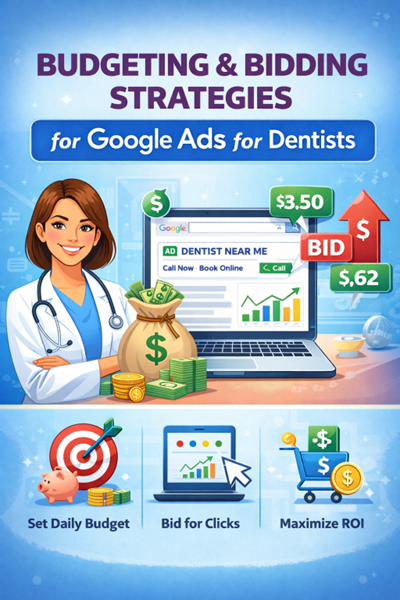
Understanding your budget and bidding options is crucial. “Do I need a huge budget?” is a question on the minds of many dentists. No, you don’t. Even $20–$50 per day can produce calls if campaigns are focused.
Bidding options:
Calculate expected ROI. Suppose a new patient is worth $500 and your average CPC is $5. Here, each booking should cost less than $500 to be profitable. Always track spend and conversion closely.
Dentists want numbers. They want to know:
Understanding benchmarks makes planning smarter.
A lead is someone who calls or books an appointment. On average, dental practices pay $50–$85 per lead.
CPC tells how much you pay each time someone clicks your ad. This depends heavily on location.
Why this matters: In high-cost areas, careful keyword targeting is key. You don’t want clicks from people looking for unrelated services. In small towns, even a modest budget can dominate search results.
Conversion rate shows the percentage of clicks that turn into appointments.
High conversion rates come from landing pages that match the ad, clear calls to action, and easy booking options. If your page is confusing or slow, even expensive clicks won’t convert.
CTR measures how often people click your ad after seeing it.
Why it matters: A higher CTR means your ad attracts attention. You can improve CTR by including:
ROI is the money you make compared to what you spend. For well-optimized campaigns:
Why it matters: ROI shows whether campaigns are profitable. Track this closely. Even a few small changes, like pausing low-performing keywords can improve ROI dramatically.
Cost per conversion measures how much it takes to get one new patient:
Why it matters: These numbers show that location changes your budget needs. A smaller city can produce similar results with a fraction of the budget needed in a large metro area.
Tracking is often overlooked, but it is one of the most important parts of running Google Ads for dentists. Without it, campaigns are like driving in the dark. You don’t know what works and what wastes money. Proper tracking shows exactly which ads bring in patients and how to improve results.
Many dental ads lead to phone calls. But how do you know which ad created the call? This is where call tracking comes in.
Conversions are actions you want potential patients to take. For dentists, common conversions include:
Tracking these conversions helps determine which keywords and ads produce the most patients.
Dental practices must follow privacy rules when tracking patient data. Google Ads and other tracking tools have options for cookie-less or consent-based tracking.
This ensures tracking is both effective and legally compliant.
Not all patients book immediately after clicking an ad. Some search multiple times or interact with different campaigns before making an appointment. Multi-touch attribution tracks the entire patient journey.
Keeping track of the right metrics is key. Create a dashboard to monitor campaigns daily or weekly. Important KPIs for dental Google Ads include:
Monitoring these KPIs helps spot trends, fix underperforming ads, and boost ROI.
Some clinics use tools beyond Google Ads for advanced tracking. These platforms can:
Using these tools provides deeper insights than Google Ads alone.
Tracking is not just about watching numbers. It also helps improve campaigns over time. A/B testing is critical for dentists.
Systematic testing, combined with tracking, ensures campaigns constantly improve. Over time, small changes can dramatically increase conversions and lower costs.
Quality Score is one of the most important factors in Google Ads for dentists. It affects how much you pay per click and where your ad appears. A high Quality Score can cut costs by nearly half and improve ad positions.
Google gives every keyword a score from 1 to 10.
This number shows how relevant and useful your ad is to users. The higher the score, the better your ad performs for less money.
Quality Score is based on three main things:
You can see Quality Score directly in Google Ads:
Regularly check this to identify low-performing keywords and fix them.
Here’s how to optimize your campaigns:
Ad Rank decides where your ad appears on Google. It’s calculated as:
Ad Rank = Quality Score × Max CPC
A higher Quality Score means:
High Quality Score is more than a number. It directly:
Even small improvements in Quality Score can save hundreds per month and attract more patients.
Even after setting up, optimization is key. Successful campaigns are never “set and forget.”
Look at metrics weekly. Small adjustments can save money and increase bookings significantly.
Avoid these pitfalls to save money and get better results:
For instance, running ads for “dentist near me” in a city-wide radius without negative keywords is unlikely to give you any results. It might attract people looking for unrelated services, wasting both money and time.
Even $20–$50 per day can work, but larger budgets allow more testing and reach.
You can see calls and bookings within days if campaigns are targeted correctly. Optimization improves results over time.
Google Ads produce instant visibility. SEO builds long-term traffic. Ideally, use both.
Yes. With smaller competition, even low budgets can dominate search results.
Google Ads for dentists can turn online searches into real appointments if campaigns are:
With the right keywords, ads, landing pages, and tracking, even small practices can compete with larger clinics in their city. So, what could a few clicks a day do for your patient schedule this month?
Start using our A/B test platform now and unlock the hidden potential of your website traffic. Your success begins with giving users the personalized experiences they want.
Start Your Free Trial

Empowering businesses to optimize their conversion funnels with AI-driven insights and automation. Turn traffic into sales with our advanced attribution platform.


