



Free Funnel Audit
Convert more customers today!

SEO
10 mins read

SEO
10 mins read
Think of it like this: you have a phone that is not cleaned for a really long time. The speakers are filled with dust, and you’re not able to hear anything. You’re all frustrated but are not sure why it’s happening. Just then, a friend comes and cleans the speaker, and voila, things are back to normal.
Content pruning is just that. Just like you prune the branches of a tree to improve their growth and fruitfulness, for SEO, you remove the content and pages that are holding back the growth of your website.
Content pruning for SEO cleans your site’s weak pages to boost strong ones so that they can rank better and convert more consistently.
If you’re serious about growing organic traffic and not just publishing more blogs for the sake of it, this is one of those topics that quietly changes how you think about SEO forever.
We’ve seen it firsthand. Teams publish for years, build hundreds or thousands of URLs, and then wonder why rankings stall even though “we’re doing everything right.” The answer usually isn’t more content. It’s better content hygiene. That’s where content pruning comes in.
In this blog, we’ll help you understand what content pruning in SEO is, why it matters, how it actually works, and how to do it.

Content pruning SEO means deliberately reviewing your existing content and deciding what actually deserves to stay visible in search engines.
Not everything needs to be deleted. That’s a common misunderstanding. Pruning can mean updating, merging, consolidating, de-indexing, or, in some cases, removing content entirely. Platforms like CausalFunnel support this process by showing which pages actually help users convert and which ones add friction.
Think of your website like a garden. If every plant grows unchecked, the strongest ones don’t get enough light. The soil gets weak, and pests spread. When you prune, it doesn’t kill the garden but saves it.
In SEO terms, low-quality or outdated pages quietly drag down the overall site. Search engines don’t judge pages in isolation anymore. They look at patterns like relevance, consistency, and trust.
Content that usually becomes a pruning candidate includes:
Content pruning SEO is not about shrinking your site. It’s about sharpening it.
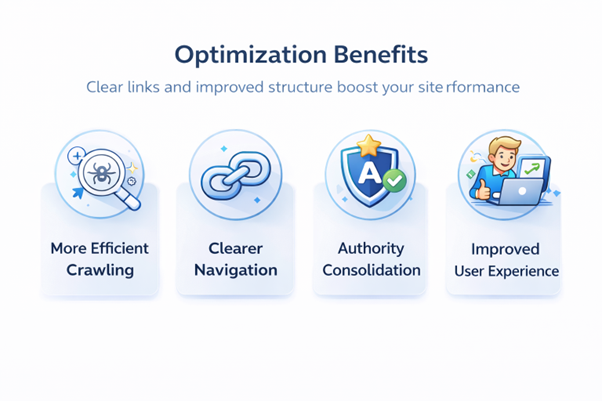
Let’s address the fear first. Deleting or changing content feels wrong. We’re taught to believe that more pages mean more chances to rank. That logic worked years ago, but it doesn’t hold up anymore.
Search engines now reward clarity, focus, and depth.
When a site has too many weak pages, a few things happen quietly:
Content pruning SEO works because it fixes these problems at the root.
Here’s what improves when pruning is done correctly:
We’ve watched rankings jump not because new content was added, but because five mediocre posts were merged into one excellent one with the same topic, same keywords, and clearer intent.
It feels counterintuitive at first. But SEO often rewards subtraction more than addition.
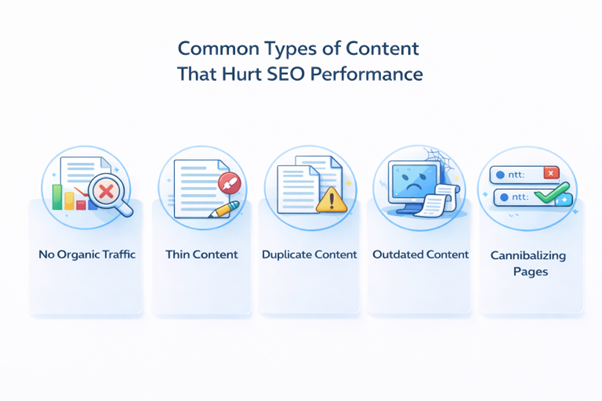
Not all bad content looks bad on the surface. Some pages read fine, but still hurt performance. The most common troublemakers tend to fall into patterns.
Content pruning SEO starts with learning to spot these patterns early.
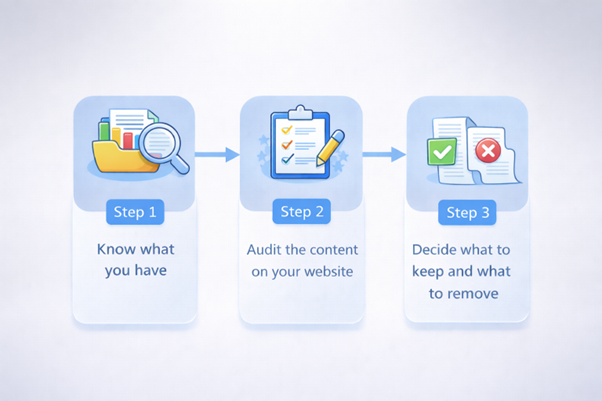
Good pruning is methodical. If you’re too emotional about your content, it can lead you to make emotional decisions, which could lead to mistakes. Always focus on the data to keep you honest.
There are three core steps. Skip any one of them, and things break later.
This step is about mapping out all your existing content so nothing is missed. Not “most of it.” Not “what’s in the blog folder.” Everything that can be indexed or gets visited.
A lot of pruning projects fail here because people only export blog posts and miss the stuff that quietly eats crawl budgets or creates duplicate signals.
You want a single place where you can look at your entire website and say:
If you don’t do this, every decision after this becomes a guess.
Include all content types, because search engines don’t care if you forgot them. Make sure your inventory contains:
Keep the inventory sheet simple enough that you’ll actually finish it. At a minimum, add these columns:
If you want it more powerful, add:
This is what Step 1 protects you from:
You’re done when you can answer these questions instantly:
If you can’t answer that yet, keep building the inventory.
Inventory tells you what exists. On the other hand, an audit tells you what’s working, what’s failing, and what’s risky to touch.
This step is where you stop thinking like a writer and start thinking like an SEO.
You’re trying to score each page so you can decide its fate confidently. Not based on opinions like:
But based on signals like:
Organic traffic is your first “Does Google want this?” indicator. Consistent organic traffic indicates that a page matches search intent and continues to earn visibility over time.
Look for pages that:
Traffic levels help identify which pages attract demand and which ones struggle to get noticed. For example:
These pages might not be SEO heroes, but they might still be business-critical.
Tracking conversions reveals which content contributes to revenue and business goals. A page can be low-traffic but high-value.
For example:
If it helps people decide, don’t prune it blindly.
This is where pruning gets serious. If a page has backlinks, it holds authority. Deleting it without a plan can burn link equity. You want to know:
Internal links show how your own site treats a URL. Strong internal linking improves crawlability, relevance, and page authority.
Pages with zero internal links are often:
Also watch for this: your internal links might be pointing to a weaker page when a stronger page exists.
Engagement indicators show how real users interact with your content beyond just traffic numbers. These help validate whether users find the page useful. Watch for patterns like:
You’re done auditing when each URL has enough information to answer:
If you can’t answer those, gather more signals before deciding anything.
This is the step that actually changes your website. Once you understand a page’s value, the next step is choosing the most effective action for it.
It’s also where most people make emotional mistakes. The best approach is to use a simple rule: every URL gets one clear decision.
Not every page needs to be removed. This is for pages that are doing their job. High-performing pages with strong relevance and engagement should be kept as they are.
Keep it if:
Even when you keep it, you can still:
Keeping is still a choice. It means “this page earns its place.”
There might be content that may have the potential, but might be underperforming. Updating existing pages can restore relevance, accuracy, and search visibility without starting from scratch.
Improve it if:
What “improve” should include:
This is often the highest ROI action.
Merging or consolidating content is the heart of content pruning SEO. When multiple pages cover the same topic, merging them often works better than keeping them separate.
You can merge the content if:
How to merge properly:
This is where rankings often jump, because you stop splitting authority across multiple pages.
This is for pages that help users but shouldn’t rank. Use a no-index tag for pages that don’t need to appear in search results but still serve a purpose for users.
No-index if:
Noindex keeps the page alive for people while removing it from search. That’s important because not every page needs to be a Google landing page.
This is the final move, not the first.
If a page serves no purpose, remove it. When it has links or traffic, redirect it to the most relevant page instead. To understand it simply, look through the list below:
Remove if:
Redirect if:
Let it 404 only if:
We understand that you must be eager to improve your website’s ranking in the search engine. But don’t prune hundreds of pages at once. Do it in waves:
This reduces risk and helps you learn what works on your site.
Let’s check this in reality.
Imagine a site with six blog posts about “customer journey analytics.” Each targets a slightly different keyword. None ranks in the top ten. Traffic is scattered.
After auditing, the team realizes:
They merge the best insights into one authoritative guide. The weaker URLs redirect to it. Internal links are updated. The page gets refreshed with examples and a clearer intent.
Within weeks, impressions rise. Rankings stabilize. One strong page replaces six weak ones.
This is one of the most common content pruning SEO examples you’ll encounter. It’s not flashy. It works.
Aspect | Before Content Pruning | After Content Pruning |
Number of pages | 6 separate blog posts covering similar customer journey topics | 1 consolidated, in-depth guide |
Keyword targeting | Multiple pages competing for similar keywords | One clear primary keyword with supporting subtopics |
Search intent clarity | Mixed and unclear (informational overlaps) | Clear intent aligned with what searchers want |
Content quality | Repetitive basics, outdated sections, uneven depth | Updated, comprehensive, and well-structured content |
Internal linking | Links are spread across several weak pages | Internal links point to one authoritative page |
Backlink value | Backlinks are split across different URLs | Link equity consolidated into a single URL |
Crawl efficiency | Search engines crawl multiple low-value pages | Crawl budget focused on one high-value page |
Ranking performance | Pages stuck on page 2 or lower | Consolidated page moves toward page 1 |
User experience | Confusing choices and overlapping answers | One strong resource that answers the full question |
Maintenance effort | Hard to update multiple similar posts | Easier to maintain and keep fresh |

The biggest risk in content pruning SEO is removing or changing pages too aggressively without proper redirects, internal link updates, and performance monitoring. Pruning content the wrong way can unintentionally hurt rankings instead of improving them.
Avoid these traps:
A staged approach works best. Start with the weakest content, wait, and then measure.
You can prevent future content pruning issues by planning content around clear search intent, avoiding overlapping topics, and regularly reviewing pages so low-value content never piles up in the first place.
You can also prevent future content pruning issues by keeping URLs evergreen. This means you use one stable, long-term URL for a topic and continuously update the content on that page. Doing this helps the content of the URL stay relevant, accurate, and competitive over time without changing the URL.
Here’s what more you can do:
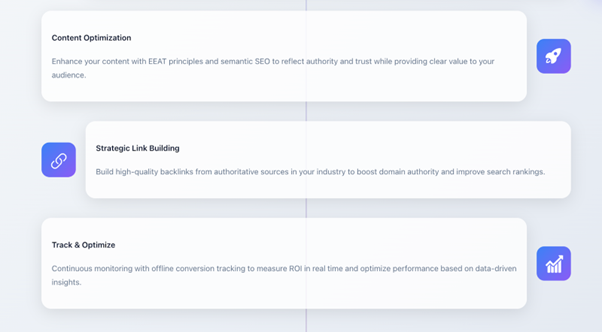
Here is when CausalFunnel enters the game. CausalFunnel uses AI to find content that isn’t helping users or conversions and guides what to update, merge, or remove.
When content is planned with long-term relevance in mind, pruning becomes lighter and safer.
Healthy websites aren’t built once. They’re maintained.
Content pruning SEO isn’t about deleting your past work. It’s about respecting it enough to keep it useful. Every page should earn its place. Every update should serve a purpose.
The real question isn’t whether you should prune content. It’s whether you’re willing to let weak pages hold back strong ones. The key is to connect with the professionals and get their help in deciding what’s working and what’s not, rather than removing everything blindly.
If your site were starting fresh today, which pages would you proudly keep?
Content pruning is the process of reviewing existing website content and updating, consolidating, or removing pages that are outdated, low quality, or underperforming to improve overall site health and SEO.
Pruning reduces index bloat. Index bloat happens when a website has too many low-value or unnecessary pages indexed by search engines. This makes it harder for search engines to properly crawl, understand, and rank the pages that actually matter. Content pruning helps search engines crawl and understand your site more efficiently, and allows your best pages to rank better by removing weak or duplicate content that dilutes authority.
A content audit collects data and evaluates your pages, while content pruning is the action phase where you decide whether to keep, improve, merge, or delete specific content based on that audit.
Most websites benefit from a light pruning review every quarter and a deeper, sitewide pruning project at least once a year, depending on how frequently new content is published.
Content pruning usually works best as a collaboration between SEO specialists, content strategists, and stakeholders from product or marketing, with one owner responsible for final decisions and documentation.
Start using our A/B test platform now and unlock the hidden potential of your website traffic. Your success begins with giving users the personalized experiences they want.
Start Your Free Trial

Empowering businesses to optimize their conversion funnels with AI-driven insights and automation. Turn traffic into sales with our advanced attribution platform.
Trusted by Customers


©CausalFunnel Inc. All rights reserved.