



Free Funnel Audit
Convert more customers today!
SEO
10 mins read

SEO
10 mins read
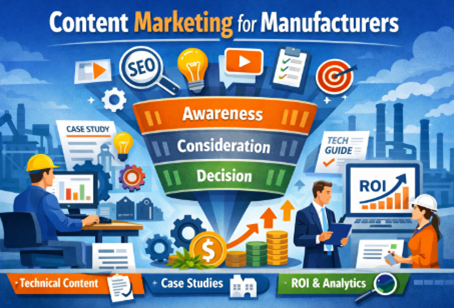
In the manufacturing world, your buyers aren’t swayed by flashy ads or catchy slogans. They want solid, practical information that makes their job easier.
Content marketing for manufacturers is about building trust, not hype, and guiding serious buyers through long, complex decisions with clear, helpful content they can actually use.
It is not about flashy ads. It is not about viral reels. It is steady, helpful work that earns attention over time.
Most generic content marketing fails in manufacturing. Why? Because industrial buyers do not act like retail buyers. They do not buy on impulse. They do not care about catchy slogans. They care about safety, cost, uptime, risk, and proof. They ask hard questions. They bring teams into decisions. And they take their time.
Manufacturing also has real challenges.
As marketers, we’ve seen it firsthand. A factory owner once told us, “I don’t need more leads. I need better leads.” That stuck with us. Because volume is not the problem. Quality is.
This guide gives you a real system, not fluff.
You will get:
If you are serious about growth, this is not optional reading. It is survival reading.
Manufacturing buyers think in systems, not impulses. They work in committees, not alone. They care about risk more than excitement.
This changes everything.
A single deal can involve:
Each person wants different proof. One blog cannot serve all of them.
No one buys an industrial system after one blog post. The journey is slow. It is layered. It is cautious.
Buyers ask:
They need time and proof.
Trust matters more than reach. A small audience that trusts you beats a big one that forgets you.
People want answers before offers. If you do not teach first, you lose early.
Manufacturing is not e-commerce. It is long-term relationships, not one-time buys.
Clear structure wins. Confusion kills deals.
Here, buyers feel a problem but cannot name it.
They search for clarity.
They want learning, not selling.
Content that works:
Thinking moments they have:
“Is this a real issue or just noise?”
“Is this normal in our industry?”
“Is this worth fixing now?”
Now they compare paths, not brands.
They want options and logic.
Content that works:
Thinking moments:
“Which approach is safer?”
“What will this change in daily work?”
“Who else has done this?”
This is where money moves.
Risk matters most here.
Content that works:
Thinking moments:
“Will this work in my plant?”
“Is this worth the money?”
“What happens if this fails?”
This mapping turns content into a system, not noise.
This is the backbone. Without this, everything breaks later.
You are not talking to one buyer. You are talking to many.
Each group needs its own language.
Not all searches mean the same thing.
Map by intent:
This stops random content.
Structure beats volume.
Build:
This makes your site easy to trust and easy to rank.
Pick channels that fit buyers, not trends.
Core channels:
If your sales team does not use your content, something is wrong.
Not all content converts. Some educate and inform, but they don’t necessarily convert.
Educational content builds trust early and removes confusion before sales talks. Buyers feel safer when they understand what they are buying and why it matters. This type of content also attracts high-intent traffic from search engines and industry platforms.
Formats that work well:
Example use case:
Popular formats:
Example use case:
Common formats:
Example use case:
Effective formats:
Example use case:
Why this content works:
Education removes fear. Clarity builds confidence. Buyers trust brands that teach instead of push.
Trust content reduces risk and emotional resistance. Manufacturing buyers fear failure more than they desire innovation. This content answers silent doubts.
Best formats:
Example use case:
Strong formats:
Example use case:
Formats that work:
Example use case:
Content ideas:
Example use case:
Why this content works:
People trust what they can see and understand clearly.
Conversion content moves buyers from interest to action. It supports decisions with logic, numbers, and clarity.
Formats that convert:
Example use case:
Common formats:
Example use case:
Useful formats:
Example use case:
Effective formats:
Example use case:
Why this content works:
Good conversion content removes friction from buying decisions.
Authority content builds long-term brand power. It positions you as a guide, not a seller.
Formats that perform:
Example use case:
Strong formats:
Example use case:
Popular formats:
Example use case:
Useful formats:
Example use case:
Why this content works:
Authority content builds long-term trust and brand gravity.
Each type plays a role in the journey.
Stage | Content Type | Purpose |
Early stage | Educational | Build trust and clarity |
Mid stage | Trust-building | Reduce fear and risk |
Late stage | Conversion | Support buying decisions |
Long term | Authority | Build market leadership |
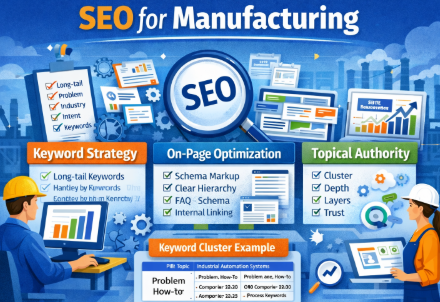
SEO is not a trick. It is structure and trust.
Good SEO starts with understanding how buyers think. Manufacturing buyers do not search like consumers. They search for problems, failures, processes, and risks.
Instead of chasing big keywords, focus on intent-driven searches.
Start with real questions from real people.
Use these simple sources:
Then turn those into search phrases.
Examples of long-tail keyword patterns:
These searches may look small. However, the intent is strong and commercial.
Use different keyword layers.
Low search volume does not mean low value. A single buyer can be a large contract.
On-page SEO helps people and search engines understand your content clearly. Clean structure makes reading easier and improves ranking signals naturally.
Every page should follow a simple flow.
This helps buyers find answers faster.
Schema helps search engines understand your content type.
High-value schema types:
Example use case:
Internal links guide users and search engines.
Good internal linking looks like this:
This creates natural buyer journeys.
Clean pages build trust.
Focus on:
Clutter kills conversions and rankings together.
Let’s take a simple example: industrial automation systems.
“Industrial Automation Systems for Manufacturing Plants”
Cluster Type | Example Topic |
Problem content | Common causes of production downtime |
Educational content | How automation improves production safety |
Process content | Automation workflow in assembly lines |
Comparison content | Manual vs automated production systems |
Trust content | Automation case studies |
Conversion content | ROI of automation investments |
Each cluster links back to the main pillar page. The pillar page links back to all clusters. This structure builds topical relevance and search authority.
Topical authority means owning a topic, not just ranking once. Search engines trust depth more than volume.
Step one: Choose core themes
Pick major topics your buyers care about. Examples include automation, quality control, safety, or compliance.
Step two: Build pillar pages
Create one deep page for each theme. These pages act as topic hubs.
Step three: Create supporting content
Write content that supports each pillar topic.
Step four: Interlink everything
Link all related content together logically. This builds clear topic signals.
Step five: Add trust signals
Include certifications, case studies, and proof points. Trust strengthens rankings and conversions together.
Search engines now understand meaning, not just words. Build content around related ideas.
Example for “manufacturing safety”:
This creates semantic depth.
SEO in manufacturing is not about views. It is about quality leads.
Good SEO content helps with:
Your SEO pages become sales tools, not just blog posts.
Here is a clear working model:
Great content means nothing if no one sees it.
SEO brings steady leads, not spikes.
This is where industrial buyers live online.
If sales does not use it, it fails.
Email still works when done with care.
Shared trust scales reach.
Industry trust builds brand power.
This is where many fail.
Track what matters:
Likes do not pay bills.
Sales is not one-touch.
Use:
This shows real impact.
Simple thinking wins.
Content Cost vs Revenue Impact
Content investment leads to a pipeline.
Pipeline leads to deals.
Deals lead to revenue.
If revenue grows, content works.
These are silent killers.
This creates noise, not growth.
Growth needs systems.
Build:
This turns content into infrastructure.
Starting from scratch can feel overwhelming. This step-by-step checklist gives you a clean path forward.
Phase | Focus |
Planning | Goals, buyers, problems |
Foundation | Pillar pages, core topics |
Creation | Blogs, guides, explainers |
Structure | SEO, linking, schema |
Activation | Sales use, distribution |
Measurement | Leads, pipeline, revenue |
The space is changing fast.
Watch for:
The brands that adapt early win later.
Most schools see leads within the first week. Optimization improves results over the first 60 days. Early data guides keyword and ad improvements. Patience and refinement deliver better enrollments.
Yes, when campaigns focus on enrollment intent. Small schools benefit from local targeting and control.Lower budgets require tighter keyword focus. Quality still beats quantity at any scale.
Exact and phrase match types work best initially. They provide higher intent and better control. Broad matches can work later with strong negatives. Starting to focus prevents wasted spending.
Most schools benefit from year-round presence. Budget adjustments can match enrollment cycles. Pausing entirely loses brand momentum. Reduced budgets work better than full shutdowns.
Start using our A/B test platform now and unlock the hidden potential of your website traffic. Your success begins with giving users the personalized experiences they want.
Start Your Free Trial

Empowering businesses to optimize their conversion funnels with AI-driven insights and automation. Turn traffic into sales with our advanced attribution platform.


