



Free Funnel Audit
Convert more customers today!
SEO
10 mins read

SEO
10 mins read
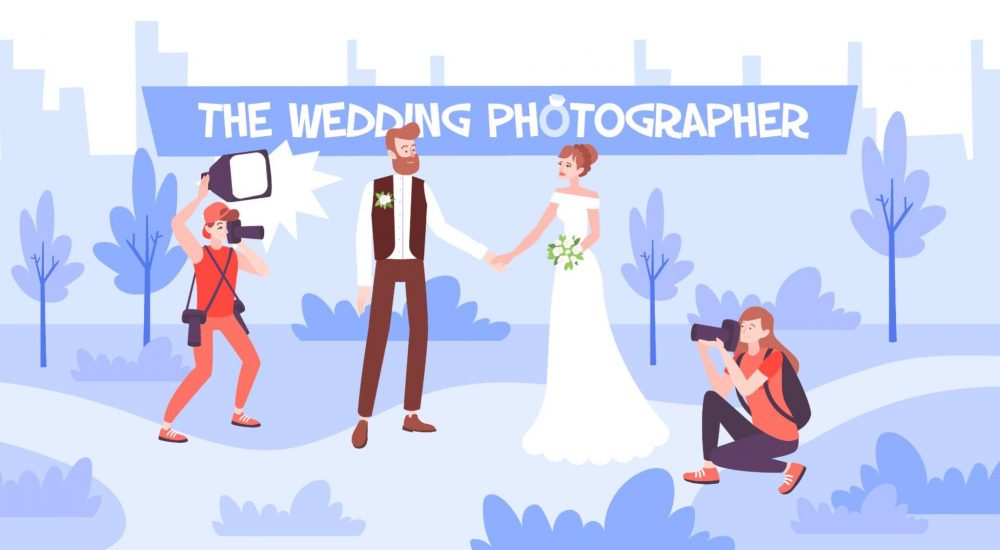
If you’re a wedding photographer trying to get steady inquiries from Google, SEO is one of the few systems that actually compounds over time. It is free compared to ads, but it doesn’t fluctuate like ads or social media reach. It builds visibility that keeps working even when you’re not posting.
Most photographers don’t struggle because their work is weak. They struggle because Google doesn’t clearly understand who they are, where they work, and why they should appear in search results.
If you want expert help to improve your website performance and growth strategy, explore CausalFunnel to understand how advanced marketing systems can support your SEO and client acquisition goals.
This guide breaks SEO into a simple system designed specifically for wedding photographers competing in US local markets where ranking is possible, but structure matters more than effort.
Social media feels active, but it’s unpredictable. One week your post performs, the next it disappears. SEO works differently. When couples are ready to book, they don’t scroll endlessly. They search with intent.
They type things like:
This is the key difference.
At this stage, couples are not exploring. They are comparing. That means if your website shows up, you are already part of their shortlist. If it doesn’t, you’re not even considered.
SEO doesn’t just bring traffic. It brings people who are actively planning a wedding. That’s why it consistently outperforms social media for bookings.
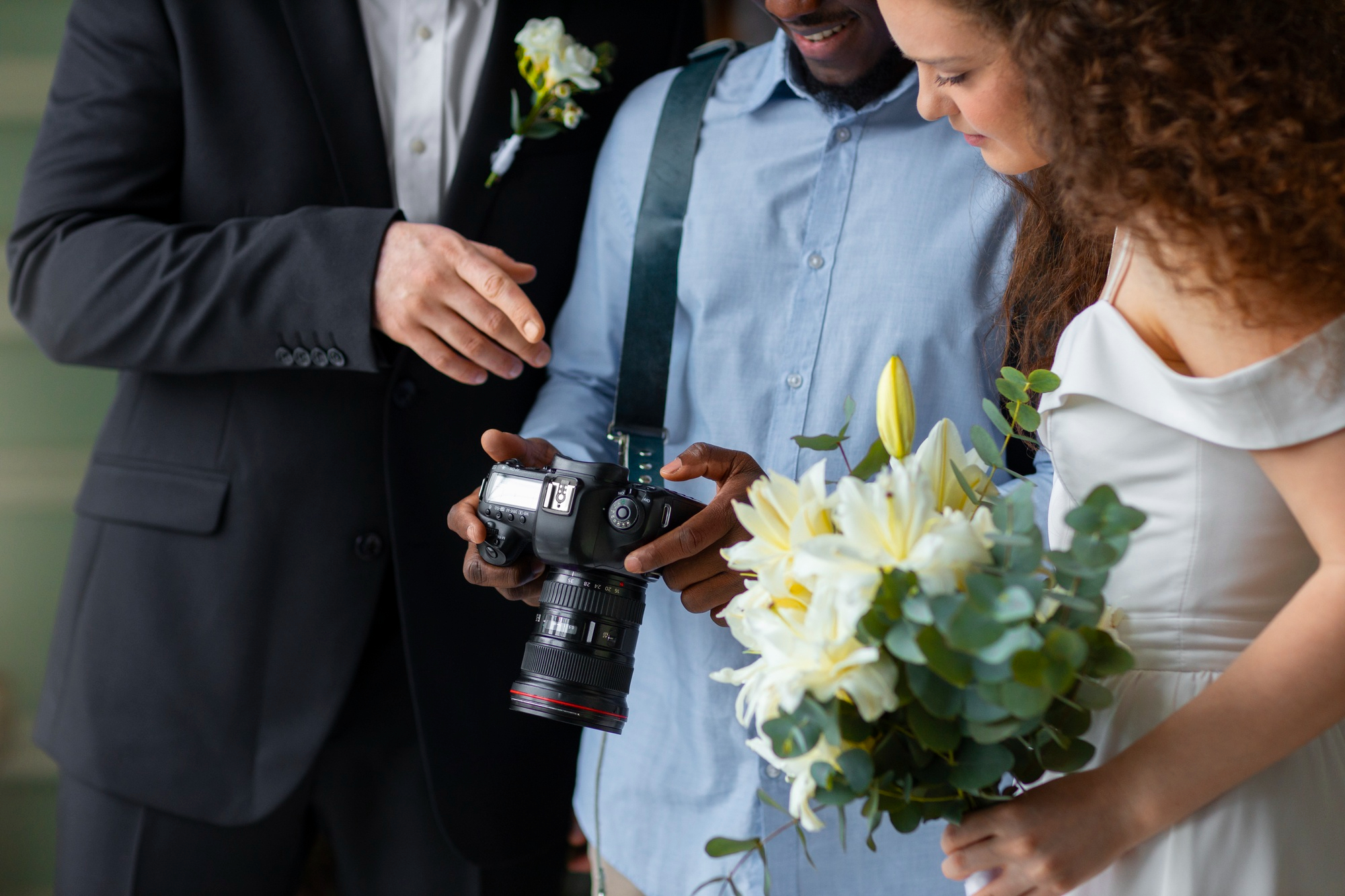
Before SEO strategy, you need to understand the decision process. Most couples don’t browse deeply. They follow a short path:
Search → Open top results → Compare → Decide
Usually 3 to 5 websites get serious attention. They decide quickly based on:
If anything feels unclear, they leave. That’s where most missed bookings happen.
Ranking gets you seen. Clarity gets you booked. So SEO is not just about appearing on Google. It’s about making your website instantly understandable when someone lands on it.
Most photography websites fail for a simple reason: They look like portfolios, not local businesses. Google doesn’t rank “beautiful websites.” It ranks structured, location-relevant businesses that match search intent.
When Google crawls many photography sites, it often finds:
From Google’s perspective, this is unclear, and unclear websites don’t rank in competitive cities.
To rank in US markets, your website must function like a structured local business system, not just a portfolio gallery. That shift changes everything.
Wedding photography SEO is not complicated. It just needs structure.
At a high level, it has five parts:
Most focus only on keywords. But ranking in cities like New York, Los Angeles, Chicago, or Austin requires all five working together. SEO is not one action. It’s a system.
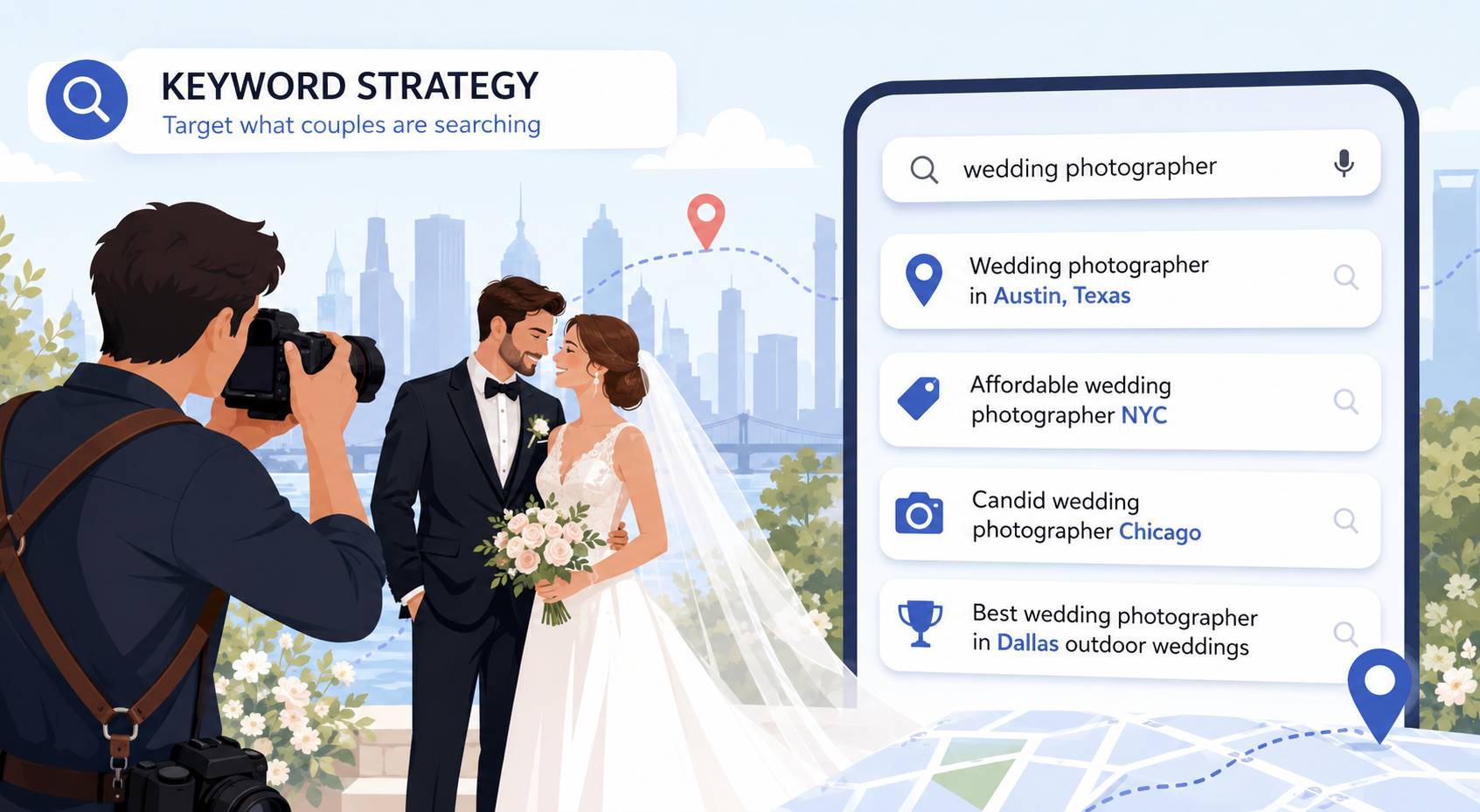
Keywords represent real search behavior. They tell you what couples already want.
They target broad terms like:
These are too competitive and too vague.
Better keywords are specific and local:
These work because they match real booking intent.
Long-tail keywords convert better because they reflect real situations. Someone searching “wedding photographer in Austin Texas” already knows:
That’s not research traffic. That’s booking traffic.
Your homepage is the strongest signal Google receives about your business. But most photographers underuse it.
A high-ranking homepage clearly shows:
That’s the foundation.
Weak: “Capturing timeless love stories through cinematic photography.”
It sounds nice but gives no location or clarity.
Strong: “Wedding Photographer in Chicago Capturing candid and documentary-style weddings across Illinois helping couples preserve real, emotional wedding moments.”
Now Google understands:
That alignment is what ranking is built on.
Local SEO is where most bookings come from. Not blog traffic, nor social media.
Google evaluates:
It doesn’t rely on one signal. It looks for patterns.
If your website says Chicago, your Google profile says Chicago, and your reviews mention Chicago, Google builds trust. That trust improves rankings.
Your Google Business Profile is often the quickest way into visibility. In many cities, it ranks before your website.
Most photographers set it up once and ignore it. But Google rewards activity, not just existence. A dormant profile slowly loses ranking strength over time.
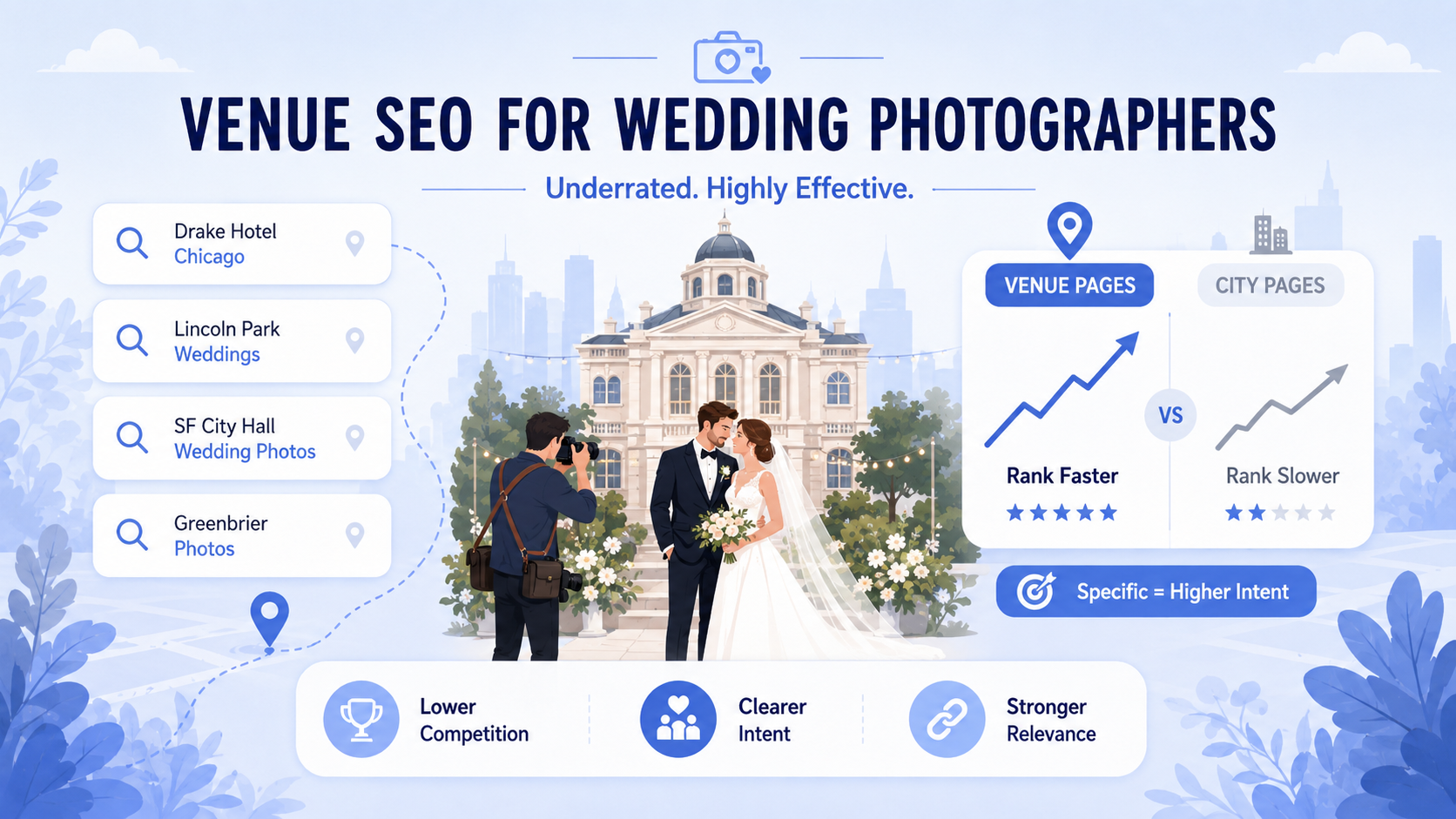
Most couples don’t just search for a “wedding photographer in Chicago.”
They also search for:
These are high-intent searches. People searching like this are already mentally committed to a venue. That means they are much closer to booking.
City pages are competitive. Venue pages are specific. Google prefers specificity because it reduces ambiguity. A page about “wedding photography at The Driskill Hotel” is easier to rank than “Austin wedding photographer” because:
Photographers often showcase venues in portfolios, but never structure them as SEO landing pages. That’s a lost ranking opportunity.
A single venue page can rank for dozens of long-tail searches like:
A strong venue page is not a gallery dump. It is a structured experience page. Here’s the format that consistently performs well in US SERPs.
Google understands context better when content is structured around real-world experience rather than generic descriptions.
Couples stay longer because they see:
That combination increases both ranking and conversions.
Most photographers confuse city pages with venue pages. They serve completely different roles.
City pages target searches like:
These are competitive but necessary.
Venue pages target:
Page Type | Search Intent | Competition | Conversion Rate |
City Pages | Broad discovery | High | Medium |
Venue Pages | Booking-ready | Low to Medium | Very High |
Top-ranking photography websites don’t rely on city pages alone.
They build layers:
City → Venue → Story → Blog → FAQ
This creates topical authority that Google rewards.

Blogging is often misunderstood in photography SEO. Most photographers treat it like a gallery update system. That’s not how ranking blogs work.
Google wants:
Instead of random posts, use structured content types:
Because they naturally include:
This creates multiple ranking entry points.
Internal linking is one of the strongest but most ignored SEO signals in photography websites. It tells Google how your content is connected.
A strong wedding photography site behaves like a connected system:
Homepage
↓
City Pages
↓
Venue Pages
↓
Blog Stories
↓
FAQ / Guides
↓
Contact Page
Instead of random linking, use intentional pathways:
Internal linking helps Google:
Without it, your content stays isolated.
On-page SEO is not about keyword stuffing. It’s about alignment between intent and structure.
Every important page should communicate:
Many photographers over-focus on images and under-focus on text structure. Google cannot rank what it cannot interpret.
Ranking in competitive US cities is not about one page. It’s about authority signals across multiple pages.
Authority comes from:
Instead of isolated pages, build clusters:
Cluster Type | Example Pages | SEO Purpose |
City Cluster | Chicago wedding photographer | Broad ranking |
Venue Cluster | Drake Hotel weddings | High intent traffic |
Story Cluster | Real wedding at Lincoln Park | Trust + engagement |
Guide Cluster | Wedding planning tips Chicago | Informational traffic |
Google rewards depth, not just presence. If you cover a topic from multiple angles, you become more relevant than competitors with single pages.
Technical SEO is often ignored because it feels complex, but photography websites are especially affected by it.
Large image files slow websites down.
That affects:
Best practice:
Most wedding photography traffic is mobile-first. If your site feels slow or hard to scroll, users leave immediately.
Google measures:
These directly affect rankings in competitive SERPs.
Getting on Google is only step one. Two photographers can rank on the same keyword:
The difference is not ranking. It is conversion clarity.
Google sends visitors, but it doesn’t guarantee they stay.
Your website must handle:
If that fails, SEO traffic becomes wasted potential.
Conversion is where SEO becomes income. This is not about design aesthetics. It is about decision psychology.
A strong wedding photography website should immediately answer:
If those answers are delayed, users leave.
Element | Why It Matters | SEO Impact |
Clear booking button | Reduces friction | High |
Short inquiry form | Increases submissions | High |
Real wedding galleries | Builds trust fast | Medium |
Testimonials near visuals | Strengthens emotional trust | High |
Pricing clarity (optional) | Filters serious leads | Medium |
Simple Conversion Rule
Every page should guide users toward one action: Inquiry, not exploration.
Backlinks are one of the strongest ranking signals in US SERPs. But photography backlinks are different from typical SEO backlinks.
Strong backlinks often come from:
Schema helps Google understand your website at a structured level. Most photographers ignore it, which is a missed opportunity.
Schema improves:
It helps Google interpret your business faster and more accurately.

If you don’t track SEO, you’re guessing, and guessing doesn’t scale.
Metric | Tool | Why It Matters |
Keyword rankings | Google Search Console | Visibility tracking |
Traffic trends | Google Analytics | Growth patterns |
Lead inquiries | CRM or form tool | Revenue impact |
Map views | Google Business Profile | Local reach |
Ranking improvements don’t happen randomly. They follow consistent execution cycles.
First 30 Days
Days 31–60
Days 61–90
Outcome
By day 90, your website starts shifting from: “portfolio website” → “local ranking asset”
Even when a photography website looks polished, rankings often stay flat. The issue is rarely design. It’s usually how the site is structured and understood by Google.
Most photographers unknowingly build websites that look complete on the surface but feel incomplete to search engines.
Here are the bigger mistakes that quietly limit growth.
A common habit is publishing wedding blogs that mainly showcase photos with minimal context. The problem is not the images. The problem is the lack of search direction.
Google does not rank content just because it looks beautiful or emotional. It ranks content when it clearly answers a specific search intent. A strong blog should feel like a documented experience, not a slideshow.
That means it needs:
When blogs are built only around visuals, they become invisible to search engines because there is no semantic depth for Google to interpret.
Many photography websites are built as if every page carries equal importance. Home, gallery, blog, and contact pages are all presented at the same level with no clear hierarchy.
This creates confusion for search engines.
Google needs to understand:
Without this structure, authority gets diluted across the site instead of being concentrated where it matters. A well-structured site behaves more like a guided path than a collection of pages. It leads both users and Google from general intent to specific booking action.
One of the most common SEO gaps in photography websites is weak location reinforcement. Mentioning a city once on the homepage is not enough to establish local relevance. Google evaluates location authority through repetition patterns across the entire site, not a single mention.
The issue usually appears like this:
As a result, the site does not build a strong “geographic identity” in Google’s system. Strong local SEO comes from layered reinforcement, where location signals appear naturally across multiple page types, not forced in one section.
Many photography websites are built once and then left unchanged for long periods. This creates a silent ranking decline. Search results evolve constantly. New competitors enter, existing pages update, and Google recalibrates relevance.
A static website slowly loses ground even if it initially ranked well. The real issue is not lack of content; it is lack of direction in content growth.
High-performing photography websites continuously expand in a structured way:
Without this ongoing expansion, the site becomes outdated in Google’s eyes, even if the visuals remain strong.
Wedding photography SEO is not about ranking a single page. It is about building a system where Google consistently understands:
When all layers work together like city pages, venue pages, blogs, Google Business Profile, and conversion design, your website stops being passive. It becomes a lead generation system that runs continuously.
If you want to scale this further and turn your website into a predictable client acquisition channel, explore CausalFunnel for advanced marketing insights and growth systems designed to improve SEO performance, tracking, and conversion optimization.
SEO for wedding photographers usually takes 3 to 6 months to show strong results. In competitive US cities, it may take longer depending on content depth, backlinks, and local SEO strength. Consistent updates improve ranking speed over time.
The best SEO strategy includes local SEO, venue-based pages, city pages, blogging, and strong Google Business Profile optimization. When combined, these elements build authority and help photographers rank for both local and venue-specific searches.
Most wedding photography websites don’t rank because of weak location signals, poor keyword targeting, lack of content depth, and missing internal linking. Without structured SEO, Google cannot understand the business clearly enough to rank it.
Yes, SEO is essential even if you use Instagram. Social media brings temporary visibility, but SEO brings long-term booking intent traffic. Couples searching on Google are usually closer to hiring than social media users.
A wedding photographer should aim for at least 2 to 4 high-quality blog posts per month. These should focus on real weddings, venues, and local search intent to build authority and improve rankings over time.
Start using our A/B test platform now and unlock the hidden potential of your website traffic. Your success begins with giving users the personalized experiences they want.
Start Your Free Trial

Empowering businesses to optimize their conversion funnels with AI-driven insights and automation. Turn traffic into sales with our advanced attribution platform.
Trusted by Customers


©CausalFunnel Inc. All rights reserved.