



Free Funnel Audit
Convert more customers today!

SEO
10 mins read


SEO
10 mins read

Most websites don’t have a traffic problem. They have a conversion problem.
People land on pages, scroll a bit, and leave without doing anything. That gap is what website conversion rate actually exposes.
Website conversion rate is simply how many visitors take a real action on your site. That could be a purchase, a signup, or even a form fill. Nothing complicated, just real behavior.
If you want to understand why users act the way they do and improve results with clearer signals, you should explore CausalFunnel. Our team helps you see what’s happening on your site instead of guessing.
A strong conversion rate usually means people instantly understand what you offer. A weak one usually means something is unclear, slow, or not convincing enough.
That difference is small on paper, but huge in real performance.
Website conversion rate shows the percentage of visitors who complete a goal. That goal depends on your business type and website purpose.
For example:
It is one of the most important website performance metrics.
A higher conversion rate means more value from the same traffic. This helps businesses grow without always increasing ad spend.
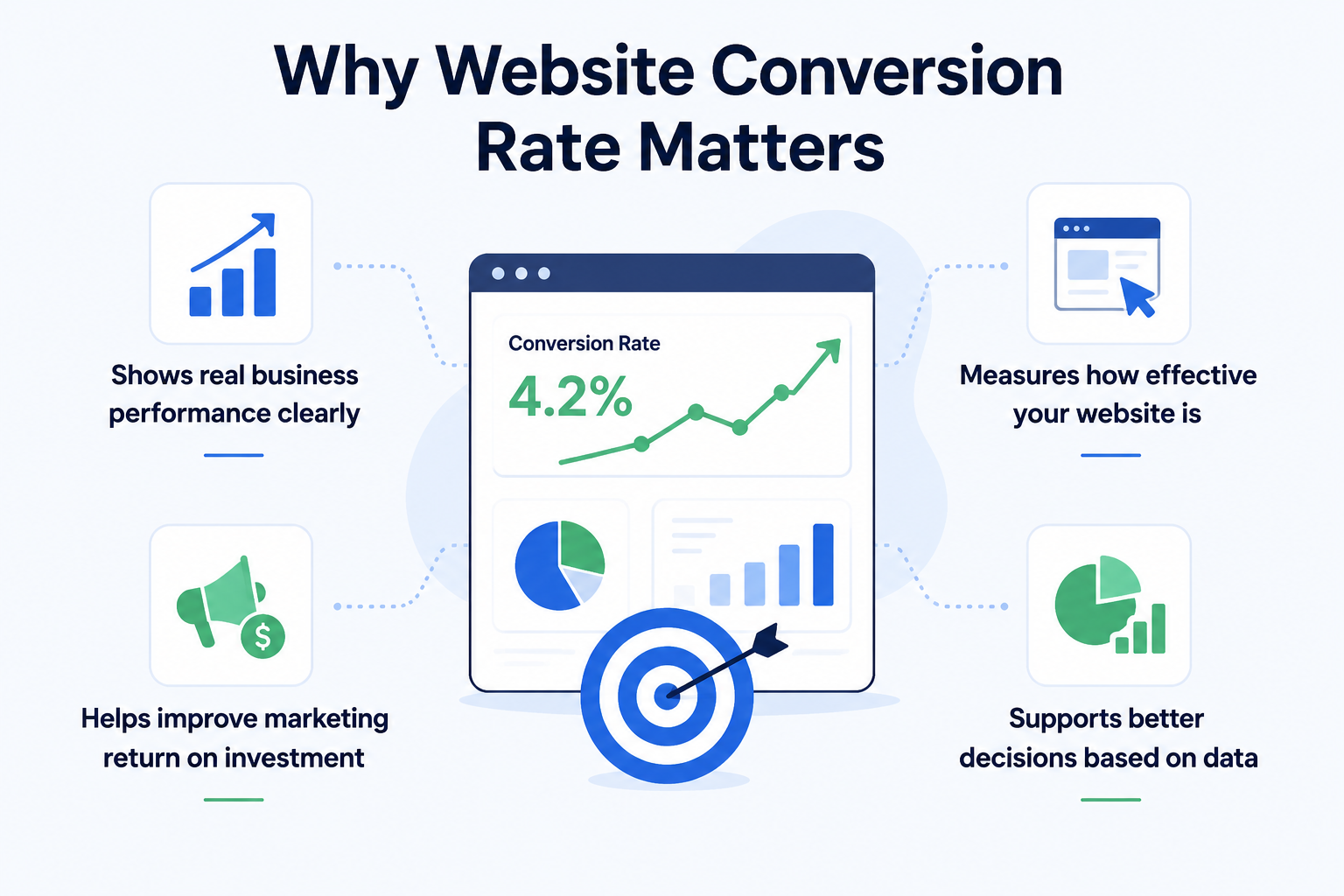
Website conversion rate is important because it shows real user action. Traffic alone does not grow your business.
A website with fewer visitors can still perform better with higher conversions. That is why this metric is widely used.
Key reasons website conversion rate matters:
This metric helps you understand what users actually do on your site.
The conversion rate formula is easy to understand and apply.
(Conversions ÷ Total Visitors) × 100
This gives you a percentage value.
For example:
This number helps you measure how well your website performs.
A website conversion rate calculator helps you find results quickly. You do not need manual calculations.
You simply enter:
The tool shows your conversion rate instantly.
Input Metric | Example Value |
Visitors | 2,000 |
Conversions | 80 |
Conversion Rate | 4% |
This makes performance tracking simple and clear.
A conversion is any action that matches your website goal. It is not always a sale.
Common conversion actions include:
Each website defines conversions based on its purpose. This makes the metric flexible and widely useful.
Not all conversions mean the same thing. Some show direct revenue impact, while others show early interest or intent. Understanding different types helps you see the full customer journey instead of only looking at final sales.
Macro conversions are the main goals of your website. These are the actions that directly impact business results.
They usually include:
These conversions matter the most because they represent outcomes.
But they don’t happen instantly. Most users move through smaller steps before reaching this point. That’s why macro conversions should always be viewed with supporting data.
Micro conversions are smaller actions that show early interest. They don’t generate revenue directly, but they show engagement.
Common examples include:
These actions help you understand user intent before they fully convert. If micro conversions are strong but macro conversions are weak, it usually means something is breaking later in the journey.
Assisted conversions are often overlooked, but very important. These happen when a user doesn’t convert immediately, but returns later and completes the action.
For example:
The first touchpoint still played a role in the conversion. This type helps you understand multi-step decision behavior. Most users don’t convert on the first visit. They take time, compare options, and return later.
Looking at only one type of conversion can give a false picture.
For example:
When you look at all three together, you understand the full funnel more clearly. It also helps you fix the right problem instead of guessing.
Businesses track conversion rate to improve performance clearly.
It helps answer important questions:
This makes marketing decisions more data-driven. These improvements in conversion rate can create strong business growth.

Conversion rate optimization is the process of improving your website so more visitors actually take action. It is less about bringing new traffic and more about making better use of the traffic you already have.
At its core, CRO focuses on how people behave on your site. Not what you assume they will do, but what they actually do.
A conversion can mean different things depending on your goal:
Each of these actions shows progress. CRO is about increasing how often that progress happens.
Most websites lose conversions for simple reasons. People get confused, distracted, or unsure about the next step.
So they leave.
CRO works by reducing that uncertainty. It removes unnecessary friction, simplifies decisions, and makes the next step obvious.
When users don’t have to think too much, they act more naturally. When the experience feels clear, conversion rates usually improve without needing more traffic.
In simple terms, CRO is just this: make the journey easier, and more people complete it.
CRO does not always need complex tools. Simple changes often bring better results.
Users should understand your page quickly. Short sentences work better than heavy text blocks.
Buttons should tell users what happens next.
Examples:
Too many links or visuals can break focus. Clean pages usually perform better.
People take action when they feel safe. You can add:
Slow pages lose attention fast.
Faster pages keep users engaged longer.
Landing pages are designed for one purpose. That purpose is action. When done well, they guide users without confusion.
Users should not think too much. They should know what to do next.
A/B testing helps you understand what users prefer. It compares two versions of a page.
You test changes like:
Half the users see one version. The other half sees another version. Then you check which one performs better.
A funnel shows the steps users take before converting. It usually looks like:
Users often leave at different stages. Funnel optimization helps fix that.
Users should feel they landed in the right place.
Fewer steps usually improve completion rates.
Fix the weakest step first.
The same tone across pages builds trust.
Emails or reminders help recover lost users.
Funnels show how users move through your site. Even strong traffic means little if users leave early. When you fix drop-off points, conversions improve naturally. It also helps you understand user behavior better.
A good website conversion rate depends on your industry and traffic type. There is no single number that fits every business.
Most websites fall within a common range. But top-performing sites go much higher.
Industry Type | Average Conversion Rate |
E-commerce | 2% to 4% |
SaaS platforms | 3% to 7% |
B2B websites | 2% to 5% |
Lead generation | 2% to 6% |
Landing pages | 5% to 15% |
These numbers show how performance changes across industries. A higher website conversion rate usually comes from better targeting and clearer messaging.

Not all websites aim for the same action. That is why conversion rates vary. Some websites focus on quick purchases. Others focus on long decision cycles.
Key factors that affect conversion rate:
Even small differences in audience behavior can change results.
This is why tracking your own website conversion rate is more important than copying averages.
Let’s say two websites get the same traffic.
Website B performs better even with less traffic.
This shows a simple truth. Conversion rate matters more than volume. Improving conversion rate often gives faster growth than increasing traffic alone.
CRM systems play a big role in improving conversion performance. They help businesses understand users better.
A CRM tracks user behavior across the journey. It helps teams respond at the right time.
When businesses understand users better, they convert more visitors into customers. This is why CRM tools are closely linked with conversion rate optimization.
Conversion rate is not just a number. It reflects the full customer journey. Users rarely convert on their first visit. They explore, compare, and return later.
A strong journey usually includes:
Each step affects the final conversion rate. When one step feels weak, users drop off before converting.
Many websites lose conversions for simple reasons.
These mistakes are common:
Fixing these issues often improves results quickly. A strong website conversion rate is not about luck. It comes from clear communication and smooth user experience.
When users understand what to do, they act faster. That is the real goal of optimization.
Website conversion rate is more than just a number. It shows how well your website actually works for real users.
When people understand your message quickly, they take action. When they don’t, they leave.
That is why small improvements matter so much. Clear pages, faster load times, and simple structure often improve results more than big changes.
If you want to understand user behavior better and improve conversions in a more structured way, you can explore CausalFunnel. We help you see what users do on your site and improve performance with clearer insights.
Website conversion rate is simply how many visitors actually do something on your site. That “something” could be buying, signing up, or filling out a form. It matters because traffic alone does not mean results. Conversions do.
There is no perfect number that fits every website. Most businesses usually fall somewhere between 2% and 5%. Some strong landing pages go beyond 10% when everything is well optimized.
It is actually very simple once you break it down. Take total conversions and divide them by total visitors. Then multiply the result by 100 to get the percentage.
For example, 50 conversions from 1,000 visitors equals 5%.
This happens more often than people think. High traffic does not always mean the right audience or clear messaging. Usually, the problem is something small but important, like confusing pages, slow load times, or weak calls to action.
The fastest improvements usually come from fixing basic friction. Make pages easier to understand and remove anything distracting. Clear buttons, faster pages, and better landing page structure often make a noticeable difference. Testing small changes also helps you learn what actually works.
Start using our A/B test platform now and unlock the hidden potential of your website traffic. Your success begins with giving users the personalized experiences they want.
Start Your Free Trial

Empowering businesses to optimize their conversion funnels with AI-driven insights and automation. Turn traffic into sales with our advanced attribution platform.
Trusted by Customers


©CausalFunnel Inc. All rights reserved.