



Free Funnel Audit
Convert more customers today!
SEO
10 mins read

SEO
10 mins read
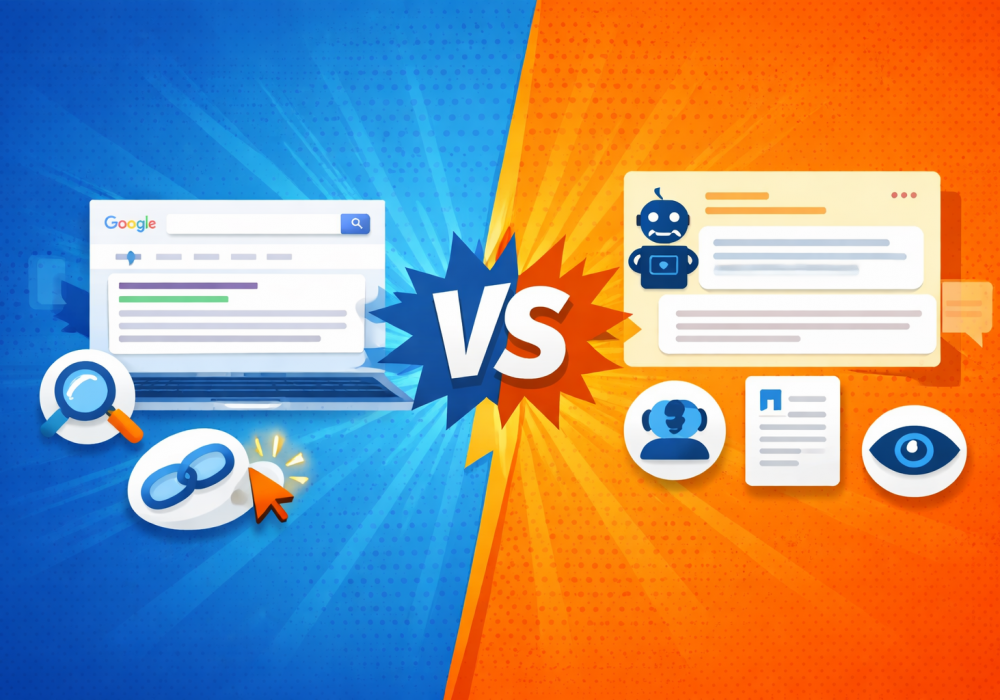
SEO helps pages rank on search engines so users can click them. GEO helps content get picked and quoted inside AI-generated answers.
Search Engine Optimization focuses on visibility in search results. Generative Engine Optimization focuses on being included in AI responses.
Core difference: SEO gets clicks. GEO gets mentions inside answers.
SEO is the process of helping a website show up on search engines like Google. The goal is to increase visibility, drive clicks, and generate consistent website traffic.
Search engines follow a basic flow. They crawl pages, store them, then rank them. Pages that match a search query and offer value move up.
Think about the last time you searched for “best pizza in New York.” You likely clicked one of the first few links. That’s SEO at work.
Success in SEO looks like:
But here’s a real question people often ask:
“Is ranking enough anymore?”
That question leads straight into the next shift.
GEO stands for Generative Engine Optimization. It focuses on getting content included in AI-generated answers.
Instead of showing a list of links, AI tools give one clear answer. That answer is built from multiple sources. The goal is to be one of those sources.
AI search works differently. It reads large amounts of content. It looks for clear answers, trusted sources, and structured information. Then it creates a response.
Success in GEO looks like:
What if users never click your link, but still see your brand?
That is the shift GEO is built for.
| Factor | SEO | GEO |
| Goal | Rank on Google | Get mentioned in AI answers |
| Output | List of links | One summarized answer |
| Focus | Keywords, backlinks | Context, clarity, authority |
| Success metric | Traffic | Mentions, visibility |
SEO is built around rankings. The goal is to appear as high as possible on search engine results pages. That matters because position drives clicks. Studies often show that the first result on Google gets around 25–30% of all clicks, while lower positions get far less. So, ranking higher directly impacts traffic.
GEO works differently. It focuses on being mentioned inside AI-generated answers. Even if a user never clicks a link, the brand can still appear in the response. For example, when someone asks an AI tool for the “best email marketing tools,” it may list a few names directly. Those mentions build awareness without requiring a click. So now, visibility is not just about position. It is about presence inside the answer itself.
SEO has always relied on keywords. Pages are optimized around specific search terms so they match user queries. For example, a page targeting “best CRM software” will include that phrase in headings, content, and meta tags. This helps search engines understand relevance.
GEO shifts the focus toward context. AI systems do not just match keywords. They try to understand intent. They look at how well a page answers a question. For instance, a page that clearly explains “Which CRM is best for small teams?” may get picked, even if it does not repeat the exact keyword many times. This is because the answer is clear and useful. So, while keywords still matter, context and clarity now carry more weight in AI-driven results.
Backlinks remain a strong ranking factor in SEO. When other websites link to a page, it signals trust and credibility. Pages with more high-quality backlinks often rank higher because search engines see them as reliable sources.
In GEO, authority goes beyond links. AI systems look at a wider set of signals. These include expertise, accuracy, brand reputation, and consistency across content. For example, a site that regularly publishes clear, fact-based content on a topic may be seen as more trustworthy than a site with many backlinks but weak content.
Research from Princeton and other studies on generative search suggests that adding credible elements like statistics and expert quotes can increase AI visibility by up to 40%. This shows that depth and reliability matter more than ever. Even smaller sites can compete if their content is clear and well-supported.
SEO success has always been tied to clicks. If users do not click, there is no traffic. That is why ranking, titles, and meta descriptions are so important. They are designed to attract attention and drive action.
GEO changes this dynamic. A brand can gain visibility without getting a click. For example, if an AI tool answers a question and includes a brand name or reference, users still see it. This can influence decisions, even without visiting the website.
This raises a real question. If users do not click, is it still valuable? In many cases, yes. Brand exposure inside answers builds trust over time. It is similar to seeing a recommendation from a friend. Even without a click, the impression stays.
SEO operates within search result pages. Users type a query, see a list of links, and choose one. They compare options, read snippets, and decide what to click. This process takes time and effort.
GEO focuses on AI summaries. Instead of ten blue links, users get one direct answer. For example, asking “What is the best budget laptop?” may return a short list with key recommendations. The user gets what they need instantly.
This shift reduces decision fatigue. People no longer need to open multiple tabs or compare sources. However, it also reduces browsing behavior. Fewer clicks mean fewer chances to engage users through traditional paths. So, the challenge now is simple but important. How can content become part of that final answer instead of just another link in the list?
Search behavior is changing. People want quick answers. Not ten links. Not endless scrolling. Just the answer.
AI tools are shaping this shift. They provide direct responses in seconds.
Think about common moments:
Users expect instant clarity. That means fewer clicks. More answers. Less browsing.
For businesses, this creates a new challenge: How do you stay visible when users stop clicking?
That’s where GEO becomes critical.
No. GEO does not replace SEO.
SEO is still the foundation. Without it, content may never be discovered.
GEO builds on top of SEO. It improves how content is used in AI systems.
Think of it like this:
Ignoring SEO is a mistake. Ignoring GEO is also a mistake.
The strongest strategy blends both.
SEO ensures pages are indexed and ranked. GEO ensures those pages are understood and used by AI.
Here’s how they connect:
So the real strategy is not choosing one. It’s aligning both.
Ask this before publishing content:
If both answers are yes, the content is future-ready.
SEO basics still matter. But they need to be done well.
A page that loads fast, answers well, and earns trust still wins.
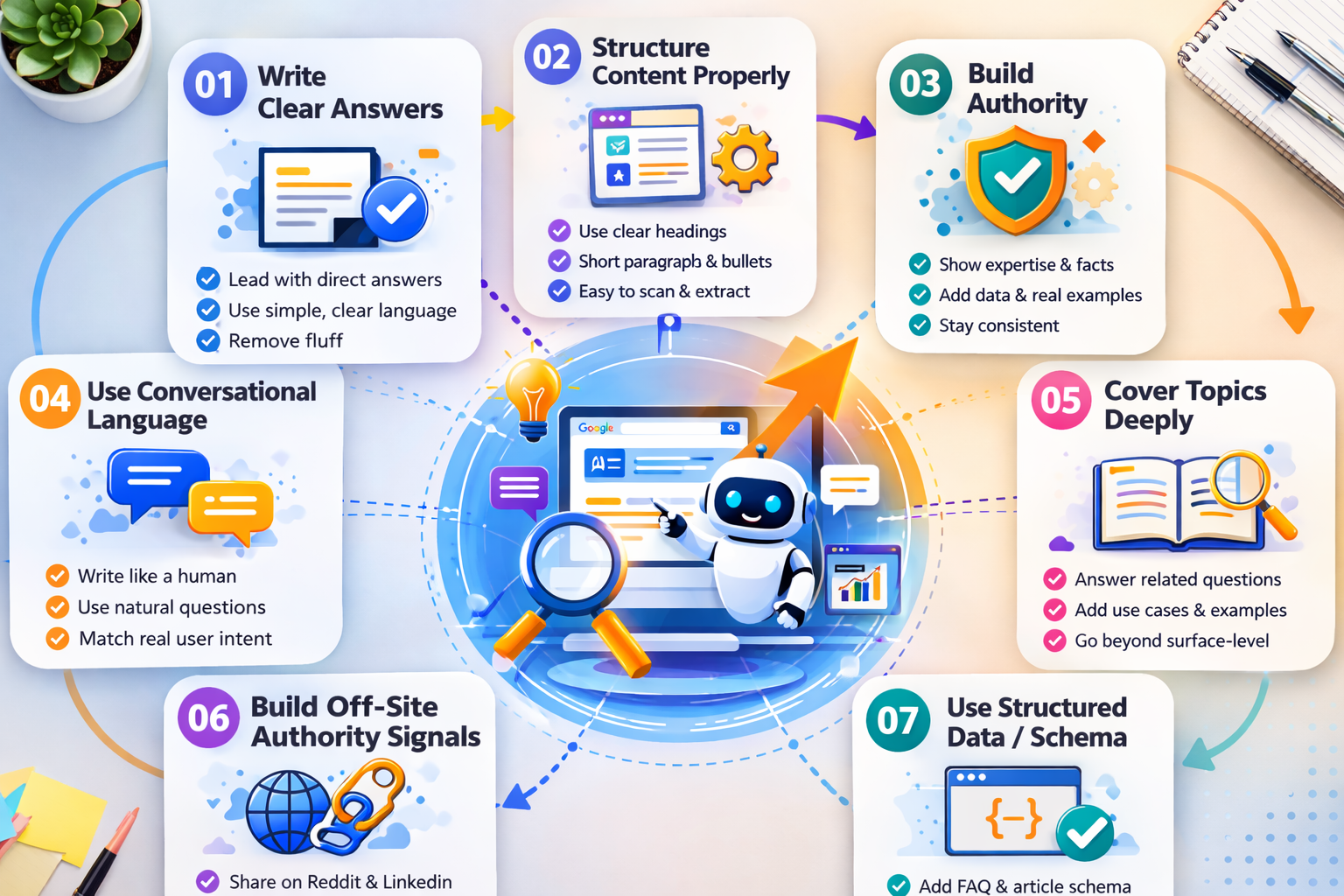
GEO about making content clear, useful, and easy to trust. Think of it like explaining something to a friend. If they understand it fast, AI tools usually will too.
Start with the answer. Not a long intro.
AI systems look for direct responses. If the answer is buried, it often gets skipped. So keep it simple and to the point. Then you can explain more after that.
Before:
“This topic can be complex depending on several factors and requires careful consideration…”
After:
“This works best for beginners who want a simple start.”
One delays the answer. The other delivers it right away. After that, you can add details, examples, or edge cases. But always lead with clarity. That builds trust quickly.
Good structure makes content easy to read. It also makes it easy for AI to extract key points.
Use clear headings. Break text into short paragraphs. Add bullet points where needed. Think of it like guiding someone through a topic step by step.
Before:
A long paragraph with no breaks, covering multiple ideas at once.
After:
Clear sections with headings, short paragraphs, and bullet points for key ideas.
When content is structured well, both readers and AI can scan it faster. When something is easy to scan, it is easier to use. That increases the chances of being picked for answers.
Authority is not just about backlinks anymore. It is about trust. And trust comes from accuracy, consistency, and real expertise.
Make sure claims are backed by facts. Use examples that reflect real situations. Keep your tone confident but not exaggerated.
Before:
“This is the best solution for everyone.”
After:
“This works well for small teams, especially those just getting started.”
The second version feels more honest. It sets the right expectation. Over time, this kind of writing builds credibility. And AI systems tend to favor sources that sound reliable and grounded.
Write the way people speak.
Think about how questions are asked in real life. They are simple and direct. Your answers should match that tone.
Before:
“Users may find this solution beneficial depending on their specific requirements.”
After:
“Will this help you save time? Yes, especially if you work with a small team.”
The second one sounds like a real conversation. That is what AI systems are trained on. So when your content matches that tone, it becomes easier to include.
Surface-level content rarely gets picked. AI tools prefer content that covers a topic from multiple angles.
Answer related questions. Add examples. Explain edge cases. Think about what someone might ask next.
Before:
A short answer with no follow-up or detail.
After:
A clear answer, followed by common scenarios, use cases, and related questions.
For example, if the topic is tools, go beyond listing them. Explain who each tool is for. Talk about pricing, ease of use, and limitations. That depth signals value. And that makes the content more useful for both users and AI.
AI systems do not just read websites. They also pull signals from platforms like Reddit, LinkedIn, and guest articles.
So, your content should not live in one place only. Share insights across platforms. Join discussions. Publish short takes or summaries.
Before:
Publishing a blog and leaving it there.
After:
Sharing the blog on LinkedIn, then discussing it on Reddit. Finally, write a guest post on the same topic.
When your ideas appear in multiple places, it builds a stronger footprint. AI tools notice repeated signals. That increases the chances of your content being trusted and cited.
Structured data helps search engines and AI systems understand your content better. It adds context behind the scenes.
Schema markup can define things like FAQs, articles, products, and more. This makes it easier for systems to identify key information.
Before:
Content with no structured data, relying only on plain text.
After:
Content with FAQ schema, article schema, and clear metadata.
For example, adding FAQ schema can highlight key questions and answers. This improves the chances of appearing in rich results and AI summaries.
It may feel technical at first. But even basic schema can make a difference. It acts like a guide, helping systems read your content the right way.
Traditional SEO metrics like traffic and rankings still matter. But they no longer tell the full story. Things are changing, and new signals are starting to matter just as much, if not more.
When content shows up inside AI answers, users may never click through. That means visibility is no longer tied only to visits. So, what should be tracked instead?
Here are the key metrics that matter in GEO:
These metrics are not as easy to track as clicks or rankings. But there are ways to get close.
Start with Google Analytics 4 (GA4). Go to traffic acquisition reports and filter referral sources. Look for domains like chatgpt.com, perplexity.ai, and gemini.google.com. These show when users actually come from AI tools. It is not perfect, but it gives a strong signal.
Next, use tools built for this shift:
To keep things simple, follow this workflow:
Imagine a blog about “best project management tools.”
Now consider this:Which one builds more trust? A ranked link or a direct mention in an answer?
Both matter. But the second feels more authoritative.
Many businesses get this wrong.
Each mistake reduces both ranking and visibility.
Search is no longer just about finding links. It is moving toward getting answers right away. This shift is happening faster than most people expected.
Gartner has predicted that traditional search engine volume could drop by up to 25% in the coming years as users turn to AI tools for direct answers. At the same time, BrightEdge has found that AI Overviews now appear in nearly 48% of Google search results. That means almost half of all searches may show an AI-generated summary before users even see regular links.
So what does this mean for you?
Users are changing how they search. Instead of clicking through multiple pages, they read one answer and move on. It feels faster and easier. Once people get used to that, they rarely go back.
Now here is something interesting. Visitors who do come from AI tools often behave differently. Some reports suggest that AI-referred users can have up to 4.4 times higher conversion rates compared to regular search traffic. That makes sense. By the time they click, they already trust the answer.
This creates a new kind of balance. Yes, total clicks may drop. But the quality of those clicks may improve.
For brands, the takeaway is clear. Visibility inside answers will matter just as much as ranking on a page. Those who adapt early will build trust faster. Those who wait may find it harder to catch up as user habits settle.
The shift is already happening. The real question now is not whether search will change, but how quickly brands are ready to change with it.
SEO focuses on ranking pages on search engines to drive traffic. GEO focuses on getting content included in AI-generated answers. SEO brings clicks, while GEO brings visibility inside responses. Both aim to increase reach but use different methods and success metrics.
GEO is not better than SEO. It serves a different purpose. SEO drives traffic through rankings, while GEO improves visibility in AI answers. The best approach is to use both together to maximize reach and authority.
Yes, SEO is still essential. It helps content get discovered and indexed. Without SEO, content may not appear in search results or AI systems. GEO builds on SEO, not replaces it.
Generative Engine Optimization is the process of optimizing content to appear in AI-generated answers. It focuses on clarity, context, and authority rather than just keywords and backlinks.
Focus on clear answers, structured content, and strong authority. Use simple language and cover topics in depth. Make content easy to read and understand so AI systems can extract and use it effectively.
Yes, small websites can perform well in GEO. AI tools often prioritize clear and helpful content over domain size. A well-structured page with strong answers can compete with larger sites.
Success is measured through AI mentions, brand visibility, and citation frequency. Unlike SEO, it does not rely only on traffic or rankings.
Start using our A/B test platform now and unlock the hidden potential of your website traffic. Your success begins with giving users the personalized experiences they want.
Start Your Free Trial

Empowering businesses to optimize their conversion funnels with AI-driven insights and automation. Turn traffic into sales with our advanced attribution platform.
Trusted by Customers


©CausalFunnel Inc. All rights reserved.