



Free Funnel Audit
Convert more customers today!
SEO
10 mins read

SEO
10 mins read
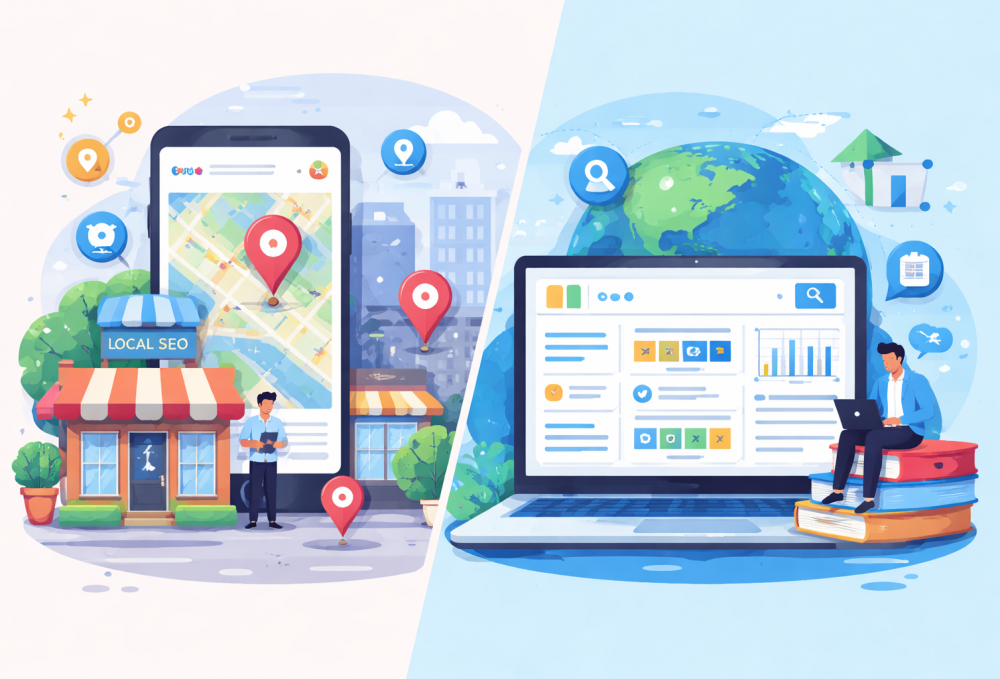
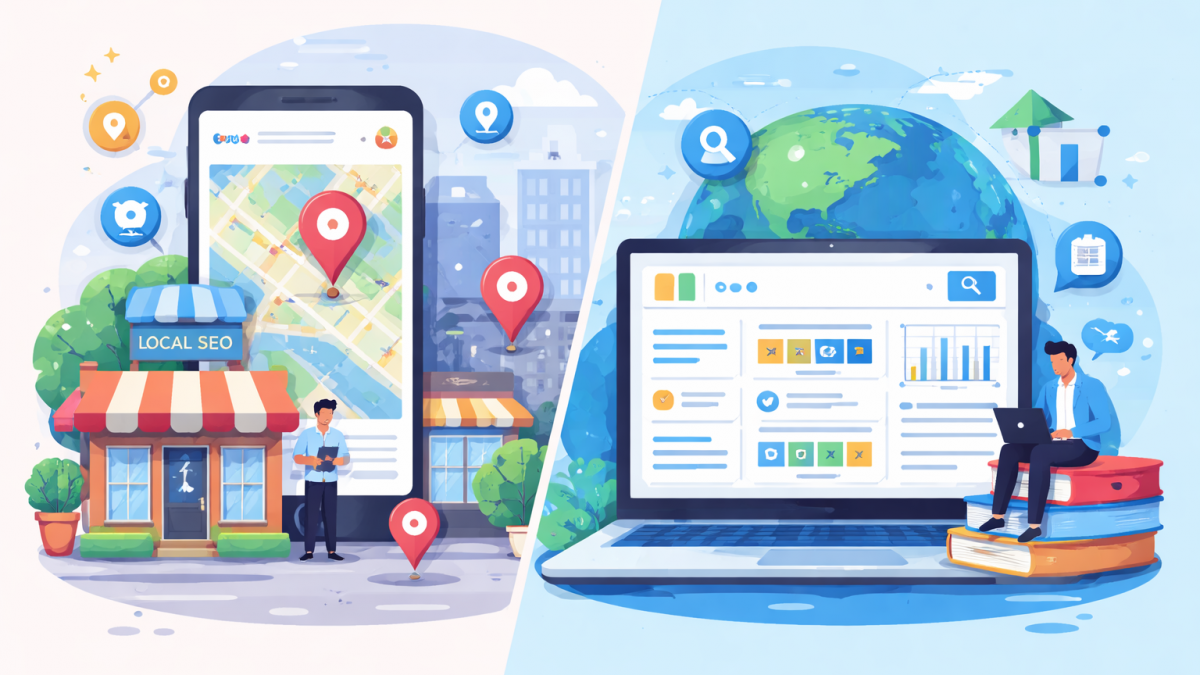
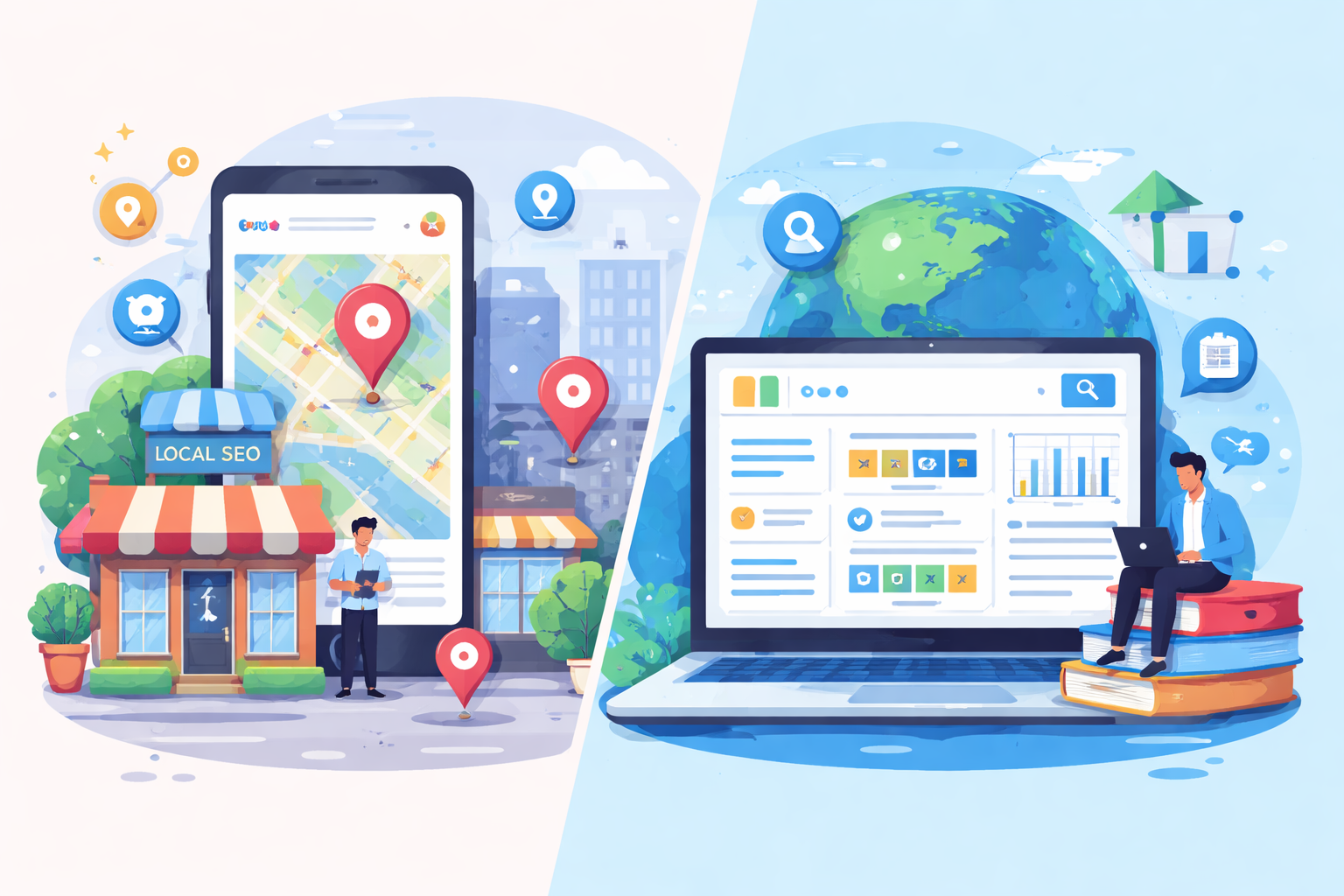
Local SEO helps a business show up when customers are searching nearby. Regular SEO helps a site rank for people anywhere. That one difference shapes every part of the search strategy in 2026.
Both help a business show on Google. Both use keywords. Both need content. Both rely on trust signals.
At first glance, they look like twins. But look closer and you will see the difference.
Search has changed fast in 2026. AI search answers show up before links. Google looks harder at trust. Reviews shape buying choices. Search results shift based on where a person stands, even down to the block in some cases.
That means the wrong SEO strategy can waste months. This guide clears that up.
It breaks down the real difference between local SEO and regular SEO, why each matters, and how to know which one fits a business best.
Local SEO helps businesses rank in location-based search results. These include the Map Pack, local organic listings, and AI local pack results. It relies heavily on Google Business Profile optimization, local citations, reviews, and proximity signals. Regular SEO helps websites rank in standard organic results using content quality, backlinks, and broader keyword relevance across regional, national, or global searches.
Local SEO is about helping nearby customers find a business when they are ready to act. This shows up in three places on Google:
| Search Surface | What Shows Up |
| Map Pack | The classic local 3-pack with maps, reviews, hours, and directions |
| Local Organic Results | Website pages ranking below map listings for local searches |
| AI Local Pack | AI-powered local recommendations with fewer business options |
To rank here, Google looks closely at signals like:
Regular SEO works differently. It helps websites rank in traditional organic search results for broader topics.
This is where people usually find:
Google focuses more on:
If someone searches:
“best tacos near me”
Google usually shows local restaurants in the Map Pack or AI local results.
If someone searches:
“how to make tacos”
Google shows recipe blogs and cooking guides.
Same topic but very different search intent.
Local SEO helps a business appear when people search in a certain place. This could be:
Google connects that search to local results. That means showing businesses in Google Maps, the local pack, and map listings before normal web pages.
A person standing in Chicago who searches “best pizza” gets different results than someone in Austin typing the same thing.
That is local SEO at work.
Google checks local trust signals. It looks for things like:
It asks one simple question: Is this business real, trusted, and relevant nearby?
If yes, it ranks. If not, it disappears.
A great local business can still stay invisible if its local SEO is weak.
A family owned bakery in Portland might make better bread than half the city. But if reviews are stale and listings are wrong, Google acts like it barely exists.
Local SEO works best for businesses serving a place. Examples include:
If customers come from a set region, local SEO matters. A plumber in Phoenix does not need clicks from Boston. Those visitors will never call. The goal is local leads, not random traffic.
In 2026, local rankings depend on a mix of profile quality, customer trust, user behavior, and local authority signals.
Here is what actually moves the needle.
| Ranking Factor | Why It Matters |
| Google Business Profile | Strongest local ranking signal |
| Reviews and review recency | Builds trust and freshness |
| Local keywords | Helps Google match search intent |
| NAP consistency | Confirms business accuracy |
| Behavioral signals | Shows user engagement |
| Local backlinks | Builds authority in the area |
Let’s break these down.
This is the foundation of local SEO.
According to Whitespark’s 2026 Local Search Ranking Factors report, Google Business Profile signals now account for about 32% of Local Pack ranking performance.
It tells Google:
A complete profile performs better than a half-filled one.
That means every detail matters:
A lot of owners obsess over big numbers. “Competitors have 200 reviews. There’s no way to catch up.”
That is not always true. Freshness matters more now.
A business with 80 recent reviews can often outrank a business with 200 old reviews if those older reviews have gone stale. Google wants signs that people trust a business right now.
That is why review recency matters so much.
A good rule to remember:
Once a business has at least 10 solid reviews, review freshness starts carrying more weight than just adding volume.
Google watches what users do after seeing a listing. It tracks signals like:
If people keep clicking a listing and staying there, Google sees value. It assumes users found what they needed. That builds ranking confidence. This is often called GBP dwell time. A longer dwell time can signal that your Google Business Profile listing matched the user’s search intent well. Actions like reading reviews, checking photos, clicking directions, visiting the website, or calling the business can all show strong engagement and help improve local visibility over time.
Keywords still matter because Google wants natural local relevance. That means using location-based terms where they make sense.
Examples:
These help Google connect services to local searches. But stuffing city names everywhere hurts more than it helps. Both readers and google notice it. Always add keywords naturally and in context.
NAP means:
These details must match across the web exactly.
That means if a business is listed as:
Smith Dental Care
It should not appear elsewhere as:
Smith Family Dental Clinic
Tiny differences create confusion which weakens trust. Google uses consistency to confirm legitimacy. If listings conflict, rankings often suffer.
Google wants proof that a business belongs in its local market. Local backlinks help prove that.
These are links from trusted local sources like:
These links tell Google: “This business is part of this community.”
A mention from a respected local paper carries more local trust than dozens of weak generic backlinks. That local trust adds up fast.
Regular SEO helps websites rank in normal organic search results. It is not tied to physical location. A site can rank nationally or globally. That is huge for digital brands.
A software company in Denver can rank for searches from London, Sydney, or Los Angeles. That is the power of regular SEO.
Google looks at:
The question here is different. Google asks: Is this the best answer online?
Not nearby, just best. That changes everything.
Regular SEO works best for:
If location does not shape the sale, broader visibility wins.
Key factors include:
Content Quality
Helpful, original content wins. Thin pages fade fast.
Keyword Targeting
Content must match what users search. Intent is important.
Backlinks
Authority links still matter in 2026. They act like trust votes.
Technical SEO
Your website should have fast load speed, clean code, mobile usability.
Site Authority
Site authority is the trust Google builds in a website over time.
It grows when a site keeps publishing helpful content, earns quality backlinks, and gives users a good experience. Google starts to see that site as reliable.
Here is where the difference becomes crystal clear.
| Comparison Area | Local SEO | Regular SEO |
| Target Audience | Nearby customers in a specific city or service area | National or global users |
| Search Intent | Visit, call, book, get directions | Learn, compare, research, buy online |
| Ranking Factors | Google Business Profile, reviews, proximity, citations | Content quality, backlinks, technical SEO, authority |
| Keyword Strategy | Location based phrases like “dentist in Dallas” | Topic based phrases like “best dental implant options” |
| Search Result Placement | Google Maps, Local Pack, local organic listings | Standard organic search listings |
| Competition Level | Local competitors in the same area | National and global websites |
| Content Strategy | Service pages, city pages, local landing pages | Blogs, guides, resource hubs, product pages |
| Best Business Types | Brick and mortar stores, local services, service-area businesses | SaaS, ecommerce, publishers, digital-first brands |
| Typical Results Timeline | Usually 2 to 6 months | Usually 4 to 12 months |
| Success Measurement | Calls, bookings, visits, direction requests | Traffic, leads, signups, sales |
| AI Overview Exposure | Around 7.9% of local queries trigger AI Overviews | Informational searches can trigger AI Overviews up to 80% of the time |
| Platform Scope | Google Maps, Apple Maps, local directories, ChatGPT local search surfaces | Google Search, Bing, AI search engines, broad discovery platforms |
Google shows each result type in a different way.
These often include:
This is built for action. Fast clicks, quick calls, and immediate visits.
These often include:
This supports research. People compare, learn, and explore. Different mindset and thus, different result layout.
It also means a different SEO strategy.
That depends on business goals. There is no universal winner.
A local dentist needs nearby patients. Ranking nationally is useless. Someone in Seattle will not drive to Tampa for a routine cleaning. Local visibility wins.
A SaaS startup sells online. Customers can come from anywhere. Location means little. Authority content matters more.
Think of a national gym brand with local branches. It needs:
That combo is powerful and smart brands use both.
A few years ago, people typed a search, scanned links, and clicked around. Now Google often answers the question first.
That answer shows up as an AI Overview.
People read it, get what they need, and sometimes never click a website at all. Studies now show AI Overviews appear on roughly 25% to 30% of all tracked U.S. searches. But that number changes a lot based on the type of search. That changes how local and regular SEO work.
Not every search gets an AI answer. Google shows them much more often for informational searches than local ones.
Here’s what current 2026 data shows:
Query Type | AI Overview Appearance Rate |
Informational searches | 70% to 80%+ |
Educational / how-to searches | 40% to 60% |
Comparison searches | 30% to 40% |
Transactional searches | 8% to 16% |
Local intent searches | About 7.9% |
That gap matters.
A search like: “How does local SEO work?” will often trigger an AI Overview.
But a search like: “SEO agency near me” usually shows maps and business listings instead.
That means local businesses are not hit as hard by AI summaries as content publishers and SaaS brands.
Still, local search is changing too.
Traditional local search usually shows the classic 3-pack. Three businesses. Three chances to win attention. AI-powered local packs are different.
Research shows they surface only about 32% as many businesses as the old 3-pack format.
That means fewer businesses get seen.
Think about that for a second. If Google used to show three local options, AI-enhanced local answers may show only one. Maybe two. That makes competition much tighter.
That is a huge deal for local brands. Especially for:
Getting into that smaller result set now takes stronger trust signals than ever.
This one feels obvious when you think about it. AI systems trust patterns. Reviews are one of the clearest trust patterns online.
Fresh reviews tell Google: “This business is active, real, and serving people well right now.”
Old reviews send a weaker signal. A five-star review from 2022 still helps. But ten fresh reviews from this month send a much stronger message.
That is why review velocity matters now. It is not just about having good ratings. It is about showing recent proof.
That is how AI decides who deserves visibility.
Some people thought AI search would kill content marketing. That has not happened.
If anything, helpful content matters more. Because AI systems need trusted sources to summarize. They pull from pages that answer questions clearly. They cite pages with depth.
Good content now needs:
That applies to both local and regular SEO. A local dentist can publish clear guides on dental implants. A SaaS company can publish deep software comparisons. Both build trust and trust gets surfaced.
GEO stands for Generative Engine Optimization. It means optimizing content so AI systems can understand it, trust it, and cite it inside AI-generated answers.
Think of it as SEO’s next chapter. Traditional SEO helps pages rank. GEO helps pages get referenced inside AI answers.
That matters because users increasingly read summaries before clicking anything.
For regular SEO, GEO means:
For local SEO, GEO means:
At the heart of all this is one thing; proof. Google wants proof, not promises.
That means:
This is where local SEO and regular SEO meet. Both now depend on trust. The businesses that show clear proof keep getting surfaced.
Ask three simple questions.
Yes. In 2026, they work better together than ever.
Google’s Gemini-powered search systems now pull signals from both Google Business Profile data and website content at the same time. That means Google looks at the full picture before deciding what to surface.
It checks things like:
In simple terms, Google wants proof from both sides. A strong business profile tells Google the business is real and active. A strong website proves expertise. When both work together,
Here is what that looks like in the real world.
Think about a fitness brand with locations across the country. Each location needs strong local SEO so nearby people can find:
That helps the local Map Pack rankings. At the same time, the main website might publish helpful content like:
That broader content builds national authority. When Google sees both, it connects the dots.
The content builds trust for the brand which helps local pages rank better too.
A dental group with offices in several cities needs local visibility for each clinic. Someone searching “dentist near me” needs the closest office. That is local SEO.
But people also search bigger questions like:
Helpful articles answering those questions build authority.
Then Google sees: “This brand has trusted local locations and useful expertise.”
That combination is powerful. It often leads to stronger rankings across every office location.
Picture a law firm serving Texas. It wants local clients in Dallas, Austin, and Houston.
Each office needs:
That handles local discovery.
But the firm can also publish legal guides on topics like:
These pages attract broader traffic. They also build topical authority. That authority often lifts local service pages too. A strong legal guide can help a Dallas office page perform better in local search.
SEO still takes time. But in 2026, the timeline can move faster or slower depending on one big thing. It is AI Overviews.
If a page gets cited inside an AI Overview, click-through rates can rise by about 35%. That is a real traffic lift.
But if AI Overviews show for your target keywords and your page is not included, clicks can drop by 46% or more.
So now, SEO timing is not just about ranking. It is also about visibility inside AI-generated results. That makes expectations very different from even two years ago.
A page can rank well and still lose traffic if AI summaries answer the question first. On the other hand, a page that earns AI citations can see traffic jump faster than expected.
That is why timelines feel less predictable now. Still, there are useful benchmarks.
Here is what most businesses can expect.
SEO Type | Typical Timeline | What Usually Happens |
Local SEO | 2 to 6 months | Profile improvements and review growth often move rankings faster |
Regular SEO | 4 to 12 months | Content authority builds slowly but compounds over time |
AI Overview visibility | 3 to 9 months | Depends on content quality, trust signals, and citation readiness |
Local SEO often shows results first. That is because small profile improvements can create visible ranking gains.
Things like:
Google reacts to these signals fairly quickly. Sometimes rankings improve within weeks. Sometimes it takes a few months. The market matters. A local bakery in Boise has fewer competitors than a cosmetic dentist in Miami. That makes a difference.
Regular SEO is slower because trust takes time. Google watches consistency. It looks for signs that a site deserves authority.
That usually means building:
Content published today may take months to peak. But once it gains traction, it often keeps growing. That is where regular SEO shines. Slow start, but strong long-term payoff.
If Google cites your page inside an AI Overview, traffic can accelerate fast. That often happens when content is:
But if AI Overviews dominate your keywords and your page is missing, traffic can flatten. Even strong rankings may not bring the same clicks they once did.
A few factors shape every timeline.
Low competition means faster gains. Crowded markets take longer.
A slow or messy site creates friction. Google and visitors notices this.
Fixing technical issues often speeds progress.
Thin pages rarely rank well. Helpful content earns trust faster.
That matters for both traditional rankings and AI citations.
This matters most for local SEO. Fresh reviews send strong trust signals.
Silence slows growth.
Authority links still matter. They tell Google other trusted sites value your content.
That trust builds momentum.
Things like:
These problems slow everything down. Fixing them often unlocks growth.
Local SEO helps nearby people find a business. Regular SEO helps anyone find content online.
That choice shapes every tactic, every keyword, every goal. The right path depends on what the business needs most.
More calls? More foot traffic? More online reach?
That answer points the way. In 2026, with AI search moving fast and trust signals growing louder, the real question is this.
Will the strategy match the business, or will the business keep chasing rankings that never turn into customers?
Local SEO can feel easier at first. There are fewer rivals in one city than online. But trust matters a lot. Reviews, listings, and local links take work. A weak profile can hold rankings back fast. Small fixes often help, but staying visible still needs steady effort month after month.
Yes, many local businesses rank well with local SEO alone. This works best for service brands that only need nearby leads. A local plumber or dentist often sees great results this way. Still, adding website content can help build more trust and improve visibility over time.
Yes, it can. Helpful website content builds trust with Google. That trust can support local service pages and improve overall site strength. Blog posts, guides, and strong backlinks often lift visibility across the whole domain. It is not the only factor, but it definitely helps.
Yes, if location helps build trust or supports service areas. Some online brands still target local markets with city pages and local listings. This works well for agencies or consultants serving regional clients. If place does not matter to buyers, regular SEO usually makes more sense.
A website helps a lot. Google Business Profile can drive traffic alone, but a website adds trust and depth. It shows services, answers questions, and supports rankings. Many businesses hit a ceiling without one. Even a simple site often makes local visibility stronger.
It helps, but it is rarely enough for the long term. A profile can rank well for some searches. Still, strong local websites usually win over time. Reviews, local content, backlinks, and site quality all add trust. Think of the profile as the front door, not the whole house.
Start using our A/B test platform now and unlock the hidden potential of your website traffic. Your success begins with giving users the personalized experiences they want.
Start Your Free Trial

Empowering businesses to optimize their conversion funnels with AI-driven insights and automation. Turn traffic into sales with our advanced attribution platform.
Trusted by Customers


©CausalFunnel Inc. All rights reserved.