



Free Funnel Audit
Convert more customers today!
SEO
10 mins read

SEO
10 mins read
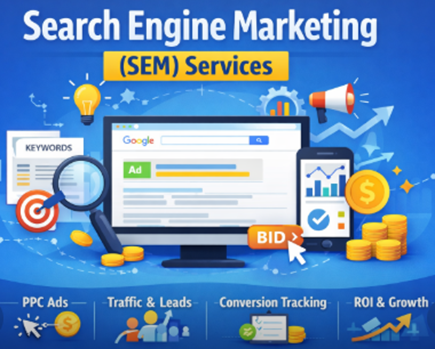
Search Engine Marketing (SEM) is paid advertising on search engines. It helps your business appear at the top of search results when people search for relevant keywords. It works on a pay-per-click model, where you only pay when someone clicks your ad.
SEM services help businesses show ads on search engines like Google. The ads appear when people search for something related to their product or service.
It means that instead of waiting months to rank on SEO, a business can appear right at the top instantly.
In short, they all connect. SEM is the bigger concept, and PPC is how you pay.
So SEM becomes the fastest way to get traffic and leads.
A good SEM service is not just running ads. It is a full system.
Here’s what it usually includes:
This is what separates average campaigns from profitable ones.
If you choose the wrong match type, your ads may show for the wrong searches. That leads to wasted clicks and poor results.
In platforms like Google Ads, match types control how closely a user’s search must match your keyword for your ad to show.
It decides when your ad appears and when it doesn’t.
Match Type | How It Works | Example Keyword | When Your Ad Shows |
Broad Match | Reaches a wide audience | digital marketing services | Related searches, even if wording is different |
Phrase Match | More control than broad | “digital marketing services” | Searches that include the phrase or close meaning |
Exact Match | Most control | [digital marketing services] | Searches with same meaning or intent |
This is the default setting.
Example:
Keyword → digital marketing services
Your ad may show for:
Good for reach, but can bring irrelevant traffic if not managed properly.
This gives you more control.
Example:
Keyword → “digital marketing services”
Your ad may show for:
Good balance between reach and relevance.
This is the most precise option.
Example:
Keyword → [digital marketing services]
Your ad may show for:
Best for high-intent keywords where you want tight control.
Negative keywords stop your ads from showing for certain searches.
Example:
If you sell premium services, you may add:
This prevents wasted clicks and reduces unnecessary spending.
There is no single best option. It depends on your goal.
Many successful campaigns follow this approach:
This keeps your campaign clean and efficient.
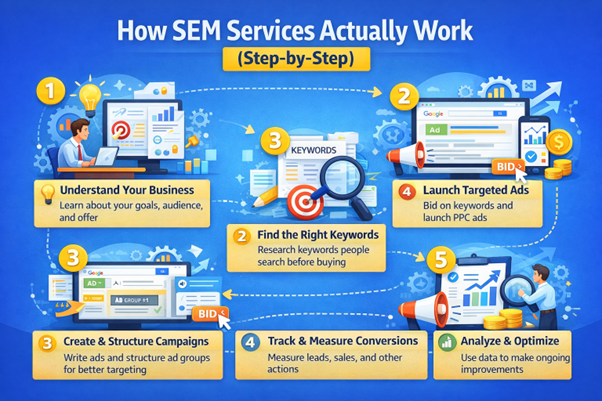
Let’s walk through how this works in real life.
Everything starts here. Before running any ads, the team needs to understand your business properly.
They look at:
They also study your competitors and your current website. This helps them avoid guesswork later. Because if the foundation is not clear, even the best ads won’t perform well.
Now comes keyword research. This is where strategy really begins.
The goal is to find:
But it is not just about volume. It is about intent. For example, someone searching “buy running shoes online” is much closer to purchasing than someone searching “best running shoes.”
So campaigns are built around high-intent keywords.
In platforms like Google Ads, campaigns are structured like this:
Here’s how it works:
Level | Purpose |
Campaign | Overall goal and budget |
Ad Group | Group of related keywords |
Ads | Actual messages users see |
Each ad group should focus on a small set of closely related keywords. This improves relevance.
Better structure leads to better performance and lower costs.
Now the ads are written. But good ads are not complicated.
They are:
At this stage, multiple ad variations are created. Then they are tested to see which one performs better.
Every time someone searches, an instant auction happens.
Here’s what decides which ads show:
This is where Quality Score plays a big role. It is based on:
A higher Quality Score can help you rank higher even with a lower bid.
So it is not just about spending more. It is about being more relevant.
Once someone clicks your ad, they land on your website.
This page must:
If the page is confusing or slow to load, users tend to leave quickly without taking any action, which ultimately leads to wasted ad spend.
High-quality landing pages, on the other hand, provide a clear user experience, load efficiently, and are directly aligned with the ad message. They help improve both conversion rates and Quality Score.
Tracking is what turns SEM from guessing into a real system.
Using tools like Google Analytics, you can track:
This data shows what is working and what is not.
Without tracking, you are just spending money without knowing the outcome.
This is where real growth happens.
Campaigns are reviewed regularly. Then changes are made based on data:
Over time, this improves performance steadily.
This is why SEM is not a one-time setup. It is an ongoing process that keeps getting better week after week.
Here’s the real reason businesses invest in SEM.
Your ads can go live today. No waiting.
You target users actively searching for your service.
You decide how much to spend daily or monthly.
Every click, lead, and sale is trackable.
If something works, you simply increase the budget.
Simple idea: spend more on what brings results.
This is where most guides stay vague. Let’s keep it clear and practical.
SEM costs have two parts:
Both matter. And both can vary.
Model | How It Works | Typical Range |
Monthly Retainer | Fixed fee every month for management | $500 – $5,000+ / month |
% of Ad Spend | Agency takes a % of your ad budget | 10% – 20% of ad spend |
Fixed Packages | Pre-set plans with defined services | $300 – $2,000+ / month |
Smaller businesses usually start lower. Larger or complex accounts pay more.
This is separate from agency fees. You also pay platforms like Google Ads for clicks.
This is called Cost Per Click (CPC).
Here are typical ranges by industry:
Industry | Avg CPC Range |
E-commerce | $0.50 – $2 |
SaaS / B2B | $2 – $10 |
Legal | $10 – $50+ |
Finance / Insurance | $3 – $20+ |
Local services | $1 – $5 |
Some keywords in legal or insurance can even go above $50 per click.
Several factors influence how much you end up spending.
Let’s keep expectations realistic.
Results get better over time because data improves decisions.
Many businesses waste money because of simple mistakes.
Small mistakes can lead to big losses over time.
Both SEM and SEO help you get traffic from search engines. But they work in very different ways.
SEM | SEO | Best used when… |
Paid traffic | Organic traffic | You need traffic quickly |
Fast results | Takes time | You can wait for long-term growth |
Easy to scale with budget | Builds over time | You want sustainable traffic |
Full control over targeting | Limited control | You want precise audience targeting |
Neither is better on its own. They just serve different purposes.
The best approach is to use both together. This is often called a Total Search strategy.
Here’s why it works well:
For example:
This way, your paid and organic efforts support each other.
This is one of the most important parts of SEM. Yet many people skip it. If you understand this well, you can lower your costs and improve results at the same time.
In platforms like Google Ads, Quality Score is a rating given to your ads. It usually ranges from 1 to 10. It tells you how relevant and useful your ad is to users.
Quality score measures how good your ad experience is.
Now comes the part that decides where your ad shows. Ad Rank determines your position on the search results page.
Even more importantly, it decides if your ad shows at all.
Let’s compare two advertisers:
Advertiser | Bid | Quality Score | Result |
A | High | Low | Lower position |
B | Medium | High | Higher position |
Even with a lower bid, Advertiser B can rank higher because their ad is better.
You don’t always pay what you bid. A higher Quality Score can:
So instead of just spending more, you focus on improving quality.
You don’t need complex tricks. Just get the basics right.
Things are changing fast. But if you understand the key shifts, it actually becomes easier to stay ahead.
Platforms like Google Ads are using AI more than ever.
One big example is Performance Max campaigns.
So instead of managing every detail, your role shifts.
You guide the strategy. The platform handles execution.
Manual bidding is slowly fading.
Now, Smart Bidding uses machine learning to:
Privacy changes are reshaping SEM.
Third-party cookies are being phased out. So tracking users across the web is becoming harder.
Because of this, businesses now rely more on first-party data.
This includes:
When you feed this data into campaigns, targeting becomes much stronger.
Simply put, your own data is now your biggest advantage.
Search Generative Experience (SGE) is starting to change how search results look.
Instead of just links, users now see:
So where do ads fit in?
Ads still appear, but the layout is evolving. Visibility depends more on relevance and intent.
This means your ads need to be sharper and more useful than ever.
Earlier, you had to define everything manually.
Now, platforms use:
This helps ads reach the right people automatically.
However, this does not mean you lose control completely.
It just means you focus more on inputs, like audience data and creative quality.
People are not typing like before.
They are asking full questions, like:
This changes keyword strategy.
You now need:
The closer you sound to real conversation, the better your ads perform.
All these changes lead to one simple shift.
Old SEM approach vs new:
Earlier | Now |
Manual control | AI-assisted decisions |
Keyword focus only | Audience + intent focus |
Third-party tracking | First-party data |
Static campaigns | Continuous learning |
So what should you do?
Let’s be honest here.
Many businesses start DIY and then switch later.
Use this simple checklist:
If something feels unclear, ask questions before committing.
Yes. But only if done right.
SEM services can grow your business faster than most channels. They give you control, speed, and measurable results.
However, success depends on strategy, not just spending money.
SEO split testing is a method to test SEO changes across groups of pages. It measures the real impact using data.
SEO testing focuses on pages, while A/B testing focuses on users. Search engines require a different testing approach.
Most tests should run for several weeks. The exact duration depends on traffic and page volume.
A control group is a set of pages that remain unchanged, which helps you compare results accurately.
Small websites can test, but results may not be reliable. Larger datasets produce better insights.
Start using our A/B test platform now and unlock the hidden potential of your website traffic. Your success begins with giving users the personalized experiences they want.
Start Your Free Trial

Empowering businesses to optimize their conversion funnels with AI-driven insights and automation. Turn traffic into sales with our advanced attribution platform.
Trusted by Customers


©CausalFunnel Inc. All rights reserved.