



Free Funnel Audit
Convert more customers today!
SEO
10 mins read

SEO
10 mins read
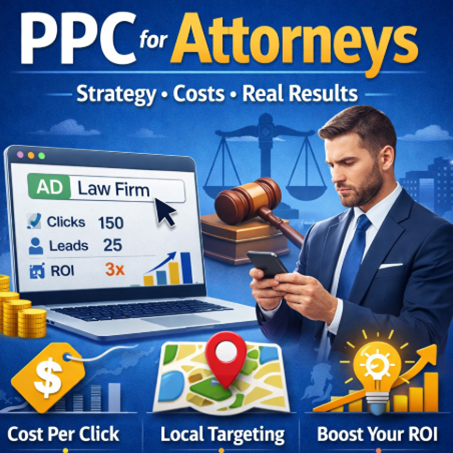
A majority of people wanting legal help look for lawyers on their mobiles. Others open up their laptops for searching. The point we are trying to make is that people find attorneys online.
If your practice doesn’t have a digital space, you lose a massive chunk of your clientele. It’s exactly here that PPC for attorneys helps you. When prospects see your ads on searching for legal help, the chances of them contacting you increases.
This blog will give you everything you must know about growing your business with PPC marketing.
PPC means you pay when someone clicks your ad. You choose keywords that people search for. SEO, on the other hand, helps you rank naturally over time.
PPC gives instant visibility. People see your firm at the top of search results. Law firms need PPC today because competition is high. Many legal searches are local. For example, someone searching “divorce lawyer near me” will see your ad first.
PPC campaigns start with choosing the right keywords. Keywords are the words your perspectives use when needing legal assistance. For example, they might input something like ‘car accident lawyer.’ Someone wanting help nearby may input ‘family attorney near me.’
If you know about these search phrases, you incorporate them into your ads. Then, upon a similar search by a prospect, your ad appears to them.
Once you select keywords, you place bids for them. You may think you’ll win if you pay the most amount. That’s not the case. Ad Rank is a criteria used by Google for this purpose. It is what tells it to showcase certain ads and their order.
Ad Rank is calculated as:
Ad Rank = Bid × Quality Score × Expected Impact of Ad Extensions
This system ensures that relevant, well-crafted ads show higher, even if another advertiser bids more.
Law firms can use several ad types in 2026. Each has a purpose and audience.
A typical search results page (SERP) for a high-intent legal keyword can have multiple elements:
Here’s a simplified view of a SERP layout for “personal injury lawyer NYC”:
[LSA] John Doe – Google Screened ⭐⭐⭐⭐⭐ – Call Today
[LSA] Smith & Co – Google Screened ⭐⭐⭐⭐ – Free Consultation
[Search Ad] Experienced Personal Injury Lawyer – Free Case Review
[Search Ad] Car Accident Lawyer NYC – Call Now
[Local Pack]
[Organic Result 1] NYC Personal Injury Lawyers – SmithLaw.com
[Organic Result 2] Car Accident Attorneys – Free Consultation
[Performance Max / Display] Video or Banner Ads across YouTube/Display Network
Performance Max (PMax) is a Google Ads campaign type that runs across all Google networks. This includes Search, Display, YouTube, Gmail, Discover, and Maps. Unlike traditional search campaigns, you do not bid on individual keywords. Instead, Google uses machine learning to optimize ad delivery to users most likely to convert.
Feature | Search Campaigns | Performance Max |
Targeting | Keywords only | Multiple networks, automated targeting |
Bidding | Manual or automated CPC | Automated, AI-driven based on goals |
Placements | Search results only | Search, Display, YouTube, Gmail, Discover, Maps |
Optimization | Requires manual adjustment | Uses Google’s AI to find best leads |
For law firms, PMax works best when you want to maximize reach and conversions across multiple channels. It can complement search campaigns, but it is not a replacement for high-intent keyword campaigns like “personal injury lawyer near me.”
PMax lets you provide audience signals to guide Google’s AI. This includes:
These signals help AI focus on high-value prospects without restricting reach. You can combine PMax with conversion tracking for calls, forms, and chats.
PMax campaigns are ideal for law firms that want automation, broad reach, and multi-channel lead generation. They work well for personal injury, family law, criminal defense, and immigration firms.
PPC gives instant visibility. Ads can appear on Google within hours. This is useful for urgent legal needs.
PPC allows precise targeting. Ads can focus on specific cities, zip codes, or neighborhoods. This saves money and reaches local clients.
Optimized campaigns give high ROI. For instance, a personal injury attorney might spend $3,000 per month. With good targeting, they could get 15–20 leads, each worth thousands.
Example: A divorce attorney used PPC for keywords like “child custody attorney.” In one month, they got 25 leads. The conversion rate was 20%. This shows PPC brings real clients.
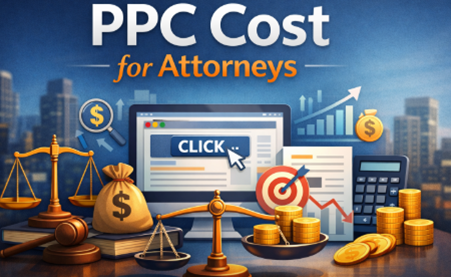
PPC costs for attorneys have risen in 2026. Legal keywords are more competitive than ever. High-demand areas like personal injury can cost $100–$300+ per click. Family law keywords are cheaper, around $25–$75 per click. Criminal defense costs fall in the $30–$80 range. Highly specialized areas like mesothelioma or mass torts can exceed $300 per click. Immigration lawyers may see clicks between $20–$60.
Costs are influenced by several factors:
Google uses a Quality Score from 1–10 to measure ad relevance. Higher scores reduce costs significantly.
This means well-written ads, targeted keywords, and good landing pages can halve your PPC spend.
Many law firms hire agencies to manage PPC. Agencies charge in different ways:
Fee Type | Typical Range | Notes |
Flat Fee | $1,000–$5,000/month | Good for predictable budgets and small campaigns. |
% of Spend | 10–20% of ad budget | Works well for larger budgets; ensures agency incentives align with spend. |
Performance-Based | $50–$200 per qualified lead | Risk-sharing model; pay more only for actual leads generated. |
Choosing the right fee model depends on budget size, campaign complexity, and comfort level with performance risk.
Some cities require higher spending to be competitive. For example:
City Tier | Practice Area | Minimum Monthly Budget |
Top Cities (NYC, LA, Chicago) | Personal Injury | $10,000+ |
Top Cities | Family Law | $5,000+ |
Mid-Sized Cities | Personal Injury | $3,000–$5,000 |
Mid-Sized Cities | Family Law | $2,000–$4,000 |
Smaller Cities | Any Practice | $1,000–$2,500 |
Budgets below these minimums may not deliver enough visibility to generate leads consistently.
It’s important to measure cost per lead (CPL), not just cost per click. Here are typical ranges in 2026:
Practice Area | Average Cost Per Lead | Notes |
Personal Injury | $200–$500 | High-value cases; ROI can justify higher spend. |
Family Law | $75–$200 | Moderate CPL with careful targeting. |
Criminal Defense | $100–$250 | Urgent cases drive higher conversion. |
Mass Torts / Mesothelioma | $1,000+ | Extremely competitive; leads are high-value. |
Immigration | $50–$150 | Often lower spend, moderate volume. |
Tracking CPL helps firms understand how much they truly pay for new clients, rather than just clicks.
Google assigns a Quality Score (QS) from 1–10 to each ad. This score measures relevance between keywords, ad copy, and landing page experience. A higher QS reduces cost per click significantly.
Here’s a concrete example:
Quality Score | Example CPC (Personal Injury Keyword) |
4 | $100 |
8 | $50 |
A jump from a QS of 4 to 8 cuts CPC in half. The same click that costs $100 with a low-quality ad now costs only $50.
How to improve Quality Score:
Investing in QS optimization directly reduces your ad spend while improving lead quality. Search engine optimization is one of the few ways to systematically improve your QS over time. Well-optimized content, relevant keywords, and user-friendly site structure all contribute to higher Quality Scores.
Running a successful PPC campaign for a law firm requires careful planning. Every detail, from keywords to landing pages, affects results. This section breaks down a step-by-step strategy that any attorney can follow in 2026.
Start by identifying the words your potential clients actually use. Include location-specific terms. For example:
Use a mix of tools for research:
Imagine a personal injury firm in NYC. Using SEMRush, you find competitors bid on:
You can prioritize high-intent keywords and note less competitive ones for smaller budgets.
How your keywords match searches affects reach and relevance.
Match Type | How It Works | Use Case |
Exact Match | Ads show only for exact keyword | High-intent, low-volume searches, e.g., “Houston DUI lawyer” |
Phrase Match | Ads show for searches containing the keyword phrase | Moderate reach, e.g., “DUI lawyer in Houston” |
Broad Match | Ads show for related terms | Max reach, but may include irrelevant clicks; monitor carefully |
A combination works best. Use exact for core high-intent terms and broad or phrase for testing or remarketing.
Quality Score (QS) measures the relevance of your ads. Google uses it to lower CPC and improve ad position. QS has three main components:
Example: A QS of 8 can cut CPC in half compared to a QS of 4 for the same keyword. This can save thousands each month for a competitive law firm.
Impression Share (IS) shows the percentage of times your ad appears compared to total opportunities.
Tracking IS helps attorneys balance visibility and budget efficiency.
Your ad text must match search intent and stand out from competitors. Include:
Personal Injury:
Family Law:
Criminal Defense:
Tailor tone by practice area. Personal injury can emphasize financial recovery, family law can emphasize trust and support, and criminal defense can emphasize urgency and protection.
Ads must direct users to a specific landing page, not the homepage.
Practice Area | Average Conversion Rate | Excellent Rate |
Personal Injury | 2–5% | 8–12% |
Family Law | 2–4% | 7–10% |
Criminal Defense | 3–6% | 9–12% |
High-converting landing pages often include trust signals, strong CTAs, and minimal distractions.
Show ads when potential clients are most likely to search.
Geo-target by city or neighborhood to focus spend locally. Avoid showing ads outside your service area to reduce wasted clicks.
Prevent wasted spend by adding irrelevant search terms. Here’s a list specifically for legal campaigns:
Updating negative keywords regularly ensures the budget goes only toward high-intent searches.
Google Ads AI can automate bids and placements in 2026. Use strategies like:
Always review AI suggestions manually. Legal campaigns require accuracy and compliance, so human oversight is critical.
A strong PPC strategy for law firms combines:
Tracking performance is the most important step in a law firm PPC campaign. You cannot improve what you do not measure. Good tracking shows which ads bring clients and which waste money.
Here are the most important PPC metrics for lawyers, along with benchmarks:
Metric | What It Shows | Legal Benchmark | Notes |
Click-Through Rate (CTR) | How many people click your ad | 3–6% average | High CTR means your ad is relevant and compelling. |
Conversion Rate | How many clicks become leads | 2–5% average; 5–10% if optimized | Depends on landing page, ad relevance, and practice area. |
Cost per Lead (CPL) | How much you pay for a new lead | Personal Injury: $200–$500 Family Law: $75–$200 Criminal Defense: $100–$250 Immigration: $50–$150 | Helps measure ROI and budget efficiency. |
ROI | Compare revenue to ad spend | Varies by case value | Track actual revenue from each lead to evaluate profitability. |
Impression Share (IS) | % of total available impressions your ads capture | Target 60–80% on core keywords | Low IS may mean raising bids or improving QS; very high IS may indicate overbidding. |
Conversion tracking is essential to know which clicks become actual clients. For law firms, there are three main conversion types:
Setting up these conversions allows Google Ads to optimize campaigns automatically. Target CPA and Max Conversions strategies rely on accurate tracking data.
Phone calls are often the most valuable leads for attorneys. Without proper call tracking, you cannot measure ROI accurately.
Call tracking is especially critical for personal injury, criminal defense, and DUI campaigns, where leads often call first.
Impression Share (IS) shows how often your ads appear out of total available opportunities.
Tracking IS alongside CTR, conversion rate, and CPL gives a complete picture of campaign health.
Avoid these mistakes:
Mistakes can waste thousands of dollars. Regular monitoring prevents this.
DIY Campaigns:
Pros: Full control, saves money.
Cons: Time-consuming, learning curve is steep.
Hiring a PPC Agency:
Pros: Expert results, saves time.
Cons: Costly, requires trust.
Hire an agency if budgets are high or results are crucial. Pick agencies with experience in attorney PPC. Ask for case studies.
Hiring a PPC agency can help law firms get better results. Agencies usually charge in three main ways:
Choosing the right pricing model depends on your budget, goals, and comfort level with risk. Many firms combine flat fee + performance bonus to balance predictability and results.
PPC for attorneys is essential in 2026. It gives instant visibility and local targeting. Optimized campaigns deliver measurable ROI.
Start small, track your results, and improve campaigns regularly. Use AI tools, LSAs, and well-written ads to boost performance. Every law firm can benefit from PPC.
Start building a successful law firm PPC campaign today. Attract more clients and grow your practice.
Focus on high-intent keywords that show client interest, like “car accident lawyer near me.” Include your city or neighborhood in keywords. Make sure your ads and landing pages are highly relevant. Track results and adjust regularly. Combining Search Ads, LSAs, and remarketing often works best.
Costs vary depending on practice area, location, and competition. Small law firms may spend $1,000–$3,000 per month. Medium firms often budget $3,000–$10,000. Large firms with multiple practice areas can exceed $10,000 per month. Keep in mind that competitive areas like personal injury in NYC require higher bids.
Yes, it can work even on smaller budgets. LSAs and local search campaigns are especially effective. They focus on clients near your office. Small firms should target a few high-intent keywords rather than broad campaigns. Optimized ads and landing pages maximize each click’s value.
LSAs are ideal for small firms on limited budgets. You only pay for leads, so the investment is predictable. They provide top-of-page visibility above paid search and organic results. Small firms can compete with larger competitors in their local area. Positive reviews improve LSA ranking and lead volume.
Quality Score (QS) is a rating from 1–10 that measures your ad relevance. It considers expected click-through rate, ad relevance, and landing page experience. Higher QS lowers cost per click and improves ad position. Improving QS involves writing clear ads, using relevant keywords, and matching landing pages. A strong QS saves money and increases leads.
CPL varies by practice area. Personal injury: $200–$500 per lead. Family law: $75–$200. Criminal defense: $100–$250. Immigration: $50–$150. Track CPL alongside conversion rates to calculate true ROI. High-value cases may justify higher CPL.
Use call tracking software like CallRail or WhatConverts. Assign unique numbers for each campaign or ad group. Track call duration, source, and outcomes. Connect call data to Google Ads for accurate conversion tracking. This shows which keywords and ads generate real clients.
Start using our A/B test platform now and unlock the hidden potential of your website traffic. Your success begins with giving users the personalized experiences they want.
Start Your Free Trial

Empowering businesses to optimize their conversion funnels with AI-driven insights and automation. Turn traffic into sales with our advanced attribution platform.
Trusted by Customers


©CausalFunnel Inc. All rights reserved.