



Free Funnel Audit
Convert more customers today!
SEO
10 mins read

SEO
10 mins read
You are here because you want one answer.
“Which one is better for my business?” FB Ads or Google Ads.
In 2026, this question matters more than ever.
Ad costs are higher.
Privacy rules are stricter.
Attention is harder to earn.
Users trust ads less.
Algorithms control delivery more than humans.
So choosing the wrong platform is expensive. But here is the truth most blogs won’t tell you:
There is no universal “better” platform.
There is only:
This guide will help you decide clearly.
Let’s define both clearly.
FB Ads are ads that run on Meta’s platforms:
All are owned by Meta.This is a discovery-based advertising model. People are not searching for your product.
They are scrolling.
They are watching videos.
They are reading posts.
They are chatting.
They are relaxing.
Your ad interrupts their attention. This is why FB Ads are called demand creation ads.
You create interest first. Then you build desire. Then you drive action.
Key traits of FB Ads:
People don’t come to buy. You show them something they didn’t know they wanted.
Google Ads run across Google’s ecosystem:
All powered by Google. This is an intent-based advertising model. People are already searching. They type:
They already want a solution. You are not creating demand. You are capturing demand. This is why Google Ads is called demand capture advertising.
Key traits of Google Ads:
People come with a problem. You offer the answer.
Or simpler:
Google catches demand. FB creates demand.
Factor | FB Ads (Meta) | Google Ads |
User intent | Passive | Active |
Buying stage | Awareness → Consideration | Consideration → Purchase |
Targeting | Interests, behavior, lookalikes | Keywords, search queries |
Ad formats | Visual/social | Search, video, shopping |
Funnel role | Demand creation | Demand capture |
Conversion speed | Slower | Faster |
Funnel depth | Full funnel | Bottom + mid funnel |
Scalability | Audience size based | Search volume based |
Learning curve | Creative optimization | Keyword optimization |
By breaking down user intent, buying stage, targeting method, funnel role, and scalability side-by-side, the table makes it clear when each platform is most effective and what strategic role it should play.
This table alone explains 80% of the decision.
FB Ads let you target people based on who they are. Not what they search.
You can target by:
This is identity-based targeting. You target people. Not problems.
Google Ads targets intent, not identity.
You can target by:
This is problem-based targeting. You target needs. Not people.
These are social-native formats. They feel like content. Not ads.
These are intent-native formats. They match user actions. Not attention.
This section will answer two most important questions:
“What will this actually cost me?”
and
“Which one makes me more money?”
FB Ads run on a CPM model.
That means:
You pay for impressions.
Not clicks.
Not leads.
Not sales.
Your cost depends on attention.
What drives performance:
Real 2026 averages:
So yes.
FB Ads are cheaper per click.
But cheaper clicks don’t mean better buyers.
Common problems:
This is creative-driven performance.
If your creatives is bad, performance dies. If your creatives is strong, costs drop fast.
Google Ads run on a CPC model.
That means: You pay per click.
Not views. Not impressions. Not attention.
You pay for intent.
What drives performance:
Real 2026 averages:
Google Ads are more expensive per click. But those clicks come from people who are already searching to buy.
Common problems:
This is keyword-driven performance. If intent is high, ROI is high. If intent is weak, money burns fast.
Metric | FB Ads (Meta) | Google Ads |
Avg CTR | ~1.4% | 3–6% (search intent) |
Lead CTR | ~2.59% | Higher on high-intent keywords |
Avg CPC | $1.92 | $5.26 |
Cost model | CPM | CPC |
Buyer intent | Low–medium | High |
Conversion speed | Slower | Faster |
Funnel role | Demand creation | Demand capture |
Industry | FB Ads CPC | Google Ads CPC | Better for ROI |
E-commerce | ~$1.02 | ~$1.91 | Both |
SaaS | ~$1.88 | ~$3.80 | |
Legal | ~$2.45 | ~$8.67 | |
Real estate | ~$1.95 | ~$2.37 | |
Finance | ~$2.60 | ~$4.62 |
FB is cheaper. Google converts better.
Here’s the truth:
Think of it like this:
Google = revenue engine FB = growth engine
A $5 click is not expensive if it leads to a buyer.
A $1 click is not cheap if it leads to curiosity.
This is the mistake people make:
They chase cheap clicks instead of valuable clicks. High CPC on Google is smart when:
That’s why Google wins for:
FB wins when:
High-intent truth:
Google Ads convert fast. FB Ads convert slowly.
Why?
Because of the searcher or user’s mindset
Google user:
“I need a solution.”
FB user:
“I’m scrolling for entertainment.”
Google Ads = buying mindset
FB Ads = discovery mindset
So the funnel velocity looks like this:
FB Ads dominate:
They shape perception.They build familiarity and memory.
Google Ads dominate:
They monetize intent, urgency, and need.
Best: Both
FB for discovery. Google for conversions.
Best: Google Ads first
Then FB Ads for scaling.
Best: Google Ads
Local intent wins.
Best: Google Ads + LinkedIn
FB only for retargeting.
Best: FB Ads
Audience building matters.
Best: Google Ads
High-intent leads convert better.
Best: Both
FB for trust.
Google for closing.
Best: FB Ads first
Market education matters.
Best: Full-funnel mix
Brand + capture + scale
Winner: FB Ads
Winner: Google Ads
Winner: Google Ads
Winner: FB Ads
Winner: FB Ads
Winner: FB Ads
Winner: Both
Winner: Both
2026 changed everything.
Both platforms use AI bidding. Humans control less. Algorithms control more.
Tracking is limited. Signals are weaker. Data is fragmented.
Third-party data is dying. First-party data is king.
Email lists matter. CRM data matters. Owned audiences matter.
Smart bidding dominates. Manual control is shrinking.
Performance depends on data quality.
Advertisers optimize inputs. Algorithms decide outputs.
Here is the honest answer:
FB Ads are better for demand creation.
Google Ads are better for demand capture.
Together?
They outperform individually. Always.
Simple flow:
FB Ads → Awareness + warming
Google Ads → Conversion + capture
Retargeting → Trust + frequency
Data sharing → Smarter algorithms
This creates a loop. Not a funnel.
Early stage:
Growth stage:
Scaling stage:
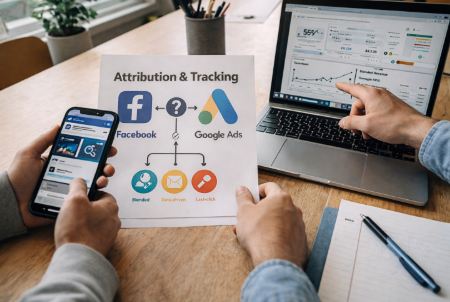
A common problem many businesses face is this. Both platforms take credit, claim conversions, and look profitable. But the numbers don’t match your bank account.
This is called attribution conflict. And it gets worse when you run FB Ads and Google Ads together.
Let’s say a customer journey looks like this:
Now:
One sale.
Two platforms claiming it. This is double attribution. Not double revenue.
What it does:
Gives 100% credit to the final click.
Problem:
Ignores discovery.
Ignores awareness.
Ignores nurturing.
Favors Google Ads.
What it does:
Uses AI to distribute credit across touchpoints.
Problem:
Still platform-biased.
Still platform-controlled.
Still partial visibility.
Better. But not perfect.
What it does:
Looks at the full journey across platforms.
Why it matters:
Shows real contribution.
Shows influence, not just clicks.
Shows true growth drivers.
This is the only model that works at scale.
Here’s what happens without blended tracking:
This kills growth quietly.
These tools show blended data, not platform bias:
Here’s a clean setup that works:
This shows:
Use this simple checklist:
Let’s make this practical. Read the one that sounds like you and follow the answer.
“I’m a local dentist with a $1,500/month budget.”
Use: Google Ads
Why:
People already search for:
They have intent. They need a service. They want fast solutions. Google captures that demand.
“I sell a $197 online course to women aged 25–40.”
Use: FB Ads
Why:
This is discovery-based buying. People don’t search for your course. They buy after seeing content.
You need:
FB Ads fit this model.
“I run a B2B SaaS with a 30-day free trial.”
Use: Google Ads first, then FB Ads
Why:
People search for software. They compare tools. They want solutions.
Google = lead engine
FB = retargeting + nurturing
“I own a Shopify store selling skincare products.”
Use: Both
Why:
FB Ads create desire. Google Ads capture buyers.
FB = discovery
Google = purchase
This combo scales best.
“I’m a real estate agent in a small city.”
Use: Google Ads
Why:
People search:
High intent. Local intent. Urgent intent
“I sell high-ticket coaching ($3,000+ programs).”
Use: Both
Why:
FB Ads build trust and authority. Google Ads capture serious buyers.
High-ticket needs:
One platform is not enough.
“I’m launching a new product no one knows about.”
Use: FB Ads
Why:
There is no search demand yet.No keywords and no awareness. You must create the market first.
“I run a lead gen business for home services.”
Use: Google Ads
Why:
Search intent is strong:
People search when they need help.
“I’m a startup with no brand and no demand.”
Use: FB Ads first
Why:
You need:
Search ads won’t work without demand.
“I’m scaling a business that already has sales.”
Use: Both
Why:
FB Ads grow the audience. Google Ads grows revenue.
Growth needs both engines.
Your Situation | Best Platform | Reason |
Local services | Google Ads | High intent |
Digital courses | FB Ads | Discovery buying |
SaaS | Google → FB | Intent + nurture |
E-commerce | Both | Scale model |
New product | FB Ads | Market creation |
Lead gen | Google Ads | Problem search |
High-ticket | Both | Trust + intent |
Startup | FB Ads | Awareness first |
Scaling brand | Both | Growth system |
FB Ads vs Google Ads isn’t about which platform is better. It’s about:
In 2026, winning businesses don’t choose one. They build systems.
They use FB Ads to create demand and Google Ads to capture demand. They use data to connect both.
That is the real growth model.
Not FB vs Google. But FB + Google.
Website traffic refers to the number of people who visit your site. It shows how often your website gets visitors. High traffic usually means more leads and sales opportunities.
You enter a domain or URL into the tool. Then it shows estimated monthly visitors and trends. It breaks down traffic into organic and paid sources.
Organic traffic comes from search results you did not pay for. Paid traffic comes from ads you run. Organic traffic grows with better SEO; paid traffic grows with ads.
The estimates use AI algorithms and keyword data. They combine keyword rankings and click‑through rates. No tool can be as exact as your internal analytics, but estimates are reliable.
Start using our A/B test platform now and unlock the hidden potential of your website traffic. Your success begins with giving users the personalized experiences they want.
Start Your Free Trial

Empowering businesses to optimize their conversion funnels with AI-driven insights and automation. Turn traffic into sales with our advanced attribution platform.
Trusted by Customers


©CausalFunnel Inc. All rights reserved.