



Free Funnel Audit
Convert more customers today!

SEO
10 mins read

SEO
10 mins read
Often people do everything in their power but still their website doesn’t perform as it should. So, what could be the reason behind it? Maybe it isn’t SEO optimized. But what exactly is an SEO-friendly website?
An SEO-friendly website is those that rank on Google when it loads fast, answers real questions clearly, and earns trust over time. That is the short, honest answer.
If you have a website and are serious about building it in a way that actually shows up on Google, not just looks good on a laptop screen, this guide walks you through the full decision process.
We have been part of projects where a site looked stunning but never cracked page five on Google. It was never about luck. It was structure, clarity, and patience.
This guide explains how to build such a website using clear, practical steps. Let’s learn more about it in the coming sections.
So, what exactly is an SEO-friendly website? These are websites that are built in a way that makes it easy for the search engines to find and understand a website’s pages. It also makes sure that visitors can use the site without frustration or confusion.
The website’s pages are scanned using search engine’s automated bots called crawlers. These crawlers read content, follow links, and measure performance signals.
Some of the main characteristics of an SEO-friendly website are:
When these elements work together, rankings become easier to earn and maintain.

In 2026, SEO is not just about adding keywords or focusing on quick fixes alone. Rather, it’s a mix of content quality, technical health, and user experience signals.
An SEO friendly website is built for people first and search engines second. Google simply follows users. If people stay, scroll, and engage, your website’s rankings will gradually increase.
Imagine you run a local physiotherapy clinic in Vancouver. Someone searched on Google “Best physiotherapist for knee pain in Vancouver.”
The moment the page loads, the page opens in under two seconds on mobile. At the top, the headline clearly says, “Physiotherapy for Knee Pain in Vancouver.”
The visitor instantly knows they are in the right place. This clarity is a ranking signal now, not a bonus. The page uses:
Google rewards websites that are helpful, fast, and easy to navigate. This applies to blogs, business websites, and online stores alike.
Beginners often think SEO is a one-time task, but it is ongoing work. Search behavior changes, competitors improve, and Google updates its systems. An SEO-friendly website adapts to these changes over time.
A strong site does three things well. It explains what it offers, removes friction, and builds trust without shouting.
An SEO-friendly website is not just about rankings. It is about building an online space that works well for your business. When done right, SEO quietly supports visibility, trust, and growth, without draining your budget month after month.
Having an SEO friendly website means you’re building a foundation for your business. You need to build it strong first and work on it later as it reaches more people.
An SEO-friendly website supports both visibility and user satisfaction, and that combination is what makes it powerful.
An SEO-friendly website brings traffic, but growth happens only when you understand what visitors actually do after they arrive. This is where behaviour-focused tools from CausalFunnel help bridge the gap between traffic and outcomes by showing how visitors move through your site in real time.
Google ranks websites it understands and trusts. An SEO-friendly website uses a clean structure, clear headings, and logical internal links, which makes it easier for search engines to crawl and interpret your pages.
SEO and user experience now go hand in hand.
If people land on your site and feel confused, overwhelmed, or impatient, they leave. Google notices this behaviour and adjusts rankings accordingly.
An SEO-friendly website is easy to read, easy to navigate, and easy to use on mobile. If your website’s content is all over the place, you lose potential customers.
Organic traffic is powerful because it comes from intent. These visitors are already looking for what you offer. They are not being interrupted by an ad. They are asking Google for help.
An SEO-friendly website aligns content with those real questions. The idea here is to offer a solution to people looking for it on the internet.
Paid ads stop the moment you stop paying. SEO continues working long after the page is published.
An SEO-friendly website allows businesses to balance their marketing spend instead of relying entirely on ads for visibility.
SEO compounds. A well-optimized page can bring traffic and leads for years with only small updates. Few marketing channels offer that kind of return.
While SEO takes time upfront, the cost per lead often drops significantly over time.
Websites that ignore SEO often struggle with traffic stability and rising costs. An optimized foundation makes future growth easier and more predictable.
Whether you’re a beginner or have been in a business for a long time, if your website doesn’t perform well, your business won’t flourish especially if you’re targeting online leads.
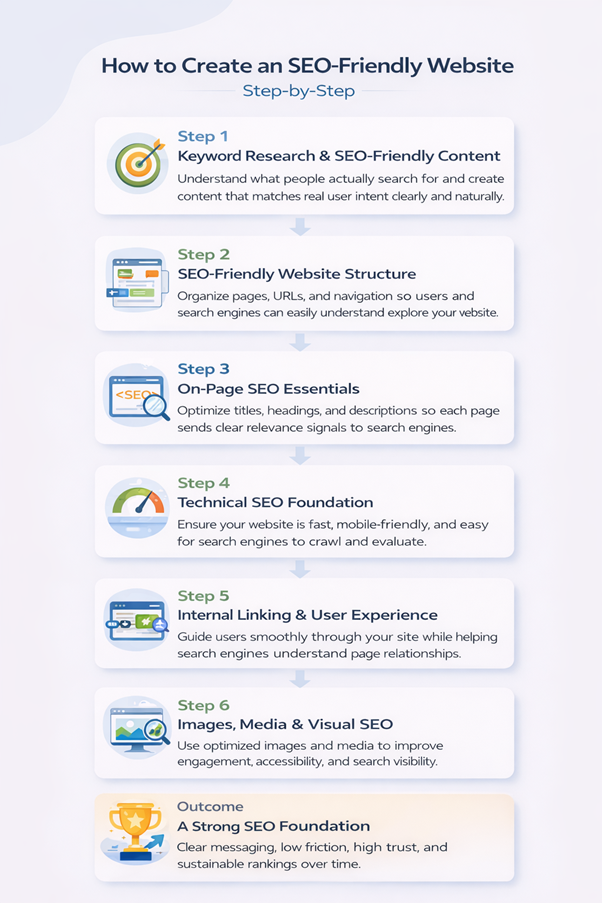
This section breaks SEO into clear, manageable steps. It explains how to do SEO for websites step-by-step without advanced technical skills. Each step covers content, structure, technical health, and user experience.
Following these steps consistently builds a strong SEO foundation over time.
Keyword research helps you understand what people search for online. It ensures your content matches real user intent, not assumptions. Good content answers questions clearly and avoids unnecessary complexity.
Choosing keywords starts with understanding search intent. Some users want information, while others want solutions or services.
When selecting keywords:
This approach keeps content focused and easier to rank.
Keywords should support readability, not harm it. Forced placement often reduces trust and clarity.
Use keywords naturally in:
Always prioritize clarity over repetition or keyword density.
Website structure helps search engines understand page relationships. It also helps users find information quickly without confusion. A clear structure supports both crawling and navigation.
URLs should be short, readable, and meaningful. They help users and search engines understand page topics quickly.
Example:
Clean URLs improve trust and click-through rates.
Logical architecture organizes content in a clear hierarchy. Best practices include:
This structure improves crawlability and user flow.
On-page SEO ensures each page sends clear signals to search engines. It focuses on optimizing visible elements users interact with directly. Strong on-page SEO improves rankings and click-through rates.
Title tags explain page topics to search engines and users. They should match search intent and remain within length limits.
Best practices include:
Meta descriptions do not affect rankings directly, but improve clicks.
Header tags structure content for readers and crawlers.
Key rules include:
Good structure improves readability and scanning behavior.
Technical SEO ensures search engines can access and evaluate your site properly. It focuses on performance, mobile usability, and clean code practices. Even great content struggles without strong technical foundations.
Page speed affects rankings and user satisfaction directly. Slow websites increase bounce rates and reduce engagement.
High-impact fixes include:
Small improvements often create noticeable speed gains.
Google uses mobile-first indexing for rankings. This means mobile experience matters more than desktop design.
Important considerations include:
Mobile usability supports rankings and conversions.
Clean code improves crawling efficiency and performance. To make it work effectively:
Internal links guide users and search engines through your website. They distribute authority and clarify content relationships. User experience signals increasingly influence SEO outcomes.
Effective internal linking supports navigation and relevance. Internal links help users explore and help Google understand your structure.
Follow these practices:
This helps crawlers discover and prioritize pages.
User experience reflects how visitors interact with your website. Google observes engagement patterns to assess content quality.
Important signals include:
Clear calls to action guide users without pressure or confusion.
Images and media improve engagement and content clarity. They also create additional SEO opportunities through image search.
Best practices include:
Visual elements support understanding and retention when used wisely.
SEO does not end after publishing content. Performance must be monitored and adjusted continuously.
Key actions include:
Consistent updates signal freshness and relevance to search engines.
 Most websites do not fail at SEO because of bad ideas. They fail because of small, avoidable mistakes that slowly block growth. These issues often go unnoticed until traffic stalls or drops.
The good news is that fixing them usually brings quick improvements.
This happens when a page repeats the same keyword again and again, hoping Google will notice. Instead, it pushes readers away.
A page about laptop repair with the keyword “best laptop repair service Toronto” repeated in every paragraph feels forced and awkward.
Visitors skim, feel annoyed, and leave. Google reads this behaviour as dissatisfaction and lowers rankings.
Speed is no longer optional. If a page takes too long to load, users bounce before reading anything.
If a restaurant’s menu page takes five seconds to appear, most visitors leave and choose another restaurant. Google sees low engagement and reduces visibility.
Most searches now happen on phones. If your site works only on desktop, it is already behind. Mobile-first design is no longer a trend. It is the default. The best fix is to create mobile friendly websites for your business so more people can reach your business.
Thin content exists only to fill space. It does not answer real questions or offer insight.
If a service page has 200 words that say the same thing in different ways but never explain pricing, process, or benefits, Google learns that the page is not helpful.
Pages shouldn’t be long, they should be useful.
Links help both users and search engines understand your site, but broken links do the opposite.
If a blog links to a service page that no longer exists, users hit a dead end, and Google sees poor site maintenance and weak structure.
Creating an SEO-friendly website is not just about getting rankings but about building something that is useful, and reliable, both for search engines and for real people who land on your pages with real problems to solve.
Many websites struggle not because SEO is too complex, but because the basics are ignored or rushed. Slow pages, confusing layouts, thin content, and poor mobile experiences quietly hold them back. Once those gaps are fixed, progress often feels less mysterious and more predictable.
An SEO-friendly website is easy to crawl, fast, mobile-friendly, and helpful. It balances technical setup with clear, useful content.
SEO usually shows results within three to six months. Timelines depend on competition, content quality, and consistency.
Yes, many improvements require no coding skills. Content optimization, structure, and tools handle most tasks.
Yes, design affects usability, speed, and engagement signals. Good design supports both rankings and conversions.
If you are a beginner, keep it basic:
These content marketing KPIs show real growth.
Start using our A/B test platform now and unlock the hidden potential of your website traffic. Your success begins with giving users the personalized experiences they want.
Start Your Free Trial

Empowering businesses to optimize their conversion funnels with AI-driven insights and automation. Turn traffic into sales with our advanced attribution platform.
Trusted by Customers


©CausalFunnel Inc. All rights reserved.