



Free Funnel Audit
Convert more customers today!
SEO
10 mins read

SEO
10 mins read
Today, the internet is truly global. People all over the world use search engines every day. But not everyone speaks English. In fact, English content makes up about 49.4% of all web content. Yet many people speak other languages online.
This means if your site is English-only, you miss people. This is where SEO website translation becomes powerful.
Translation without SEO can help people read your content. But it won’t help your website show up in search engines. Simple translation only changes the text. It doesn’t tell Google how your content should rank. SEO website translation does.
Basic translation just swaps words into another language. SEO website translation does this plus:
SEO website translation also improves rankings in global search engines.
Search demand in non-English languages is growing fast.
Language | Content Share on Web |
English | ~49% |
Spanish | ~6% |
German | ~5.9% |
Japanese | ~5.1% |
French | ~4.5% |
But only about 25.9% of all internet users speak English. That means the majority of people prefer content in other languages.
Global rankings are not just about ranking high in English searches. They include rankings in:
Global rankings mean visibility across languages and regions.
People search differently in different languages. A good SEO website translation answers those needs. It aligns content with what local users search for.
SEO website translation means transforming your website content into other languages in a way that helps it rank well in search engines globally. It goes beyond literal translation. It targets local search intent, user behavior, keywords, and technical SEO.
Concept | Meaning |
Content translation | Literal word-for-word change |
Localization | Cultural and contextual customization |
International SEO | Global search strategy |
SEO website translation | Translation + SEO optimization |
Many sites:
These mistakes cause low visibility and poor rankings.
Good SEO website translation captures featured snippet opportunities. It aligns translated pages with local search intent, often by understanding how people ask questions in their language.
Search engines must understand content to rank it. SEO website translation helps them do that across languages.
Google crawls translated pages separately. Each language variant has its own URL and can rank on its own. But Google also needs signals to know the language, region, and purpose of each page.
A French user could be in Canada or France. SEO website translation must consider both language and region.
A good SEO website translation strategy leverages both.
People search differently in English, Spanish, or Hindi. That’s why translating keywords isn’t enough.
Crawlability:
Translated pages increase the number of crawlable pages. Search engines can discover more topic variations.
Indexing:
More languages mean more indexed pages. That boosts visibility.
Ranking signals:
Language-specific keywords and local content boost relevance signals.
User engagement metrics:
Local language content improves engagement, lowers bounce rates, and increases time on site. All these are positive ranking indicators.
Search engines aim to serve the best result for each language query. If your translated page aligns with search intent, it has a better chance of ranking.
Keyword translation is not the same as multilingual keyword research.
Direct translation assumes that the same words have the same search demand in another language. That is not true. This happens because of:
For example, the English phrase “best laptop bags” might directly translate into another language, but people in that country may search for a different phrase altogether.
To get it right:
A system works best when you map pages to language keywords.
Steps:
This ensures each language site has a clear SEO direction.
Your website’s architecture matters for SEO.
There are three main choices:
Comparison:
Type | SEO Impact | Best Use |
Subfolder | Strong domain authority | Easy to scale |
Subdomain | Separate site signals | Good for independent markets |
ccTLD | Strong regional signal | Best for country targeting |
For most businesses, subfolders balance authority and simplicity.
hreflang tags tell search engines the language and region of a page.
Geo-targeting signals help deliver the right content to the right country.
When search engines understand your structure, they index and rank better.
Earlier in this guide, we discussed hreflang as a signal. Now let’s go deeper. Let’s talk about how to actually implement it. According to research published by SEMrush in collaboration with OnCrawl, 67% of websites have hreflang implementation errors.
That means more than half of multilingual websites are sending the wrong signals to Google. When hreflang is wrong, search engines:
Let’s fix that properly.
Hreflang tells search engines:
Without it, Google guesses. And guessing is not good for rankings.
This method goes inside the <head> section of your page.
Here is a real example.
Imagine you have:
Here is the correct HTML code:
<link rel=”alternate” hreflang=”en” href=”https://example.com/en/” />
<link rel=”alternate” hreflang=”es” href=”https://example.com/es/” />
<link rel=”alternate” hreflang=”fr” href=”https://example.com/fr/” />
<link rel=”alternate” hreflang=”x-default” href=”https://example.com/” />
Let’s understand this clearly.
x-default is important. It tells Google what to show if no language match is found.
Wrong version:
<link rel=”alternate” hreflang=”en-us” href=”https://example.com/en/” />
<link rel=”alternate” hreflang=”es” href=”https://example.com/es/” />
Why is this wrong?
Correct version:
<link rel=”alternate” hreflang=”en” href=”https://example.com/en/” />
<link rel=”alternate” hreflang=”es” href=”https://example.com/es/” />
Always match language and region correctly.
This method works well for large websites.
Instead of adding hreflang inside every page, you define it inside your sitemap.
Here is a real example:
<url>
<loc>https://example.com/en/</loc>
<xhtml:link rel=”alternate” hreflang=”en” href=”https://example.com/en/”/>
<xhtml:link rel=”alternate” hreflang=”es” href=”https://example.com/es/”/>
<xhtml:link rel=”alternate” hreflang=”fr” href=”https://example.com/fr/”/>
</url>
Important:
This method is cleaner for large WordPress site translation setups.
This is used for:
Example header:
Link: <https://example.com/file-en.pdf>; rel=”alternate”; hreflang=”en”,
<https://example.com/file-es.pdf>; rel=”alternate”; hreflang=”es”
This tells search engines language versions exist even if the file is not HTML.
This is where many fail.
If Page A says Page B is an alternate, Page B must also say Page A is an alternate.
Let’s see clearly.
English page:
<link rel=”alternate” hreflang=”es” href=”https://example.com/es/” />
Spanish page must include:
<link rel=”alternate” hreflang=”en” href=”https://example.com/en/” />
If reciprocal linking is missing, Google may ignore the tag completely. Google officially confirms this in its documentation.
Here are the most common issues found in technical audits:
Many multilingual websites rely on auto language translator for website tools but do not validate technical SEO. That causes silent ranking loss.
Here is a quick reference for common mistakes.
Language | Correct Code | Wrong Code Often Used |
English (US) | en-us | us-en |
English (UK) | en-gb | en-uk |
Spanish (Spain) | es-es | sp-es |
French (France) | fr-fr | fr |
Always use ISO 639-1 language codes and ISO 3166-1 country codes.
You should never guess. Always test. Here are reliable tools:
The Merkle tool is simple. You enter your URL. It shows:
Testing should be done:
When hreflang is correct:
Search engines reward clarity.
When hreflang is wrong:
In global SEO, hreflang is not optional. It is structural.
Before you publish your multilingual pages, check:
If even one of these fails, your SEO website translation strategy weakens.
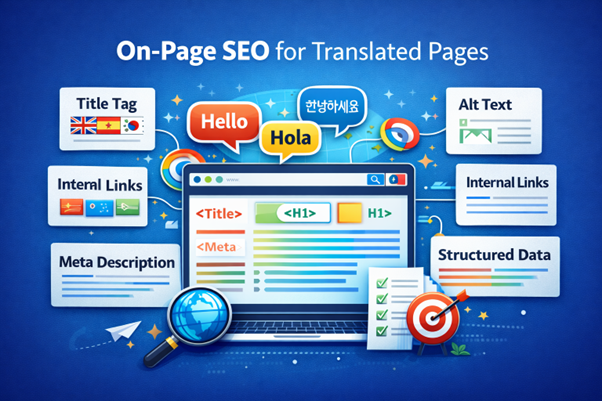
Don’t just translate body content. Also translate:
This strengthens SEO signals in the language.
Semantic SEO means meaning over exact words. In translation:
This helps search engines understand context across languages.
Good semantic SEO improves relevance and rankings in each language.
Translate your:
These are pages that bring your business value.
Some content should be created from scratch in the language:
This local native content drives deeper engagement.
Content tailored to local search behavior will outrank generic translated content.
Machine translation without quality checks can:
Raw machine translation does not consider local intent.
Good translation signals quality, which helps engagement and SEO.
Many businesses use:
This gives quality and speed together.
Google’s guidelines favour clear, accurate content that serves user intent. High-quality translation aligns with that.
Good translation builds trust and authority. Both are ranking signals.
Internal links help search engines discover and pass authority.
A smart internal linking plan strengthens topical authority and rankings.
Backlinks are still one of the strongest ranking factors. That has been confirmed in multiple academic and industry studies.
When you enter a new country or language market, Google does not automatically trust your translated site. You must build authority in that local ecosystem. That is where local link building becomes powerful.
Search engines evaluate authority at multiple levels:
If your German page only has links from English websites, Google may not see it as highly relevant in Germany.
Local backlinks send three strong signals:
For example:
According to research published by the National Bureau of Economic Research (nber.org), network connections strongly influence visibility and diffusion in digital systems.The insight here is simple. Visibility spreads through networks. In SEO, backlinks are that network. If you want rankings in a market, you need links inside that market.
Imagine you have:
If only the English page has backlinks, it will rank well. The Spanish and Korean pages may not. But once each language page gets backlinks from local sites:
Search engines evaluate topical and regional clusters. Local links strengthen both.
Now let’s talk about real strategies. You do not need hundreds of links. You need relevant ones. Here are practical approaches:
Start by identifying blogs and publishers in your target country.
Focus on:
When writing guest content:
This builds both authority and referral traffic.
Public relations works very well in new markets.
You can:
For example:
If expanding into Germany, publish a German-language report about industry trends in Germany. Then distribute it to German media outlets.
Links from local newspapers and trade portals build strong authority signals. This shows why local PR placements can be powerful for SEO. Users and search engines both value local trust.
Influencer marketing is not just social media. It can support SEO.
You can:
When those influencers link back to your localized page, you gain:
This works especially well in markets like South Korea, Germany, and India where local online communities are strong.
Finding opportunities is easier when you follow a structured method.
Here is a simple process you can follow:
First, search in the local language:
Second, analyze competitor backlinks in that language market.
Look at:
Third, use tools to discover local domains.
Tools you can use:
Focus on:
These links often carry strong trust signals.
Anchor text matters more than most people realize.
If your Korean page gets links using English anchor text, that weakens language signals.
Instead, use:
For example:
Instead of linking with “SEO website translation” in English on a German blog, use the German equivalent that people actually search for.
This reinforces:
Search engines use anchor text to understand page context. When the anchor matches local language search terms, ranking signals strengthen.
Before building links, evaluate quality carefully.
Check:
Avoid:
Quality matters more than quantity.
Here’s a workflow you can follow:
A scalable workflow reduces errors and boosts results.
So far, we have talked about strategy. Now let’s talk about execution. Many people understand what SEO website translation is. But they struggle with one question: How do I actually do this at scale?
Manual translation works for small sites. But once you have 100+ pages, you need systems. This section will help you choose the right tools and build a clean workflow.
There are many platforms available. Each works differently. The right choice depends on:
Below is a simplified comparison of widely used tools.
Platform | Best For | SEO Control | Workflow Type |
Weglot | Fast deployment | Good | Automated + human |
Smartcat | Team collaboration | High | Human + AI hybrid |
TranslatePress | WordPress users | Strong | Manual + AI |
WPML | Large WordPress sites | Strong | Structured multilingual setup |
Shopify Translate Apps | Ecommerce | Moderate | App-based workflow |
Let’s break this down in practical terms.
Weglot connects quickly. It auto-detects content and translates instantly.
Strengths:
Limitations:
Good for:
Smartcat is more of a translation management platform.
Strengths:
Best for:
It is strong for structured SEO website translation projects.
TranslatePress works directly inside WordPress.
Strengths:
If your site runs on WordPress, this is often one of the best SEO-friendly choices.
WPML is one of the most advanced WordPress site translation plugins.
Strengths:
Best for:
Your CMS matters. Here is a simple breakdown:
If you use a custom stack, you will likely need developer support.
This is where smart scaling happens. Here is a practical workflow:
Step 1: AI draft translation
Step 2: Human SEO review
Step 3: Native editor refinement
Step 4: Technical validation (hreflang, meta tags)
Step 5: Publish and monitor performance
Why this works:
AI handles volume. Humans handle nuance and intent. AI improves speed, but human review improves trust and clarity.
For SEO website translation, clarity directly impacts engagement and ranking.
If you translate content regularly, you must use translation memory.
Translation memory stores:
Benefits:
Glossary management ensures that key SEO keywords stay consistent across content.
Example:
If your main keyword in German is defined as a specific phrase, it must remain consistent in:
Inconsistent terminology weakens semantic signals.
Let’s compare three main approaches clearly.
Pros:
Cons:
Best for:
Pros:
Cons:
Best for:
Pros:
Cons:
Best for:
In most real-world SEO website translation projects, the hybrid model delivers the strongest ROI.
Translation tools must connect smoothly with your current systems. You should check compatibility with:
For example:
If using WordPress with Yoast SEO, ensure your translation plugin allows per-language meta editing.
If using Shopify, confirm structured data remains intact after translation.
Poor integration can break:
That directly harms rankings.
If your site grows fast, manual work becomes risky. Here is a scalable automation structure:
Automation reduces human error.
But automation must always include quality control.
If you want a clear action plan, follow this:
This approach keeps your SEO website translation structured and scalable.
To measure success:
Good measurement links SEO work to business outcomes.
Numbers drive improvement and planning.
Here are common pitfalls:
Avoid these to protect your rankings.
These mistakes are often the reason global sites fail.
Technology is changing search rapidly.
To stay ahead, align translation with emerging SEO signals.
SEO website translation is more than words. It’s about intent, keywords, content, and architecture.
Translate with strategy. Use technical SEO and research.
Think long term. Think language. Think SEO.
Marketplace SEO is the process of optimizing your product or service listings so they appear higher in a marketplace’s internal search results and, in some cases, on Google. It focuses on helping buyers find you faster when they are already in a buying mindset. Instead of ranking blog posts or articles, you are optimizing listings, categories, filters, and trust signals that influence purchase decisions.
Yes, and the difference matters. Regular SEO often targets informational searches on Google, while marketplace SEO targets buyers who are ready to compare and purchase. Ranking factors are more closely tied to engagement, conversions, reviews, and listing quality rather than backlinks or long-form content.
Marketplace SEO usually shows early signals faster than traditional SEO. Small improvements in titles, categories, or images can increase impressions within days or weeks. Consistent results, however, come from ongoing optimization, testing, and refinement as buyer behavior and competition change.
Start with your top-performing or most important categories first. Optimizing everything at once can feel overwhelming and hard to measure. Focus on a small group of listings, learn what works, then scale those improvements across your marketplace presence.
Start using our A/B test platform now and unlock the hidden potential of your website traffic. Your success begins with giving users the personalized experiences they want.
Start Your Free Trial

Empowering businesses to optimize their conversion funnels with AI-driven insights and automation. Turn traffic into sales with our advanced attribution platform.
Trusted by Customers


©CausalFunnel Inc. All rights reserved.