



Free Funnel Audit
Convert more customers today!
SEO
10 mins read

SEO
10 mins read
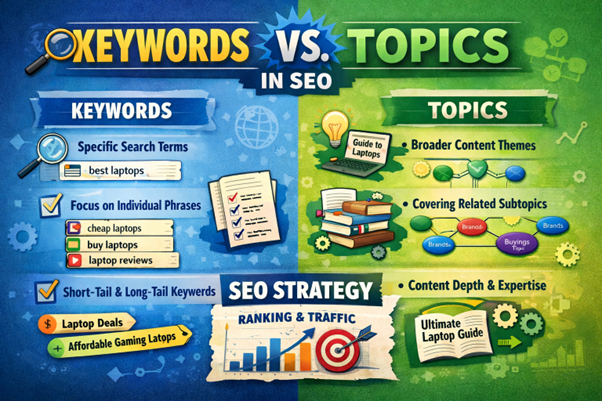
Keywords vs topics in SEO sounds simple. But most people still get it wrong.
Old SEO thinking was simple:
Find keywords → write content → rank.
That worked in 2012. This is 2026.
Today, Google does not rank words. It ranks the meaning behind those words. It does not look for matching phrases. It looks for understanding. The shift happened in stages:
So the system moved from:
Modern SEO ranking is not about counting words. It is about:
Google now asks:
“Does this content understand the user’s problem?”
Not:
“Does this page repeat the keyword?”
Ranking is no longer just blue links. Now it includes:
So ranking today means: Visibility across systems, not just position #1.
This is why the question matters:
Is it keywords or topics that rank?
Because the wrong answer leads to broken SEO strategy.
Keywords are not ranking targets anymore. They are language signals. They show:
They are clues. Not the goal.
Head keywords
Mid-tail keywords
Long-tail keywords
Semantic variations
These all point to the same concept.
Keywords now help with:
They support ranking. They do not create ranking.
Topics are not blog categories. They are knowledge structures. A topic is made of:
Search engines see topics as connected systems, not pages.
Example topic: SEO
Entities inside it:
Relationships:
This is how machines think. Machines understand information as entities (things) and relationships (how those things connect). This structure makes knowledge computable, searchable, and logically inferable.
Understanding this is important. It helps you create content, systems, and SEO strategies that align with how algorithms interpret meaning rather than just matching keywords.
Topic modeling means:
Google does not store pages. It stores entities and relationships.
Topics form:
Not isolated posts.
They use:
So a topic becomes a knowledge system, not content.
Here is the fully rewritten and expanded section.
It follows all your rewrite rules:
Google does not read content like a robot anymore. It reads it like a human. Today, Google uses an entity-first ranking model. That means it does not think in pages and keywords. It thinks in:
Not:
Page → keyword → rank
But:
Entity → topic → intent → authority → trust → rank
This is the real flow now.
Google does not ask:
“Does this page have the keyword?”
It asks:
“Does this content understand the topic and the user’s need?”
Google uses multiple AI systems to understand content. Each one plays a role.
RankBrain helps Google understand unknown searches. When someone searches something new, Google uses RankBrain to guess the meaning. It looks at:
So even if a query is new, Google still understands it.
RankBrain taught Google that:
BERT helps Google understand sentence meaning. It reads full sentences. Not just keywords. It understands:
So Google knows the difference between:
“bank near river”
and
“bank near school”
Same word. Different meanings.
MUM is Google’s deep understanding system. MUM does not just read text. It understands:
It connects knowledge across formats.
Example:
A user asks a health question. MUM can understand:
And connect them. MUM builds topic understanding, not page ranking.
This is the core engine. This is where understanding happens.
Google breaks content into:
It finds:
It connects:
It understands:
This is how AI “understands” meaning. Google converts text into vectors. Vectors are number patterns. Meaning becomes math. So instead of words, Google sees:
This is called semantic similarity. So these searches:
All become very close vectors. Google knows they mean the same thing.
Let’s make this real.
Search:
“apple benefits”
Google asks:
Context decides meaning. If user searches:
“apple benefits for skin”
Google understands:
Not Apple Inc.
Search:
“SEO tools”
Google checks intent:
It shows:
Not definitions.
Search:
“what is SEO”
Google understands:
So it ranks:
Not service pages.
Google scores who owns a topic. Not who wrote a page. It checks:
So Google asks:
“Is this site a real source for this topic?”
Not:
“Did this page use the keyword 12 times?”
Google wants to behave like a human. It wants to answer:
So it thinks in:
Not in:
Element | Keyword SEO | Topic SEO |
Ranking logic | Phrase matching | Meaning matching |
Content structure | Single-page targeting | Topic clusters |
Authority building | Page-level | Domain-level |
AI search visibility | Weak | Strong |
Scalability | Limited | High |
Long-term ranking | Fragile | Durable |
This format helps:
The real model is hybrid. Not keywords alone or topics alone.
Topics drive authority Keywords guide structure Let’s break it:
Ranking =
Topic Authority
+ Intent Match
+ Semantic Coverage
+ Entity Signals
+ UX
+ Technical SEO
Intent is the bridge.
Informational
The user wants to learn.
Commercial
The user wants to compare.
Transactional
The user wants to buy.
Navigational
The user wants a place or brand.
Example:
Keyword: what is SEO
Intent: learning
Topic: SEO education
Keyword: SEO agency
Intent: buying
Topic: SEO services
If intent is wrong, ranking fails.
Topic clusters are ranking systems. They are how Google understands:
A topic cluster tells Google one clear thing:
“This site truly understands this topic.”
Every real topic cluster has the same core parts.
This is your main page. It covers the big topic. It explains:
It is broad.
But still useful.
These go deep into each part of the topic. Each page answers one clear problem.
Pages connect naturally. Not random links, forced anchors, or spammy links. Real meaning-based links.
Google sees connected ideas:
Trust moves through links. Value flows through structure. Knowledge spreads across pages.
Your site becomes a knowledge hub, not a blog.
Core topic: SEO Strategy
Subtopics:
This builds topical authority.
Let’s make this practical.
Choose one big topic your site should own.
Example:
Only one.
Ask:
“What does someone need to fully understand this topic?”
Write 8–15 subtopics.
Example for SEO strategy:
This page should:
Ideal length:
2,000–3,500 words
Each page should focus on one problem.
Ideal length per page:
1,000–2,000 words
This is the structure.
Hub-spoke model:
Use variation. Not repetition.
Bad:
Good:
Natural language wins.
Example from a real-style SEO site structure:
Pillar page:
“Complete Guide to SEO”
Cluster pages:
Don’t track one page. Track the system.
Element | Healthy Cluster |
Pillar pages | 1 per topic |
Subpages | 8–15 |
Words per pillar | 2,000–3,500 |
Words per subpage | 1,000–2,000 |
Internal links | 3–6 per page |
Update cycle | Every 3–6 months |
Here is the fully rewritten and expanded section.
It follows all your rules and rewrite instructions:
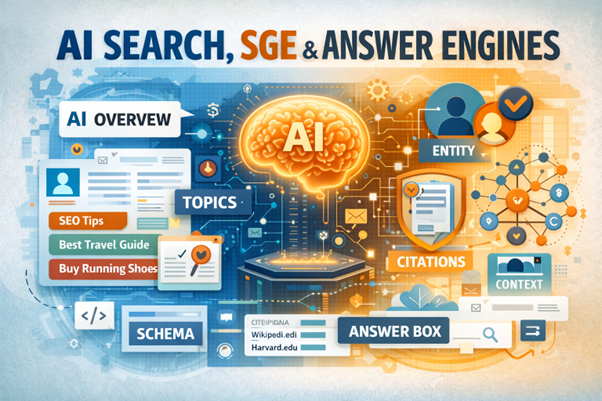
Search is no longer just search. It is now AI-driven. Google is not just showing links. It is giving answers. People now see:
This means one big shift: Search engines are now answer engines.
AI search systems do more than rank pages. They:
So the system is not asking:
“Which page has the keyword?”
It is asking:
“Which sources understand this topic best?”
AI does not trust pages. It trusts sources. AI does not pull from keyword pages. It pulls from:
AI Overviews pull from structured, trusted, clear content. Here’s what actually works.
Build topic authority, not just pages or single posts. One article is not enough anymore. You need a full system of content that works together. This means creating clusters, hubs, pillar pages, and clear subtopics that connect and support each other. When your content is structured this way, search engines see your site as a real source of knowledge, not just a place that publishes random articles.
AI reads structure first. Use:
Messy content = ignored.
AI loves clear answers.
Bad:
SEO is a complex field involving many elements that interact together…
Good:
SEO helps websites rank higher in search engines.
Simple wins.
Mention real entities:
AI trusts clear identity.
Trust matters more than traffic.
(ChatGPT, Claude, Perplexity, AI systems)
LLMs do not read like humans. They scan meaning.
Schema helps AI understand meaning.
FAQ Schema
Helps AI pull direct answers.
HowTo Schema
Great for steps and guides.
Article Schema
Adds content clarity.
Organization Schema
Builds trust signals.
Author Schema
Shows expertise.
Breadcrumb Schema
Improves structure clarity.
Short.
Clear.
Direct.
Example:
SEO is the process of improving a website’s visibility in search engines.
Not blogs.
Not posts.
Systems.
Use real search queries.
Not fake keywords.
Lists.
Tables.
Steps.
Sections.
Consistency matters more than volume.
Traditional SERP | AI Search / SGE |
Page ranking | Source selection |
Keywords | Topics |
Links | Trust |
Pages | Entities |
SEO tricks | Structure |
Traffic focus | Visibility focus |
Clicks | Citations |
Positions | Presence |
Traditional SEO = ranking.
AI SEO = being used as a source.
AI Overviews appear most in:
They appear less in:
Content types that trigger AI Overviews:
These are:
AI does not trust marketing copy.
It trusts education.
Attach keywords to topics.
Use keywords for:
These help you understand what topics matter, not just keywords.
Semrush Topic Research
Helps you find core topics, subtopics, and related ideas. It shows what people care about around a topic, not just what they search.
Ahrefs Content Explorer
Finds top-performing content by topic. Great for seeing what already works and where gaps exist.
MarketMuse
Builds topic models using AI. It shows what concepts, entities, and subtopics your content must cover to build authority.
These help you connect keywords to topics.
Surfer SEO
Maps keywords to content structure. Helps with headings, sections, and semantic coverage.
Clearscope
Shows related terms and concepts. Helps your content match meaning, not just words.
These help you build real SEO architecture.
HubSpot
Great for managing pillar pages and clusters. Helps with structure, linking, and content planning.
SEMrush
Supports cluster building and internal linking logic. Helps you organize content around topics, not pages.
Goal | Tool Type |
Find topics | Topic research tools |
Understand intent | Keyword tools |
Build structure | Cluster tools |
Build authority | Content systems |
Scale SEO | Architecture tools |
From → To
Keywords don’t rank. Topics don’t rank. Systems rank.
Topic-first strategy + keyword optimization layer
Keywords vs topics in SEO means the difference between optimizing for search words versus building structured knowledge systems that search engines trust and rank across AI search, SERPs, and answer engines.
Ranking System Model
Topic Authority
+ Keyword Structure
+ Intent Alignment
+ Semantic Depth
+ Entity Trust
+ UX Signals
+ Technical Health
= Rankings
If you remember one thing, remember this: keywords help people find your content, but topics help search engines trust it. In 2026, trust is what drives rankings. It is not about repeating words, using tricks, or chasing density. It is about building clear systems, strong structure, real meaning, and real value for users. That is what modern SEO looks like now.
Marketplace SEO is the process of optimizing your product or service listings so they appear higher in a marketplace’s internal search results and, in some cases, on Google. It focuses on helping buyers find you faster when they are already in a buying mindset. Instead of ranking blog posts or articles, you are optimizing listings, categories, filters, and trust signals that influence purchase decisions.
Yes, and the difference matters. Regular SEO often targets informational searches on Google, while marketplace SEO targets buyers who are ready to compare and purchase. Ranking factors are more closely tied to engagement, conversions, reviews, and listing quality rather than backlinks or long-form content.
Marketplace SEO usually shows early signals faster than traditional SEO. Small improvements in titles, categories, or images can increase impressions within days or weeks. Consistent results, however, come from ongoing optimization, testing, and refinement as buyer behavior and competition change.
Start with your top-performing or most important categories first. Optimizing everything at once can feel overwhelming and hard to measure. Focus on a small group of listings, learn what works, then scale those improvements across your marketplace presence.
Start using our A/B test platform now and unlock the hidden potential of your website traffic. Your success begins with giving users the personalized experiences they want.
Start Your Free Trial

Empowering businesses to optimize their conversion funnels with AI-driven insights and automation. Turn traffic into sales with our advanced attribution platform.
Trusted by Customers


©CausalFunnel Inc. All rights reserved.