



Free Funnel Audit
Convert more customers today!
SEO
10 mins read

SEO
10 mins read
There’s a quiet reason some local businesses keep showing up everywhere customers look, while others, just as good, feel completely invisible.
It’s not always better service. Or bigger budgets.
Very often, it comes down to one unsexy thing most owners ignore until it’s a problem: citations and how they shape local rankings.
When a business keeps popping up in local results, in maps, in those “near me” searches, it isn’t an accident. It’s usually the result of consistent, accurate information about that business being repeated again and again across the web in all the right places.
What are citations in SEO, exactly? They’re online mentions of your business information. Specifically, your NAP (Name, Address, Phone number). These mentions can appear on business directories, websites, apps, social platforms, and anywhere else your business details get listed. Sometimes they include a link back to your site. Sometimes they don’t. Both versions count.
That repetition becomes a kind of proof that the business really exists where it says it does, and search engines use that proof when deciding which local results deserve to be seen first.
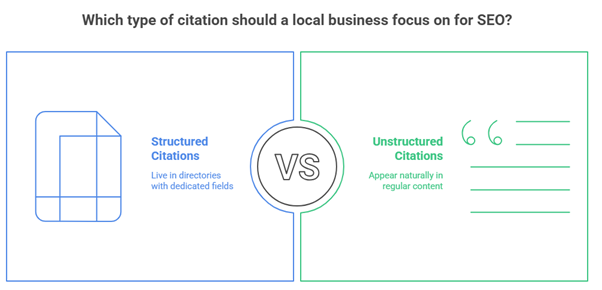
Before talking about rankings, it helps to get crystal clear on what citations are in SEO in a local context. In local search, citations are simply references to a business’s name, address, and phone number (often called NAP) on other websites, apps, maps, and directories.
These references do not always need to include a link to the website to count as a citation, because the presence of consistent NAP data itself is what search engines evaluate.
A citation is any online mention of the core details of a local business. At minimum, that means business name, physical address, and phone number (NAP). Many citations also include website URL, categories, hours, photos, and other attributes.
There are two types:
Google doesn’t care which bucket a citation falls into. It only cares about volume, consistency, and authority of the source.
Google’s local algorithm (codenamed “Vicinity” until it was retired and folded into the core algorithm) always leaned heavily on proximity, relevance, and prominence. Prominence is the part everyone fights over. Reviews used to dominate prominence. They still matter a lot. But Google now has hundreds of billions of reviews and has gotten extremely good at spotting fake, incentivized, or review-gated patterns.
Citations, on the other hand, are harder to fake at scale. A real local business naturally accumulates mentions over the years from local newspapers, industry associations, event sponsors, suppliers, partners, and directories. Fake businesses rarely bother (or don’t know how) to build that footprint convincingly.
Studies and industry tests over the years have shown that citations remain one of the key signals in local ranking systems, even as algorithms have evolved. That’s why businesses that invest in professional local SEO services.
They are especially influential for visibility in map packs and local finder results, where proximity, relevance, and prominence all interact. Citations contribute to the prominence part by reinforcing that the business is recognized and established across the web.
Clean citation profiles also reduce friction in how search engines connect different mentions of the same business. When the same NAP appears in many trustworthy places, the system can confidently merge them into a single entity, which helps that business accumulate authority rather than splitting it across conflicting records. That consolidation directly supports stronger local rankings, especially over time.
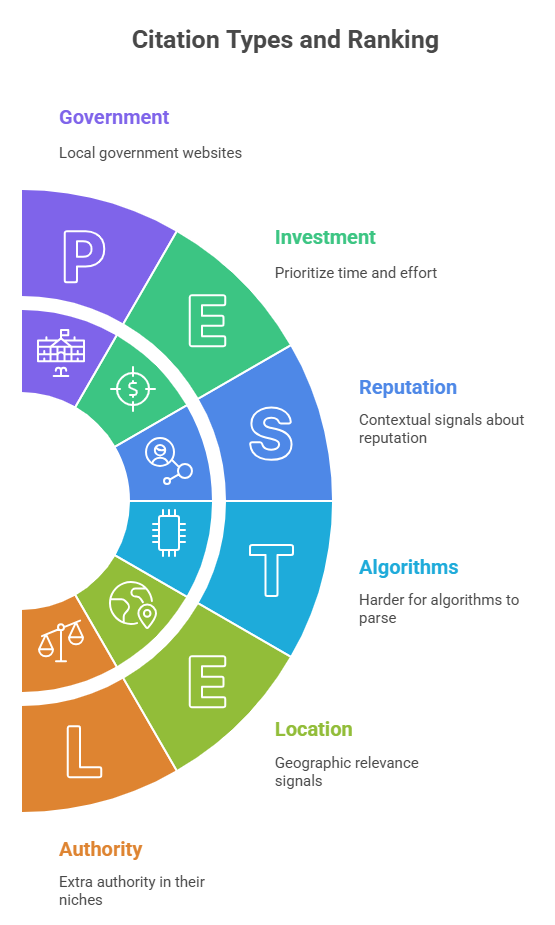
Not all citations deliver equal value. Understanding the hierarchy helps businesses prioritize where to invest time and effort.
These appear on traditional business directories with standardized formats and dedicated fields for:
Key platforms include: Google Business Profile, Yelp, Facebook Business, Apple Maps, Bing Places, Yellow Pages, Better Business Bureau
These structured listings provide the most direct ranking impact because search engines can easily extract and verify the data. The standardized format eliminates ambiguity about what information represents which business attribute.
These appear within body content of websites, blogs, news articles, and social media posts. The mention might read naturally like: “Check out Riverside Dental at 456 Oak Avenue for amazing family dentistry.”
Characteristics:
Sources specific to your geographic area carry special weight:
These confirm your legitimate connection to the location you serve and provide powerful geographic relevance signals.
Platforms tailored to your business type carry extra authority in their niches:
Industry | Key Citation Platforms |
Legal | Avvo, Justia, FindLaw, Martindale-Hubbell |
Healthcare | Healthgrades, Vitals, RateMDs, Zocdoc, WebMD |
Restaurants | Zomato, OpenTable, Resy, TripAdvisor |
Home Services | Angi, HomeAdvisor, Thumbtack, Houzz, Porch |
Retail | Google Shopping, Yelp, industry marketplaces |
Companies like Neustar, Localeze, Data Axle, Foursquare, and Factual collect and distribute business information to hundreds of downstream platforms. Getting listed correctly on these aggregators can spawn citations across dozens of sites automatically.
The efficiency advantage: Instead of manually submitting to 200 directories, businesses can ensure accuracy on four or five major aggregators and watch consistent citations proliferate across the web.
Search engines face a challenging problem. Millions of businesses claim to operate in specific locations. Some are legitimate operations with physical storefronts. Others are spam listings created to manipulate rankings. How does Google separate the real from the fake?
Citations provide the answer. When your business information appears consistently across authoritative platforms like Yelp, Yellow Pages, Better Business Bureau, and industry specific directories, it signals legitimacy. The algorithm interprets this pattern as proof that your business genuinely exists and operates where you claim.
Consistency matters enormously here. Imagine seeing these two listings:
Same business? Maybe. But to an algorithm, these look like different entities. This inconsistency creates confusion and dilutes the ranking power that citations should provide.
Search engines also evaluate the quality of citation sources. A mention on a spammy directory that accepts any submission without verification carries minimal weight. A listing on a well-maintained, industry-specific platform that vets businesses before inclusion signals credibility.
The quantity of citations influences rankings too, but not in the way many businesses assume. Having 500 mediocre citations won’t outperform 50 high-quality, consistent ones. Quality beats quantity every time.
Here’s the part that makes grown business owners cry.
If the business name, address, or phone number differs even slightly across the web, Google gets confused about which version is correct. Confusion = lower trust = lower rankings. Period.
Examples of fatal inconsistencies almost no one catches:
Google does not “pick the most common version.” It downgrades the entire entity until a clear winner emerges.
Everyone knows the big four data aggregators in the U.S.: Infogroup, Acxiom, Localeze (now part of Yext), and Factual (now part of Foursquare). Those still matter because hundreds of smaller directories pull from them.
But in 2026, the sources that create the biggest ranking jumps are:
These carry exponentially more weight than random $5 Fiverr gigs blasting to 300 obscure directories.
Step 1: Pull the current NAP Google has on file
Go to Google Business Profile Manager → Info → look at the “From the business” column. That’s what Google believes is correct right now.
Step 2: Run a full citation audit
Tools that show 95%+ of existing citations in 2026:
Step 3: Export every citation found and color-code:
Step 4: Prioritize fixes by authority
Fix Google Business Profile first (obviously), then the four major aggregators, then the top 50-70 authority sites (Apple Maps, Bing, Yelp, Facebook, YellowPages, BBB, etc.).
Manual outreach template that works 80% of the time in 2026:
Subject: Quick update to our business listing on [Site Name]
Hi [Site Name] team,
Hope you’re doing well! I’m the owner of [Business Name] located at [Full Address]. We recently noticed our listing on your site shows an old phone number/address. Could you please update it to:
Name: [Exact Legal Name]
Address: [Full Address Exactly as on GBP]
Phone: [Exact Phone on GBP]
Website: [URL]
Here’s our Google listing as proof: [shortened GMB link]
Thank you so much takes 2 minutes and helps local customers find us!
Best,
[Real Name]
[Real Phone]
[Business Name]
For sites that ignore email, use their “claim listing” or “suggest an edit” feature. Apple Maps Connect, Bing Places, and Yelp all allow verified owners to fix directly.
The local pack and map results are where many customers make instant decisions about who to contact. Citations help determine which businesses earn those coveted spots by backing up the location and contact data shown in map profiles. When search engines see strong, consistent NAP signals across important platforms, they can confidently highlight those businesses to nearby searchers.
Citations also interact with other local signals like proximity, categories, and reviews. A business that is physically close to the searcher but has messy or thin citations may still lose visibility to another that is slightly farther away but better established and more trustworthy on paper. In this way, citations act as tie breakers when several local businesses appear similarly relevant.
Over time, a strong citation profile can support not just appearance in local packs but also improved local organic rankings beneath the map results. That broader visibility matters because customers often scroll past the pack to compare websites, hours, and other details before deciding. A business that appears both in the map and the organic results gains more overall real estate and credibility in the searcher’s mind.
The algorithm’s treatment of citations reveals how search engines conceptualize local business trust. When Google evaluates a business for local rankings, citations contribute to what’s called the “local search ranking algorithm” or more specifically, the “local pack algorithm.”
This system evaluates three primary factors:
Relevance – How well does your business match what the searcher is looking for?
Distance – How close is your business to the searcher’s location or the location they specified?
Prominence – How well-known and established does your business appear online?
Citations primarily influence the prominence calculation. Prominence measures how well-known and established a business appears online. It’s Google’s way of asking: “Should searchers trust this business?”
Each mention from a reputable source functions like a reference check. The more sources independently confirm your business details, the more prominent you appear.
The algorithm also uses citations for disambiguation. When multiple businesses share similar names or operate in close proximity, consistent citation patterns help the system differentiate between them. This becomes particularly important in competitive markets.
Natural growth pattern:
Suspicious growth pattern:
The temporal dimension matters too. Fresh citations from recently updated sources carry more weight than stale mentions on sites that haven’t been updated in years. This encourages ongoing citation maintenance rather than one-time bulk submissions.
When your business frequently appears alongside other businesses in local roundups, directory categories, and industry lists, the algorithm learns contextual relationships. Getting listed in the same categories as established, high-ranking competitors reinforces your legitimacy in that business category.
These two concepts often get confused, but they serve different purposes in search optimization.
Factor | Citations | Backlinks |
Primary Purpose | Establish local legitimacy | Pass authority for organic rankings |
Link Required? | No (though helpful) | Yes (it’s the defining feature) |
Main Impact | Local pack rankings | Organic search rankings |
Key Element | NAP consistency | Link quality and relevance |
A citation without a link still provides value. When Yelp lists your restaurant’s name, address, and phone number, but that information isn’t hyperlinked, you’ve gained a citation but not a backlink. This mention still helps local rankings by confirming your business exists at that location.
A citation with a link provides dual benefits. The citation helps local rankings through NAP consistency and trust signals. The link helps organic rankings by passing authority and creating pathways for Google to discover and crawl your site.
The relationship becomes powerful when both elements align. Businesses with strong citation profiles AND quality backlink profiles outperform competitors in both local and organic search results. The two signals reinforce each other, creating comprehensive trust across multiple ranking systems.
When building citations, prioritize:
When building backlinks, prioritize:
Common mistake to avoid: Some businesses obsess over the “domain authority” of directories when building citations, believing higher DA directories provide better citations. While authority matters somewhat, consistency and verification matter more. A verified listing on a mid-tier directory outperforms an unverified listing on a high-DA platform.
Citation work doesn’t end after initial submissions. Ongoing monitoring ensures accuracy persists as platforms update their databases, competitors report incorrect information, and your business details potentially change.
Core Information Accuracy
Duplicate Listing Detection
Sometimes platforms create multiple profiles for the same business through user submissions or data aggregation errors. These duplicates cause:
Citation Consistency Scores
Tools like Moz Local, BrightLocal, and Whitespark scan major platforms and calculate what percentage of your citations contain accurate, consistent information.
Score Range | Citation Health | Action Needed |
90-100% | Excellent | Maintain current practices |
80-89% | Good | Minor cleanup recommended |
70-79% | Fair | Significant issues to address |
Below 70% | Poor | Urgent comprehensive audit required |
Review and Reputation Monitoring
Many citations double as review platforms. Monitoring reviews across your citation profile helps you:
Weekly Tasks:
Monthly Tasks:
Quarterly Tasks:
Annual Tasks:
Certain events require immediate citation updates across your entire profile:
Business moves to a new location
Phone number changes
Business name changes
Hour changes (seasonal or permanent)
Citations function as one component within comprehensive local SEO strategies. They work alongside other critical elements to create a dominant local search presence.
Think of local SEO as a four-legged table. Remove any leg and the table becomes unstable:
Leg 1: Google Business Profile Optimization
Leg 2: Citations and NAP Consistency
Leg 3: Reviews and Reputation
Leg 4: Website and Content
Citations support Google Business Profile performance by confirming the accuracy of information displayed there. When Google sees your business information matching across hundreds of sources, it gains confidence that your GBP data is correct.
Review generation becomes easier with strong citations. When satisfied customers can find your business across multiple platforms, they’re more likely to leave reviews. Each citation platform becomes a potential review source.
Website SEO gets enhanced by citation links. Most business directories include your website URL in the listing, creating backlinks that support organic rankings. These links also send both users and search engine crawlers to relevant content.
Strong citations → Better local rankings → More website traffic → More customer reviews → Even better rankings → Greater visibility → More citations from media mentions → The cycle continues
This interconnection creates synergistic effects where improving one element amplifies the others. A comprehensive approach always outperforms focusing on citations alone.
Behind the scenes, search engines employ sophisticated processes to extract, validate, and utilize citation data.
Natural language processing algorithms identify business names within unstructured text by looking for:
This technology allows search engines to find citations even when they’re embedded in blog posts, news articles, or social media content without structured formatting.
These systems compare mentions across sources to determine consistency while accounting for common variations:
Acceptable variations the algorithm recognizes:
Problematic variations that confuse matching:
Search engines maintain databases of known directories, websites, and platforms. Each source receives a trust score based on:
Trust Factor | What It Measures |
Historical Accuracy | How often the platform has provided accurate business information |
Update Frequency | How regularly the platform refreshes its data |
Verification Processes | Whether the platform verifies businesses before listing |
Spam Resistance | How well the platform prevents fake or manipulative listings |
User Engagement | How actively real users interact with listings |
Citations from high-trust sources carry significantly more weight than mentions on low-quality platforms.
When algorithms encounter inconsistent information:
Citations decay in value over time unless refreshed:
This encourages ongoing citation maintenance and rewards businesses that keep their information current.
LocalBusiness schema on your website creates authoritative baseline information:
{
“@context”: “https://schema.org”,
“@type”: “LocalBusiness”,
“name”: “Your Business Name”,
“address”: {
“@type”: “PostalAddress”,
“streetAddress”: “123 Main Street”,
“addressLocality”: “City”,
“addressRegion”: “ST”,
“postalCode”: “12345”
},
“telephone”: “+1-555-123-4567”
}
Search engines compare other mentions against this structured data to evaluate consistency.
Numerous businesses unknowingly undermine their local SEO through citation mistakes that seem minor but create significant algorithmic problems.
Wrong approach:
Right approach:
Wrong:
Right:
Why it matters: Platform moderators edit promotional names, creating inconsistencies. Marketing language belongs in business descriptions, not names.
The problem scenario:
Result: Algorithm sees three potentially different businesses
Solution: Use your most permanent number for all citations, even if you use tracking numbers on your website or in ads.
Be consistent with:
Timeframe | Citation Count | Algorithm Interpretation |
500 citations in 1 week | SPAM | Triggers penalties |
50 citations in 1 month | Aggressive | Risky but might work |
50 citations over 3 months | Natural | Ideal growth pattern |
10-15 citations monthly ongoing | Organic | Best long-term approach |
The promise: “We’ll submit your business to 500 directories for $99!”
The reality:
Better approach: Manual submission to 50 high-quality, relevant platforms
The role of citations continues evolving as search engines refine their algorithms and new platforms emerge.
Voice search amplifies the importance of citation accuracy. When users ask Alexa, Siri, or Google Assistant for business recommendations, these systems rely heavily on structured citation data to provide answers. Inaccurate citations mean you might not appear in voice search results at all.
Artificial intelligence improves how search engines interpret unstructured citations. Advanced natural language processing allows algorithms to extract business information from blog posts, news articles, and social media with increasing accuracy. This means mentions in less structured environments contribute more to rankings than ever before.
Visual search introduces new citation considerations. When users take photos of business storefronts or products and search using images, algorithms need accurate location data to provide relevant results. Citations help connect visual search queries to specific business locations.
Augmented reality applications require precise location data. As AR navigation becomes more common, the accuracy of your citation information directly impacts whether users can find your physical location through AR interfaces.
Hyperlocal search refinement continues to increase citation importance. As search engines get better at understanding micro-local intent, citations on neighborhood-specific platforms and mentions in community-focused content gain additional weight.
Cross-platform identity verification becomes more sophisticated. Search engines increasingly share data about verified businesses across ecosystems. A verified listing on one major platform might help establish trust with others more quickly than currently possible.
User-generated citation data plays a larger role. When thousands of smartphone users share location data showing they visited your business, this behavioral information functions as an implicit citation. Search engines combine this foot traffic data with traditional citations to evaluate business prominence.
Understanding what are citations in SEO means nothing without implementation. Practical action generates results.
Week 1-2: Audit and Baseline
Week 3-4: Foundation Building
Week 5-6: Aggregator Optimization
Week 7-9: Industry Directory Submissions
Week 10-12: Local Platform Targeting
Ongoing Maintenance:
Tool Category | Recommended Tools | Primary Use |
Citation Building | BrightLocal, Moz Local, Yext | Automated submissions and tracking |
Monitoring | Google Alerts, Mention, Brand24 | New citation discovery |
Analysis | Whitespark, SEMrush Local | Competitor research |
Verification | Platform-specific dashboards | Ownership confirmation |
Create a master spreadsheet tracking:
This prevents confusion when staff turnover occurs and ensures consistent maintenance.
DIY approach works well when:
Professional services make sense when:
Citations in SEO are not a “set it and forget it” task from 2015. They are a living, breathing trust signal that Google cross-references hundreds of times per second when deciding whether a business deserves to show up when someone’s basement is flooding at 2 a.m.
Get them consistent on the top authority sources. Earn new ones through real community involvement. Fix inconsistencies faster than a teenager changes their TikTok bio.
Do that, and the Local Pack spot that seemed impossible becomes inevitable.
Because in local SEO, the business with the cleanest, widest, most authoritative citation footprint doesn’t just rank higher.
It becomes the default choice in the minds of both Google and the customer, desperately searching on their phone.
And that’s worth every minute spent fixing “Suite” vs “Ste” at 11 p.m. on a Friday.
Unless you’d rather let a team that does this daily handle it through proven local SEO services.
Lead generation for architects means helping the right people discover your firm. These people already have a real need for architectural services. The goal is to build trust early so the first conversation feels comfortable.
Yes, online lead generation works when it supports how clients research. Most people look online before they contact an architect. Helpful content and a clear website guide them during that early stage.
Lead generation rarely works overnight in architecture. Clients often take time to plan, budget, and compare options. With consistency, better inquiries usually appear within a few months.
Small firms benefit from simple and focused efforts. Clear messaging, helpful content, and referrals often work well together. These approaches build visibility without requiring large marketing budgets.
Start using our A/B test platform now and unlock the hidden potential of your website traffic. Your success begins with giving users the personalized experiences they want.
Start Your Free Trial

Empowering businesses to optimize their conversion funnels with AI-driven insights and automation. Turn traffic into sales with our advanced attribution platform.
Trusted by Customers


©CausalFunnel Inc. All rights reserved.