
Free Funnel Audit
Convert more customers today!
SEO
10 mins read

SEO
10 mins read
Google Ads for doctors still works in 2026. It remains one of the fastest and most reliable ways to attract high converting leads. These are new patients who are actively searching for care right now.
Many doctors hesitate before starting Google Ads. The questions come fast. Is it too expensive? Does it still work? Will it bring real patients or just clicks? Is this worth the money, or will it turn into another marketing headache?
This guide walks through those questions step by step. Keep reading to find practical guidance that helps you decide what makes sense for your practice.
Google Ads for doctors means paying to appear at the top of Google when someone searches for medical care. These are not casual searches. They are moments of need.
Think about how people behave today. Someone wakes up with tooth pain. A parent searches late at night because a child has a rash. A new resident types “family doctor near me” during lunch break. These searches are urgent, local, and intent-driven.
Organic search takes time. Social media builds awareness slowly. Google Ads shows up immediately when the patient is ready to act.
That is why Google Ads still matter in 2026. Patient behavior has not slowed down. If anything, it has become more direct.
Patients do not search like marketers expect. They search like humans under stress.
Most searches follow a few clear patterns:
Mobile dominates these searches. Many happen while sitting in a car, waiting in line, or lying awake at night. Voice search is common. So are short, direct phrases.
This matters because Google Ads for doctors works best when it matches this mindset. Campaigns built around broad medical terms often fail. Campaigns built around intent usually perform better.
A useful way to think about it is this. Patients are not browsing. They are deciding.
This is the question that stops most practices from moving forward.
The honest answer is simple. Google Ads for doctors is worth it when done with clear goals, tight targeting, and realistic expectations. It fails when treated like a slot machine.
Costs vary by specialty and location. Competitive areas cost more. High-value services cost more. That is normal.
What matters more than cost per click is cost per patient. One new patient who stays for years can justify dozens of clicks.
Doctors often ask if there are free Google Ads for doctors. Google sometimes offers small promotional credits for new accounts. These help test the platform, but they are not a strategy. Long-term results come from proper setup and steady management, not free credits.
The real question is not “Is it expensive?”
The better question is “Does one new patient cover the cost?”
Medical advertising is not like other industries. Rules matter. Compliance matters.
Google requires healthcare advertisers to follow strict policies. Some services need special certification. Some claims are not allowed. Patient privacy must be protected at all times.
Key points doctors should understand:
This is not meant to scare anyone. It is meant to prevent costly mistakes. Ads that break rules get disapproved. Accounts can get suspended. Fixing those issues later is much harder than doing it right from the start.
This is one reason many practices seek the best Google Ads for doctors through experienced healthcare-focused teams rather than general marketers.
Not all Google Ads are equal. Choosing the wrong type wastes money. Choosing the right one brings steady leads.
Search ads are the foundation. These appear when someone types a query into Google.
They work best for:
Search ads capture intent. Someone searching “dermatologist near me” is not browsing. They are looking to book.
Many patients prefer to call, not fill forms. Call-focused ads work well for:
Timing matters here. Ads should run during office hours. Otherwise, calls go unanswered and budgets burn fast.
Location matters in healthcare. Patients rarely travel far unless necessary.
Google Ads integrated with local listings helps practices appear in map results. This improves trust and visibility, especially for new clinics.
Display and video ads are often misunderstood. They rarely work well for direct patient booking. They work better for awareness or remarketing.
Used too early, they waste money. Used later, they can support growth.
The right keywords decide whether ads bring patients or just burn money.
Strong keyword strategy starts with intent. Not volume. Not fancy tools. Just intent.
Think about how real patients search. Someone in pain types fast and clearly. Someone doing research types broad and vague. Ads should show only for the first group.
That single choice changes everything.
High-volume keywords look tempting. But many of them attract the wrong crowd.
Students. Job seekers. People who are just “looking things up.”
For example:
These searches rarely turn into appointments.
High-intent keywords show urgency. They signal action.
For example:
These searches come from people ready to book.
That difference separates profitable campaigns from frustrating ones.
High-intent keywords (worth paying for):
Low-intent keywords (usually waste money):
If a keyword does not hint at booking, calling, or visiting, it likely does not belong in an ad campaign.
Each specialty attracts different search behavior. Treat them differently.
Dentist
Dermatologist
Urgent Care
Primary Care
Notice the pattern.
Location. Condition. Urgency.
That combination drives calls.
Long-tail keywords sound specific. That is the point.
A search like
“pediatric dentist accepting Medicaid in [city]”
does not get thousands of searches.
But the people who search it are ready to book.
Long-tail keywords:
They also match how people actually talk.
In 2026, long-tail keywords outperform broad lists every time.
Healthcare is local. Ads must reflect that.
Use local modifiers consistently:
These phrases tell Google exactly who to show ads to.
They also reassure patients that help is close.
Negative keywords stop ads from showing to the wrong people.
Skipping this step quietly drains budgets.
A strong starter negative keyword list includes:
This list blocks:
Each blocked click saves money for real patients.
Negative keyword lists should be reviewed monthly. New junk terms appear over time.
Match types control how closely searches must match keywords.
Exact match
Shows ads only for very close searches.
Best for tight control and high intent.
Example:
[dentist near me]
Phrase match
Shows ads when the phrase appears in order.
Balances reach and relevance.
Example:
“dentist near me”
Broad match
Shows ads for related searches.
Risky without strong negative keywords.
Broad match works only when:
For most doctors, exact and phrase match do the heavy lifting.
Google Keyword Planner remains a solid research tool when used correctly.
Here is a simple process:
Avoid chasing big numbers.
Small, relevant keywords bring better patients.
In 2026, smaller keyword groups perform better.
Why?
A tight ad group might contain:
That focus improves relevance. Relevance lowers cost. Lower cost brings more patients.
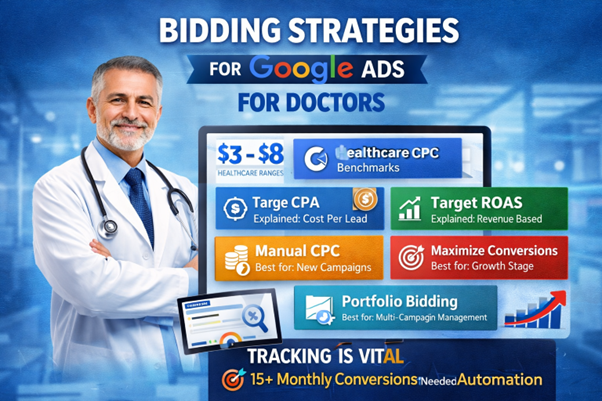
Bidding decides how much each patient inquiry costs.
Get it right, and ads scale smoothly. Get it wrong, and budgets disappear fast.
In healthcare, bidding should never be aggressive by default. It should be deliberate, calm, and based on real numbers.
Cost-per-click varies by specialty, location, and competition. Still, most practices fall within a clear range.
For many medical specialties in 2026:
A higher CPC does not always mean worse performance.
What matters is whether those clicks turn into booked visits.
Target CPA focuses on cost per lead, not traffic.
This strategy tells Google:
Target CPA works best when:
For example:
If an average appointment is worth $250 and the practice is comfortable paying $50 per lead, Target CPA can work well.
Without enough data, this strategy struggles. Google needs patterns to learn.
Target ROAS focuses on revenue.
Target CPA focuses on leads.
Target ROAS fits better when:
Target CPA fits better when:
Most medical practices use Target CPA.
ROAS works better for high-ticket services like cosmetic procedures.
Each strategy fits a different stage of growth.
Manual CPC
Maximize Conversions
Small practices often start with Manual CPC.
Larger practices benefit from automated strategies once data stabilizes.
Use Manual CPC when:
Use Maximize Conversions when:
Use Target CPA when:
Choosing the wrong strategy too early causes frustration.
Portfolio bidding manages multiple campaigns under one strategy.
It works well when:
Instead of optimizing each campaign alone, Google balances them together.
This often smooths results and reduces swings.
Portfolio bidding suits group practices and clinics with complex structures.
Bidding is not about winning auctions.
It is about controlling cost while staying visible.
The smartest campaigns start simple, gather data, then automate slowly.
Rushing automation too early usually backfires.
The real question is not which bidding strategy is best.
It is which one fits the practice today.
Medical ads need a different tone. Hard selling feels wrong. Overly clinical language feels cold.
Patients respond to clarity and reassurance.
Effective ads often include:
Trust signals matter. Years of experience. Board certification. Emergency availability. These details help patients choose.
Calls to action should feel natural. “Call today” works better than aggressive promises. Patients want confidence, not pressure.
Ad extensions are often overlooked but are one of the simplest ways to boost Google Ads performance. They are free, easy to set up, and can dramatically increase click-through rates, often by 10–15%. For doctors, ad extensions also build trust, provide essential information at a glance, and make it easier for patients to take action immediately.
Think of them as little signposts that guide a patient from a Google search straight to booking an appointment.
Sitelinks allow you to add extra links beneath your ad. For healthcare practices, they can point to pages that matter most to patients:
Sitelinks reduce friction. Instead of landing on a homepage and searching for details, patients get what they need immediately.
Phone calls remain the strongest conversion signal for healthcare.
This is especially important for urgent care, dentists, and primary care offices. Patients often act fast and expect instant contact.
Healthcare is local. Location extensions show your clinic’s address, map pin, and directions.
Benefits include:
For multi-location practices, location extensions help Google show the nearest office to the patient’s search location.
Callout extensions are short, non-clickable snippets that emphasize key benefits. Examples for healthcare:
Callouts reassure patients and answer common objections instantly. They also make ads visually bigger, which improves CTR.
Structured snippets let you list multiple offerings or specialties without adding extra words to the headline.
For example:
This improves relevance and helps patients quickly see if the practice meets their needs.
Ad extensions do more than fill space. They:
The best part? They are free. Google does not charge extra to show extensions—they only help ads perform better.
Starting Google Ads can feel overwhelming. But with a clear process, it becomes simple. A well-structured setup ensures ads reach the right patients, spend stays controlled, and campaigns start producing leads quickly.
Here’s a practical, step-by-step guide that any healthcare practice can follow.
A clean account structure is critical. Think of it like a filing system:
Pro tip: One service per ad group is ideal. Avoid lumping multiple services together. It dilutes relevance and increases cost.
Here’s a numbered, practical guide:
Keep ad groups focused. Examples:
One service per ad group improves relevance, CTR, and Quality Score.
Tracking is critical to know what’s working.
Tools to use:
Without tracking, campaigns operate blindly. Track only what is HIPAA-safe: clicks, calls, and completed appointments, not patient health data.
Budgets depend on practice size:
Start small, monitor performance, and scale gradually.
Realistic timing is essential. Google Ads is fast, but results improve with data:
Patience is key. Early data informs smarter decisions later.
Landing pages decide whether ad clicks become patients. Sending paid traffic to a homepage often fails because homepages try to please everyone.
A good landing page does one thing well. It matches one service with one clear action.
When that focus slips, even the best ads stop working.
Homepages carry too many goals. They explain the practice, list services, show blogs, and tell long stories.
Patients coming from ads do not want all that. They want reassurance and a next step.
If the page feels slow or confusing, they leave. No second chance.
Every high-performing healthcare landing page includes:
Missing even one of these lowers conversions.
The first screen must answer three questions fast:
Above the fold should always include:
If scrolling is required to find contact details, patients hesitate.
Healthcare decisions come with fear. Trust eases it.
Strong trust elements include:
Trust is not built through long text. It is built through proof.
More than half of healthcare searches happen on mobile.
Often from a car, a couch, or a waiting room.
Mobile pages must:
If the page feels hard to use on a phone, patients move on.
Patients are impatient by necessity. Pain does that.
Pages should load in under three seconds.
Every extra second increases drop-offs.
To improve speed:
Speed does not just help ads. It builds trust.
Patients decide at different moments.
Place calls to action:
Use simple language like:
Avoid vague buttons like “Learn More.”
Landing pages should reassure without overwhelming.
A short privacy notice works well:
Avoid collecting unnecessary details.
Less data means less risk.
Insurance questions slow decisions.
Clearly state:
Uncertainty causes hesitation. Clarity brings action.
Small changes make big differences.
Test:
Test one change at a time. Let data guide decisions, not assumptions.
Landing pages do not fail because ads are bad. They fail because patients feel unsure. The page’s job is to remove that doubt, one step at a time.
Results matter. Numbers matter. Doctors run real businesses, not guesswork.
At the same time, healthcare demands restraint. Tracking should bring clarity, not cross lines.
The goal is simple. Measure what leads to patients. Ignore what risks privacy.
Not every click deserves attention. Not every user action should be logged.
Track actions that show intent:
Do not track:
HIPAA-safe tracking focuses on actions, not identities. The moment tracking turns personal, it becomes a problem.
Google Tag Manager keeps tracking clean and organized. It also reduces code errors.
A simple setup looks like this:
Using one manager avoids messy scripts scattered across the site. That alone prevents many tracking mistakes.
Phone calls remain the strongest signal of intent.
Two safe options work well:
Google forwarding numbers
Dedicated call tracking numbers
What matters is call quality.
A 60-second call usually signals a real patient. A 5-second call often does not.
Calls should be counted. Conversations should not be recorded unless legally allowed.
Forms show intent when done right.
Track:
Do not track:
The safest method uses:
This approach tracks success without touching sensitive data.
Google Analytics 4 works well when configured carefully.
Key steps:
GA4 should support decisions, not create compliance risks. Keep the setup lean.
Vanity metrics confuse more than they help.
Focus on these instead:
If leads rise but quality drops, something is off. Numbers must match reality at the front desk.
Return on investment is not clicks versus spend.
It is patients versus cost.
A simple method:
If a new patient is worth $2,000 over time and acquisition costs $150, the campaign works.
If not, adjustments are needed.
Data should guide decisions, not panic.
Pause or adjust when:
Do not pause based on one bad week. Patterns matter more than spikes.
Tracking exists to guide smart changes, not constant tinkering.
Good tracking answers one question clearly.
Is this campaign bringing the right patients in the right way?
Mistakes repeat because they feel logical at first.
Common issues include:
Another mistake is expecting instant perfection. Google Ads needs testing. It improves with data. Early patience saves money later.
Some doctors enjoy learning ads. Others prefer focusing on patients.
Running Google Ads for doctors takes time. It needs regular review, testing, and adjustment.
Hiring help makes sense when:
The best Google Ads for doctors often come from teams that understand both healthcare and advertising. Experience matters here.
Each channel plays a role.
Google Ads brings speed. SEO builds long-term visibility. Social media builds awareness.
For most practices, Google Ads leads the funnel. It captures immediate demand. SEO supports it over time. Social media reinforces trust.
The mistake is choosing only one. The smarter move is sequencing them properly.
Budgets depend on goals, specialty, and location. Start small. Scale with data.
Occasional credits exist for new accounts, but they are limited and temporary.
Many campaigns see leads within days. Optimization takes weeks.
Yes, when set up correctly and compliant with healthcare rules.
Start using our A/B test platform now and unlock the hidden potential of your website traffic. Your success begins with giving users the personalized experiences they want.
Start Your Free Trial

Empowering businesses to optimize their conversion funnels with AI-driven insights and automation. Turn traffic into sales with our advanced attribution platform.


